
Pressure washing price calculator: per sq ft rates, minimums and a worked job
Driveway Desk team 19 October 2026 13 min read
Your next job
Less time at the desk.
Build your price book, schedule the next visit and turn completed work into an invoice.
Start your first quoteIn this article
Price pressure washing by the square foot: measure each surface, multiply by its rate (this calculator starts at $0.20 for driveways, $0.25 for fences, $0.30 for siding, $0.40 for decks and $0.50 for roof soft washing), add any prep, then charge your minimum if the total comes in below it. At the starting inputs, an 800 sq ft driveway is $160.
Short answer
Price = the larger of your minimum job or (square feet x rate per sq ft + extra prep). At $0.20/sq ft and a $150 minimum, an 800 sq ft driveway is $160.
How much to charge for pressure washing
Charge per square foot of the surface you clean, with a different starting rate for each surface and one minimum for the visit. The table below is the calculator's own price sheet: five surfaces at the same 800 sq ft, using its starting rates and a $150 minimum. These are editable starting inputs, not a survey of what contractors in your town charge.
For a national reference point, Fixr's pressure washing cost guide (fetched 2026-10-16) lists $0.30 to $0.80 per sq ft for pressure washing, minimums between $100 and $350, and hourly rates of $50 to $150. The starting rates here sit at or below the bottom of that band on purpose. Set your own once you have a few jobs timed.
Pressure washing price sheet: 800 sq ft at the starting rates, $150 minimum
| Surface, 800 sq ft | Starting rate | Area x rate | Calculated price |
|---|---|---|---|
| Driveway | $0.20/sq ft | $160.00 | $160.00 |
| Siding | $0.30/sq ft | $240.00 | $240.00 |
| Deck | $0.40/sq ft | $320.00 | $320.00 |
| Roof soft wash | $0.50/sq ft | $400.00 | $400.00 |
| Fence | $0.25/sq ft | $200.00 | $200.00 |
Try your numbers
Example estimate of your job price. Before tax.
Your example price
Change the surface, the area and the rate adjustment to match the job. An adjustment of 125 turns the $0.20 driveway rate into $0.25; 80 turns it into $0.16. The roof line is priced as a soft wash because it is a different method, not a high-pressure job at a higher rate.
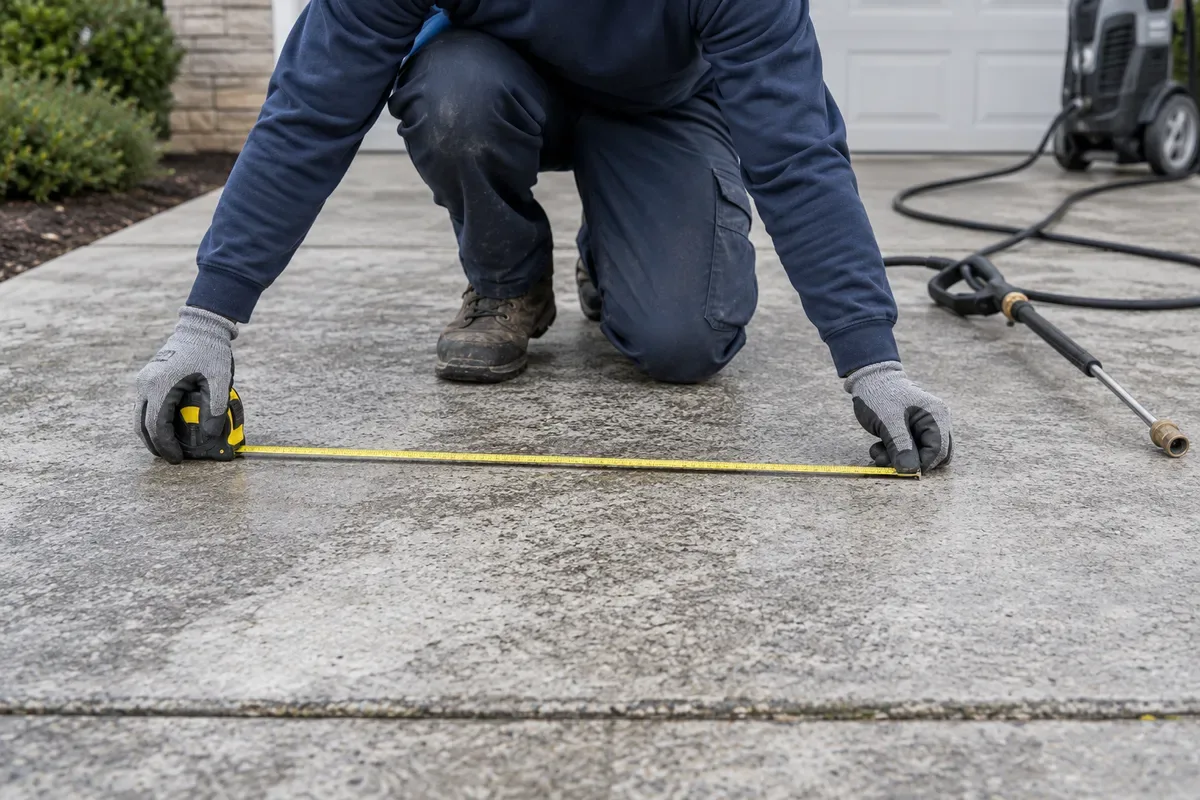
How to measure each surface
The rate is only as good as the square feet under it. Most pricing mistakes are measuring mistakes, so take the tape out on every first visit.
| Surface | What to measure | Example | Square feet |
|---|---|---|---|
| Driveway | Length x width, split odd shapes into rectangles | 24 ft x 36 ft two-car driveway | 864 |
| Siding | Perimeter x average wall height, gables included | 180 ft x 10 ft one-story ranch | 1,800 |
| Deck | Length x width of the boards, rails and stairs priced as extra prep | 12 ft x 16 ft deck | 192 |
| Fence | Length x height, times two if you wash both sides | 100 ft x 6 ft, one side | 600 |
| Roof soft wash | Footprint x pitch factor from your roofing reference | Measured per job | Per job |
Siding is where quotes go wrong most. A 2,000 sq ft house is floor area. You wash walls, and wall area depends on the perimeter and the height, not the rooms inside. A one-story ranch with a 40 x 50 ft footprint has a 180 ft perimeter. At an average wall height of 10 ft with the gable ends, that is about 1,800 sq ft of siding. A two-story house with the same floor area has less footprint but taller walls, so measure it rather than guessing.
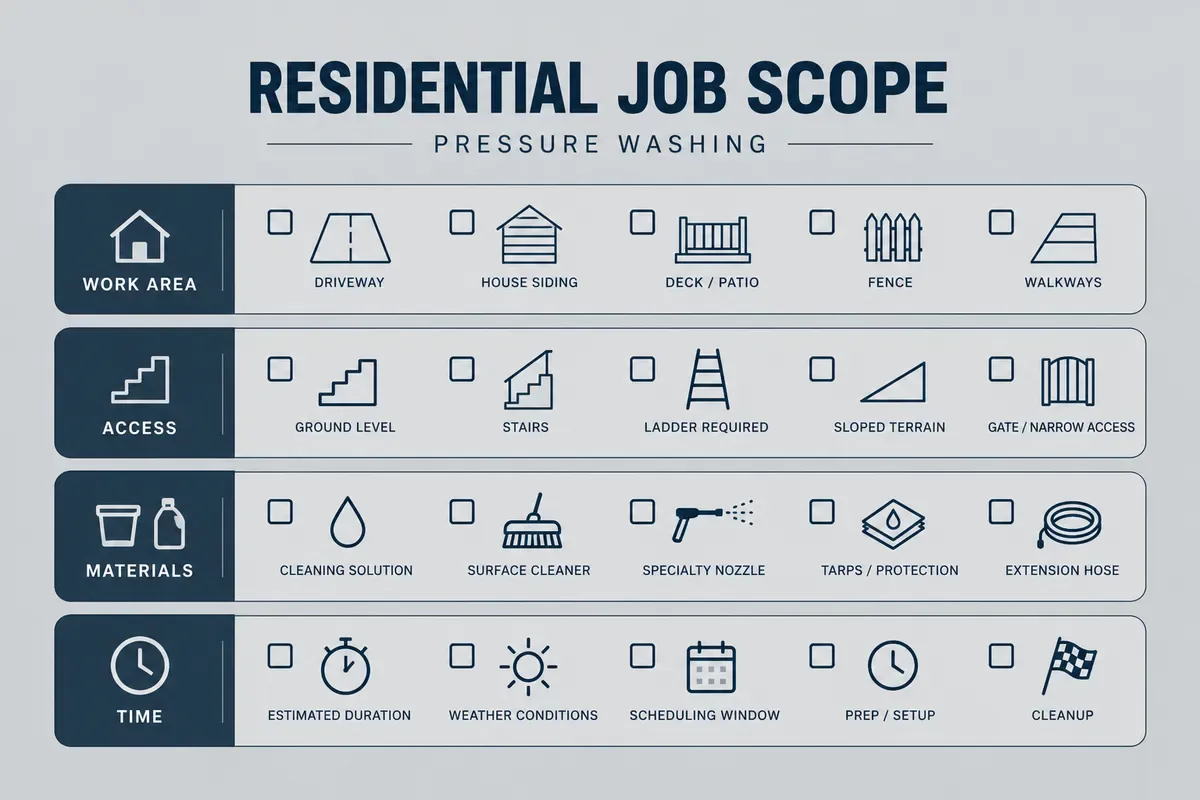
Walk the job before you price it
Walk the whole job before you commit to a number. You are looking for anything that changes the time, not the area:
- Access: ladder work, stairs, slopes and a narrow side gate all slow you down.
- Water: where the spigot is and how much hose you need to reach it.
- Delicate surfaces: soft wood, old paint, plants against the wall and cars in the drive.
- Runoff: where the wash water will go.
Put each of these into the rate adjustment or the extra prep line, so the customer can see what they are paying for.
Runoff is not just a nice-to-have. Ohio EPA's fact sheet on mobile power washing treats power washing wastewater as industrial wastewater under the Clean Water Act and says it cannot go into storm drains. Rules differ by state and city, so check yours. If the job needs berms, a vacuum recovery mat or a trip to dump the water, that is prep time and it belongs on the quote.
How to price a pressure washing job
- Measure each surface
Measure the driveway, walls, deck or fence in square feet. Split odd shapes into rectangles and write each surface down on its own line.
- Pick the starting rate for each surface
Use the driveway, siding, deck, fence or roof soft wash rate. Different surfaces get different rates because the method and the risk are different, even at the same size.
- Adjust for condition and access
Raise the rate adjustment for heavy algae, oil stains, ladder work or a long hose run. Lower it only when your own records show the job goes faster.
- Add prep as its own line
Covering plants, moving patio furniture, degreasing oil spots and containing runoff go in extra prep, so the customer can see them and say yes or no.
- Apply your minimum once per visit
If the combined total is under your minimum, charge the minimum. Apply it to the visit, not to each surface on the same stop.
- Check the total against your hours
Divide the price by the hours you expect to spend, setup and cleanup included. If that number is below what an hour of your time costs, raise the rate before you send it.
Worked example: a two-car driveway, a house wash and a deck
Here is one real-sized residential stop at the calculator's starting rates. The customer wants the two-car driveway, the siding on a one-story 2,000 sq ft ranch and the 12 x 16 ft back deck. You add $40 of prep to cover the beds along the house and move the patio furniture.
| Line | Square feet | Rate | Area x rate | Priced on its own | Priced as one visit |
|---|---|---|---|---|---|
| Two-car driveway, 24 x 36 ft | 864 | $0.20 | $172.80 | $172.80 | $172.80 |
| Siding, 180 ft x 10 ft | 1,800 | $0.30 | $540.00 | $580.00 with $40 prep | $580.00 with $40 prep |
| Deck, 12 x 16 ft | 192 | $0.40 | $76.80 | $150.00 (minimum) | $76.80 |
| Total | 2,856 | $789.60 | $902.80 | $829.60 |
Priced one surface at a time, the deck hits the $150 minimum and the stop totals $902.80. Priced as one visit, the minimum is checked once against the whole job and the stop is $829.60. That $73.20 gap is a second setup charge for a setup you only do once. Charge it and a careful customer will notice; drop it and you still clear the minimum several times over.
The minimum, not your rate, sets the price of every small job: at the starting $150 minimum and $0.20 driveway rate, any driveway under 750 sq ft costs the same $150. That flips how you should sell. Cutting your rate does nothing for a small driveway, while adding a second surface to the same stop is nearly all margin, because the drive, the setup and the cleanup are already paid for.
Where the $150 minimum stops mattering, at each starting rate
| Surface | Starting rate | Minimum covers up to | Example at that size |
|---|---|---|---|
| Driveway | $0.20/sq ft | 750 sq ft | A 25 x 30 ft drive |
| Fence | $0.25/sq ft | 600 sq ft | 100 ft of 6 ft fence, one side |
| Siding | $0.30/sq ft | 500 sq ft | One side of a small house |
| Deck | $0.40/sq ft | 375 sq ft | A 15 x 25 ft deck |
| Roof soft wash | $0.50/sq ft | 300 sq ft | A porch roof |
Below those sizes every job is a $150 job. Above them, the rate takes over. That is why a 12 x 12 ft deck and a 15 x 25 ft deck cost the customer the same as standalone jobs, and why the small one is worth far more to you as an add-on to a driveway.
What your rate per square foot has to cover
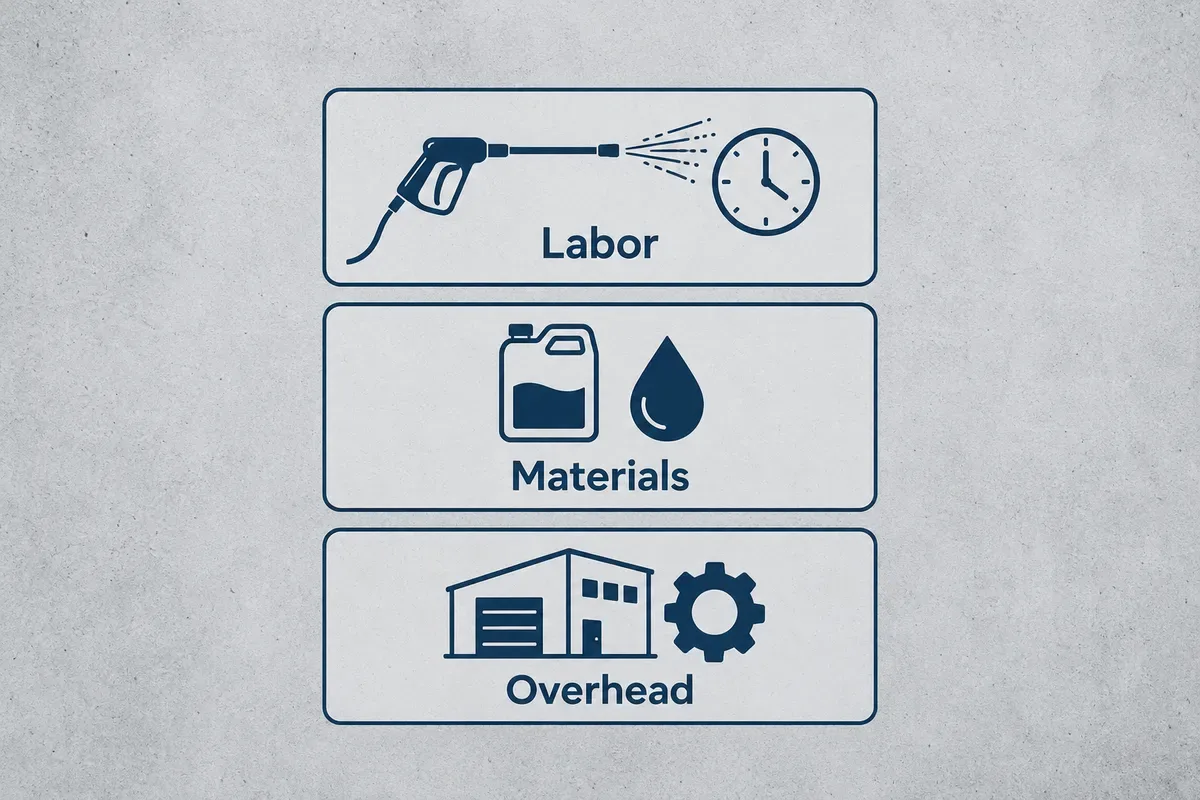
A rate per square foot is just a fast way to price your hour. It has to cover three things: your labor, the chemicals, fuel and water you use up, and the overhead behind the rig, including the van, the pump, insurance and the evenings you spend on the office stuff.
Check every quote against time. Suppose your own records say the two-car driveway takes 1.5 hours with setup and cleanup. $172.80 over 1.5 hours is $115.20 an hour before chemicals and fuel. If the house wash takes 3 hours, $580 is about $193 an hour. Fixr's $50 to $150 an hour band is a national reference, not your number. To find yours, run it through what an hour of your time really costs, then confirm the margin left after materials with the markup and margin calculator.
Solo operator or small crew: what changes
Crew size changes your cost per hour, not the customer's price per square foot. The customer pays for a clean driveway, not for how many people it took.
| Situation | Price it by | Watch for |
|---|---|---|
| Solo, mostly driveways and walks | Square foot rate plus a firm minimum | Small jobs that only ever pay the minimum |
| Solo, house washes | Siding square feet, measured from the perimeter | Two-story walls and ladder time |
| Owner plus one helper | Same rates, check the hourly math with two wages | Helper hours on setup and cleanup |
| Small crew of 3 to 5, multi-surface stops | One visit total with the minimum applied once | Second setup charges on add-on surfaces |
A helper makes a big house wash faster, which raises what you earn per hour of the stop, but your cost per hour goes up with every wage. Quote the same per-square-foot price either way, then check that the job still pays once two or three people are on the clock. If you are still deciding between going solo and hiring, the pressure washing startup guide covers equipment, insurance and finding the first customers.
Turn the number into a quote
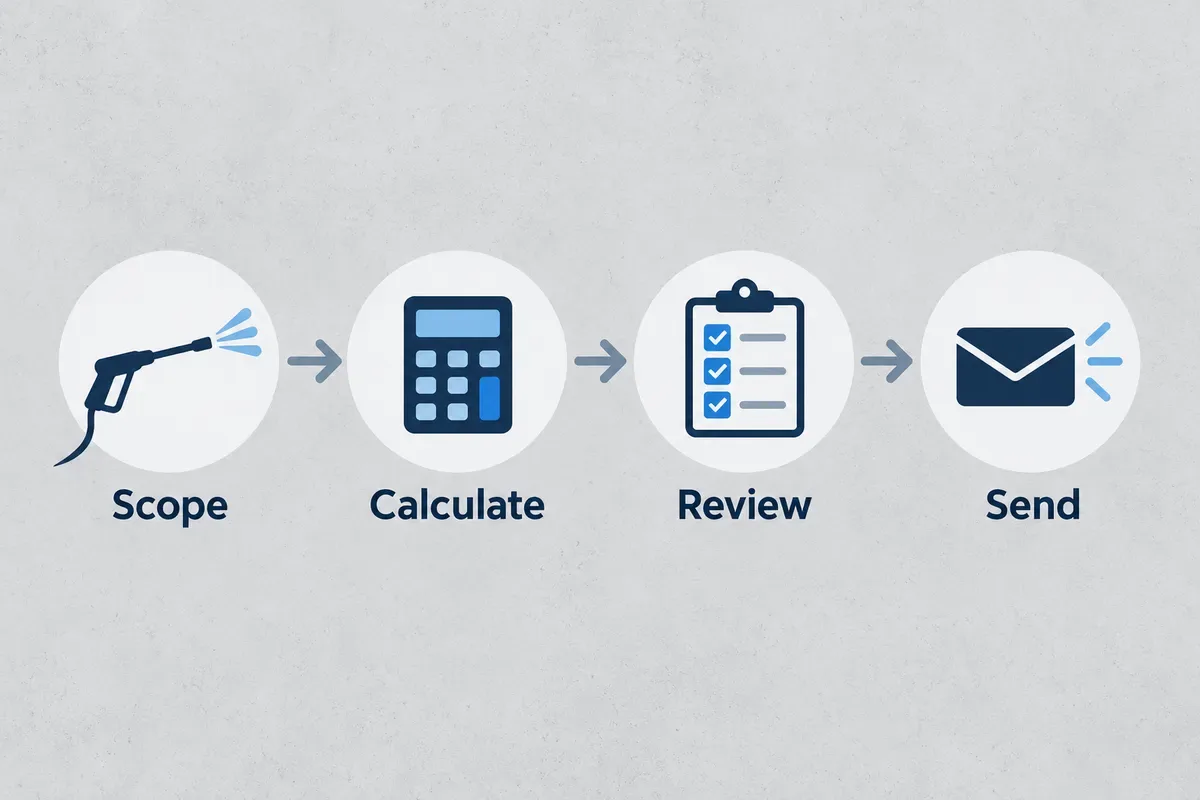
On paper, this method works. Measure, multiply, apply the minimum, write it on a quote template and send it. The wall comes on the tenth quote, not the first: you retype the same five rates on every job, redo the minimum math at night, and chase the invoice a week after the driveway dried.
Driveway Desk keeps your price book, so the driveway, siding and deck rates fill in when you add a line. You build the quote on your phone in the driveway, review it and tap send. When the job is done, the invoice goes out in one tap and you get paid into your own Stripe or Square account. One flat price for the whole crew, no contract. If you are weighing it against bigger field service apps, here is how Jobber prices its plans for comparison.
Price it once, then start your first quote from the driveway next time.
Price it once, then start your first quote from the driveway next time.
How we calculate this
Effective rate = selected surface starting rate x rate adjustment / 100. Price = max(minimum job, measured area x effective rate + extra preparation). The starting rates are $0.20 per sq ft for driveways, $0.25 for fences, $0.30 for siding, $0.40 for decks and $0.50 for roof soft washing, with a $150 minimum and $0 extra prep. They are pricing inputs, not pressure settings: choosing a rate does not tell you a safe pressure, chemical mix or access method for the surface.
The rates are illustrative starting points, not quoted national averages. The Fixr cost guide linked above (fetched 2026-10-16) is the national reference for the per square foot, minimum and hourly ranges cited in this article. Replace every input with your own once you have timed a few jobs.
Review the job before you send it
Measure every surface, price each at its own rate, put prep on its own line and apply the minimum once per stop. Then divide by the hours and make sure the job pays. Selling the second surface on the same visit raises your take more than any rate change will.
If you run other services on the same route, the per-visit math works the same way in the house cleaning price calculator and the lawn mowing price calculator.
Frequently asked questions
Measure each surface in square feet, multiply by a rate for that surface, and add prep such as degreasing, covering plants or moving furniture. If the total is under your minimum job charge, quote the minimum. This calculator starts at $0.20 per sq ft for driveways, $0.30 for siding and $0.40 for decks with a $150 minimum. Then divide the price by your expected hours to check that the job pays.
Price the siding area, not the floor area, because you wash the walls. Measure the perimeter and multiply by the average wall height. If the siding comes to 2,200 sq ft, this calculator's starting siding rate of $0.30 per sq ft gives $660 before prep. Fixr's cost guide puts the average house wash at $500 to $900, about $700 for a 2,000 sq ft vinyl home. Set your own rate for your market and condition.
A 12 x 12 ft deck is 144 sq ft. At the starting deck rate of $0.40 per sq ft that is $57.60, so a $150 minimum applies and the standalone job is $150. Sold as an add-on to a driveway or house wash on the same visit, the minimum is already covered and the deck adds $57.60 to the stop. Rails and stairs are extra prep.
Most owner-operators charge per square foot with a minimum job charge, because area tracks the work and the minimum covers travel and setup on small jobs. Flat prices work for repeat jobs you have timed, such as a standard two-car driveway. Hourly pricing suits jobs you cannot measure up front. Whichever you use, put the price, the surfaces and any prep on a written quote before you start.
Fixr's cost guide says most house washes take two to four hours, and complex jobs up to eight. Grime level, wall height, ladder work, siding material and how far you run hose all move it. Time your first few house washes from unloading to packing up, then use those hours to check that your per square foot siding rate pays what an hour of your time costs.
This calculator starts decks at $0.40 per sq ft, higher than driveways because wood needs lower pressure, more care and often a cleaner or brightener. A 12 x 16 ft deck is 192 sq ft, or $76.80 at that rate, so it falls under a $150 minimum when sold alone. Price rails, stairs and any sealing as separate lines, and raise the rate for soft or weathered boards.
For the business, a house wash is usually the best job on the route: it is a large area at a higher rate than flatwork, and it pairs well with a driveway or deck on the same stop. At the starting rates, an 1,800 sq ft ranch is $540 before prep. For the customer, it removes dirt and algae that otherwise stain siding. Confirm the siding material before quoting, since some surfaces need a soft wash.
Put the method to work
Markup and margin calculatorMarkup divides profit by cost; margin divides profit by selling price. Convert either percentage before quoting.
Your prices, remembered.
Build your first quote on your phone in about two minutes, send it, and get paid into your own account.
Start your first quoteShare article
About the author
Field notes team
We write practical guides for home service crews of one to five. Our editorial standard is to show the calculation, state its assumptions, cite primary sources for factual claims and date competitor comparisons. We distinguish worked examples from market prices and correct errors when they are found. We do not claim trade licenses or credentials on behalf of the team.
More articles
Pricing jobs · 12 min
Lawn mowing price calculator: price every mow by the minute
Turn lawn size, deck width, trimming and drive time into a per-visit mowing price, with a pricing chart by lawn size and a worked quarter-acre weekly mow.

Pricing jobs · 10 min
Handyman price list
Build a handyman flat price from task hours and materials, using your own hourly rate and minimum visit.
Pricing jobs · 8 min
House cleaning price calculator
Price a house clean from floor area, room adjustments, cleaning depth, and the discount you choose.
Pricing jobs · 9 min
Carpet cleaning price calculator
Add measured carpet or room charges, stairs, stains, and upholstery, then apply your minimum job charge.
Running a small crew · 7 min
How to Start a Pressure Washing Business: Price It Before You Buy
Start a pressure washing business with the legal basics, the right equipment and a price sheet that sets a minimum charge and sells a second surface on every visit.
Running a small crew · 6 min
How to Start a Cleaning Business: Prices for Your First Homes
Start a cleaning business with the legal basics, a small supply kit and prices for standard, deep and move-out cleans, and quote every first visit as a deep clean.