How to Price Garage Sale Items So It All Sells by 2 PM
Driveway Desk team 1 November 2026 10 min read
Your next job
Less time at the desk.
Build your price book, schedule the next visit and turn completed work into an invoice.
Start your first quoteIn this article
Price most garage sale items at 25 to 33 percent of what they cost new, round to $1, $5 and $10 so nobody needs change, and cut everything to half price after lunch. Only items that cost over $50 new get two minutes of research on sold listings; the rest gets group pricing by the table or the bin.
Short answer
Price at about a quarter of retail, research only the items worth over $50 new, and mark down on a schedule so the driveway is empty by 2 PM.
That rule of thumb comes from the Pass It On Sales pricing guidelines, which suggest 25% to 33% of retail for most goods and up to half of retail for barely used, in-demand equipment. The rest of this guide is how to apply it fast, plus the one number most sellers forget to price against.
How to price garage sale items in 5 steps
The trick is to spend your pricing time where the money is. Most of what's in a garage is worth a dollar or two, and stickering it one piece at a time eats a whole evening.
How to price items for a garage sale
- Sort into two piles
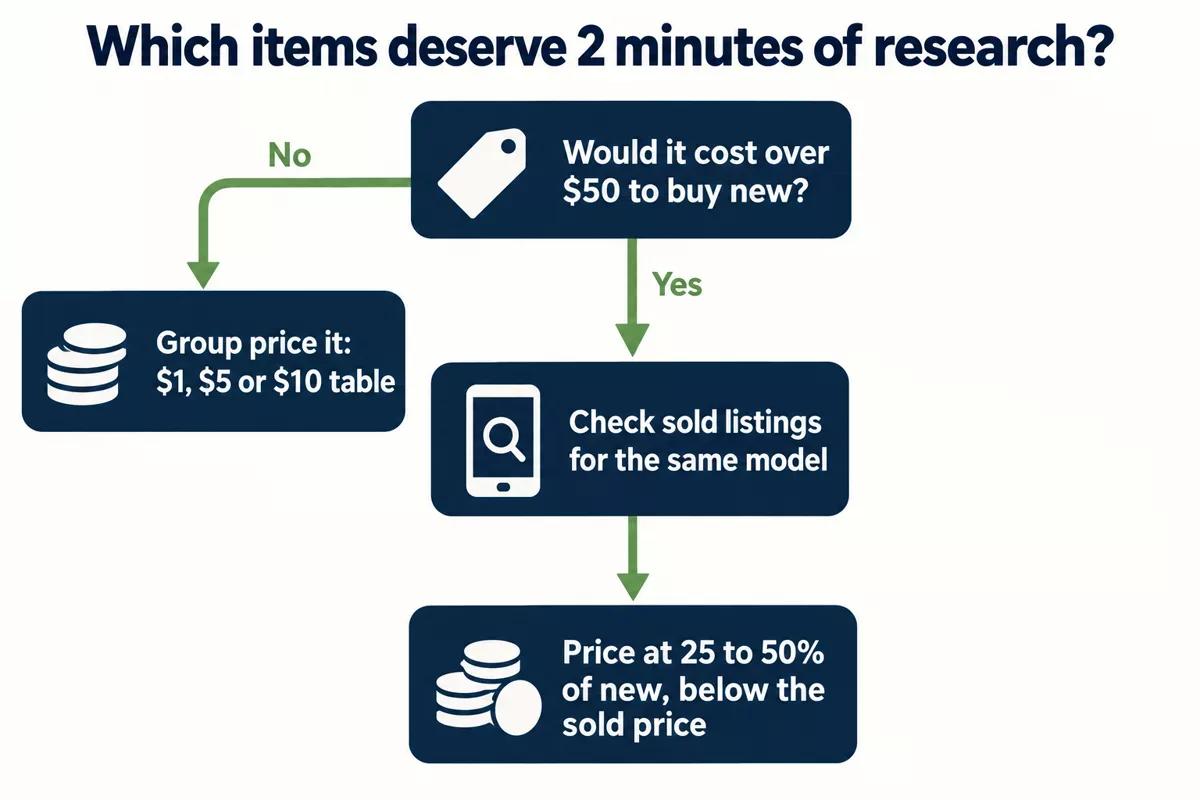
Walk the garage once. Anything that cost over $50 new and still works goes in pile one. Everything else goes in pile two. Pile two is most of the stuff, and it gets no individual research.
- Look up sold prices for pile one only
Search the exact model on eBay and filter to sold items (how eBay's sold and completed filter works). Asking prices are wishes. Sold prices are the market. Note the middle of the last few sales.
- Price pile one at 25 to 50 percent of new, under the sold price
Start from what the item costs new today, take 25 to 50 percent, and make sure the result sits below the eBay sold price. A garage sale buyer pays cash, skips shipping and expects a real discount for it. Barely used, in-demand items sit near the top of that range. Scuffed or missing parts sit near the bottom.
- Group price pile two
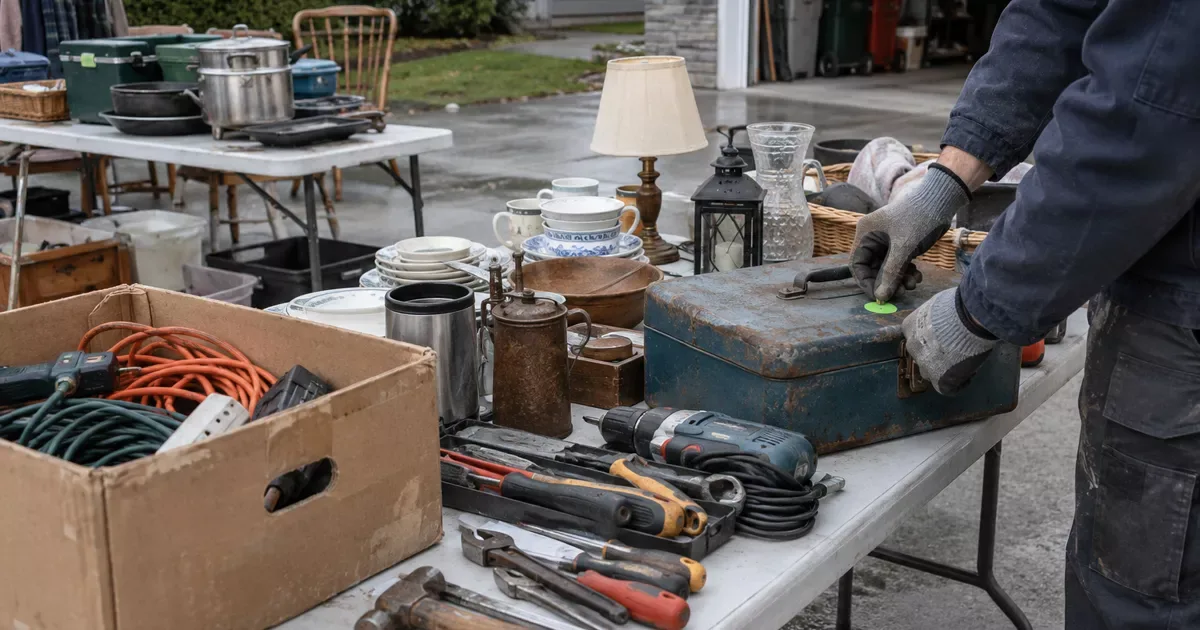
Use colored dot stickers or price by table: a $1 table, a $5 table, a $10 table. Shoppers read the price at a glance, and you sticker one box instead of 200 items.
- Write the markdown times down before you open
Decide now when prices drop and by how much. Then at 1 PM you're following a plan, not haggling over a lamp.

Garage sale price list by item type
Use this as the starting sticker, then adjust for condition. The percentages and the clothing, DVD and stroller figures come from Pass It On Sales; the worked examples just apply that range to a typical new price.
| Item type | Price as share of new | Worked example | Research it? |
|---|---|---|---|
| Power tools that run | 25-50% | $120 drill: $30-60 | Yes, check sold listings |
| Hand tool sets | 25-33% | $60 socket set: $15-20 | Full sets only |
| Solid wood furniture | 25-50% | $400 dresser: $100-200 | Yes |
| Baby equipment | 25-50% | Most strollers: $60-100 | Yes for big items |
| Kids' clothing | 25-33% | $3-6 per piece | No, price by table |
| Kitchen and small household | 25-33% | $20 mixing bowls: $5 | No, $1 or $5 table |
| Electronics that work | 25-33% | $80 speaker: $20-25 | Only if over $50 new |
| DVDs and Blu-rays | flat price | DVDs $2-3, Blu-rays $4-8 | No |
Ranges: Pass It On Sales pricing guidelines (passitonsales.com/pricing-guidelines, fetched 2026-11-01). Worked examples apply those ranges.
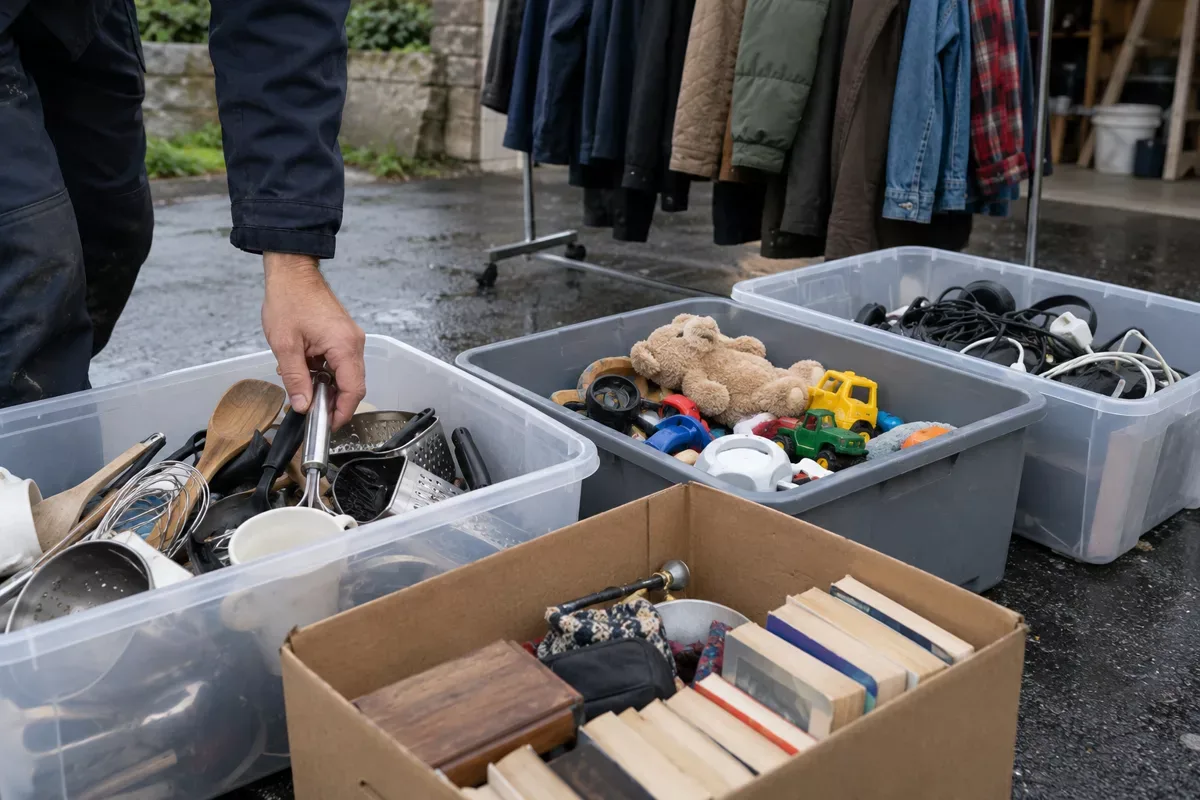
Round every price to a number you can make change for out of a cash box. $1, $2, $5, $10, $20. Quarters slow the line and nobody wants a pocket of coins.
Price tools and equipment higher than the rest
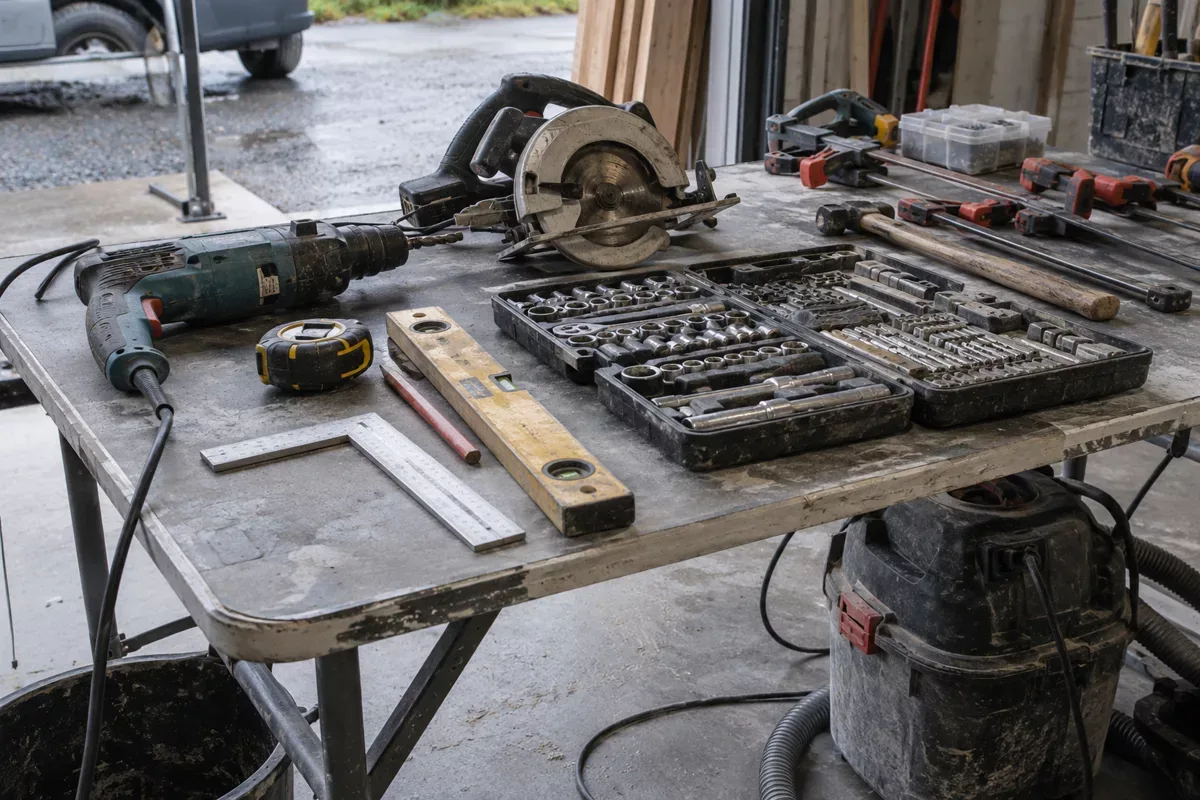
If you run a crew, the clear-out usually includes the shop: a spare drill, a second shop vac, clamps you bought twice. Tools are the one category where garage sale buyers pay up. Contractors and weekend fixers show up at 7 AM looking for exactly that table.
- Sell the battery and charger with the tool. A bare cordless tool is worth a fraction of a kit.
- Keep sets together. A full socket set sells; a bag of loose sockets sits.
- Run an extension cord to the table so buyers can pull the trigger. A tool that runs in front of them sells at the top of the range.
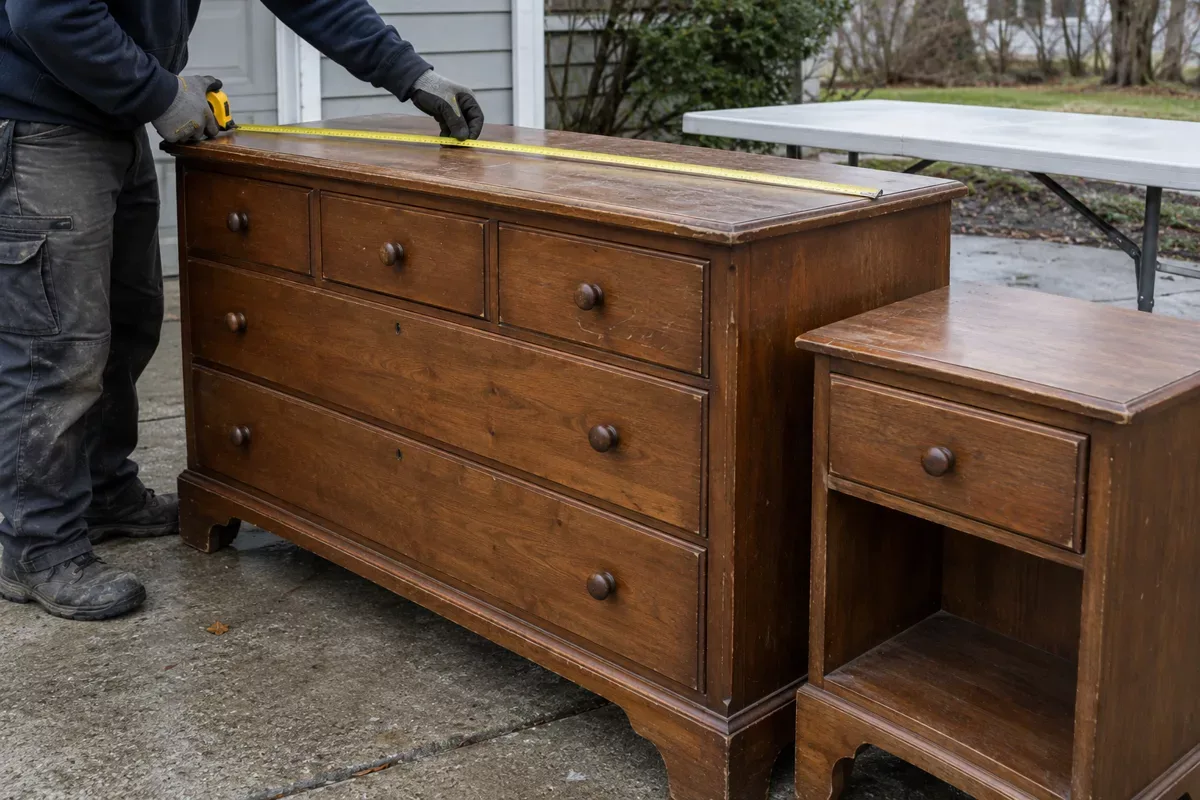
Furniture follows the same split. Solid wood with a few scuffs holds value and is worth a sold-listings search. Measure it before the sale and tape the dimensions to it, because the first question is always "will it fit in my truck".
Your real price floor is the haul-off cost
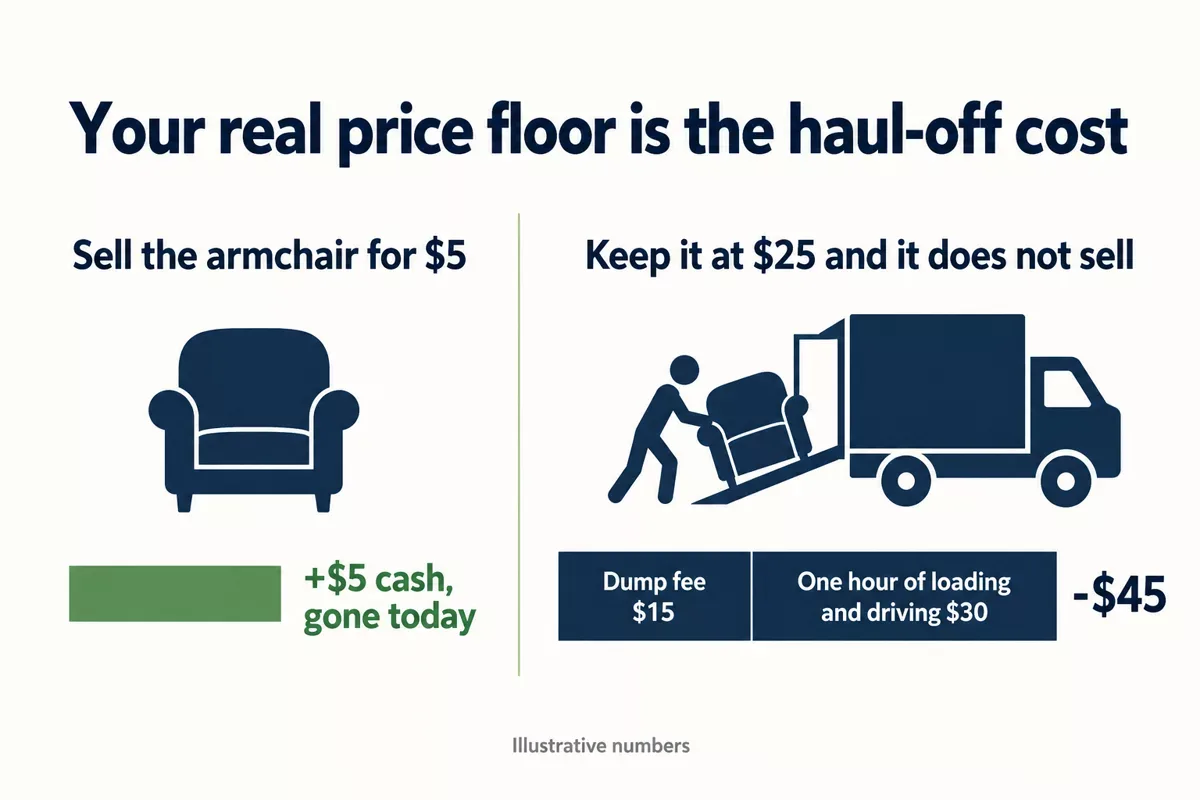
Here is the part most pricing guides skip. Your floor is not what you paid. It's what it costs to get rid of the thing if it doesn't sell. Anything still on the driveway at 3 PM has to be loaded, driven and dumped or donated, and that costs money and an hour you could bill.
| Item | Your sticker | Sells for $5 at noon | Doesn't sell: dump fee | Doesn't sell: 1 hour loading and driving | Real gap |
|---|---|---|---|---|---|
| Worn armchair | $25 | +$5 | -$15 | -$30 | $50 |
| Exercise bike | $40 | +$5 | -$15 | -$30 | $50 |
| Box of dishes | $10 | +$5 | $0 (donated) | -$15 | $20 |
Illustrative assumptions: $30 an hour for your time and a $15 transfer-station fee per bulky item. Check your local fees and use your own hourly number.
Read the last column. Holding the armchair at $25 doesn't protect $25. It risks $45 of cost against a $5 sale. If you don't know what an hour of your time is worth, work out what an hour of your time really costs before you set any floor.

Price it once, then start your first quote from the driveway next time.
When to mark garage sale prices down
Early buyers are the ones who pay full price, so don't discount before they've had their pass. After that, drop on the clock, not on a hunch.
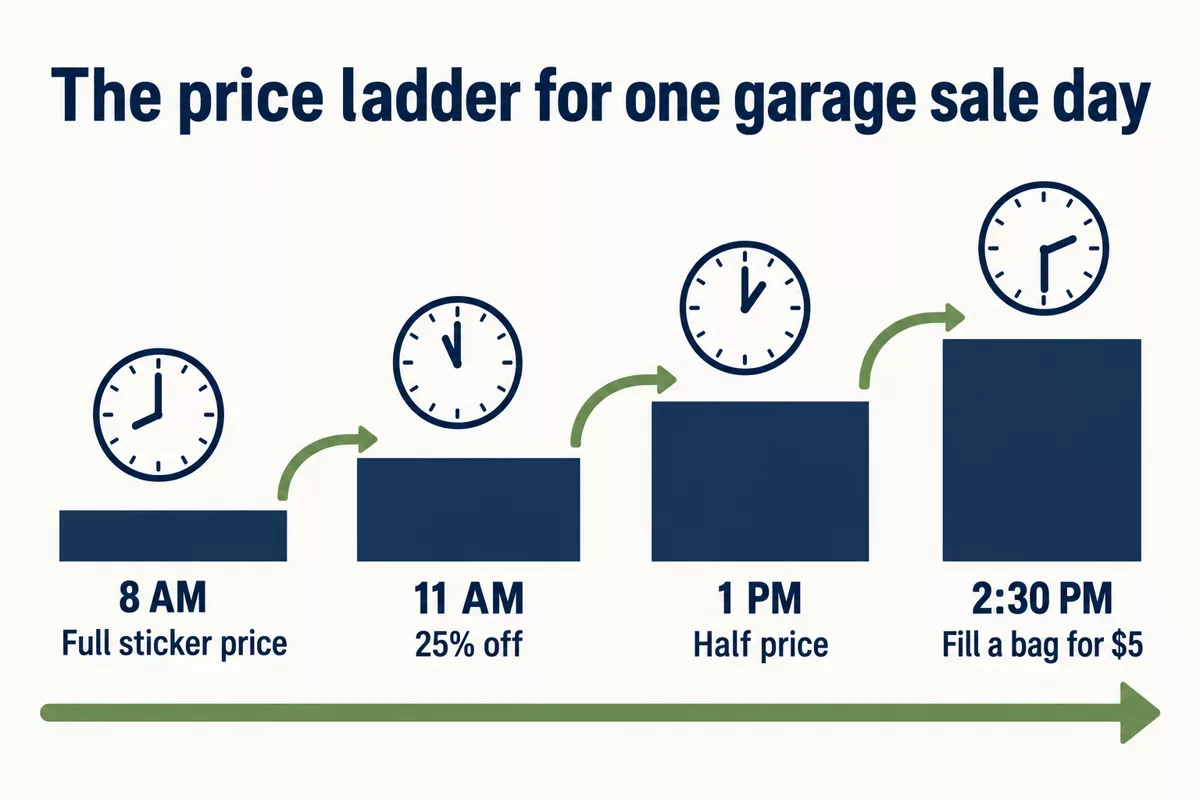
- 8-11 AM: full sticker price. Take reasonable offers on big items only.
- 11 AM: 25% off everything. Say it out loud to every shopper.
- 1 PM: half price. The Pass It On Sales guide makes the same point: getting 50% beats hauling it back inside.
- 2:30 PM: fill a bag for $5, and offer the big pieces for whatever's in the buyer's pocket.
A markdown is just a margin decision on a single day. If you want the math behind a discount in your business, the markup versus margin breakdown shows how fast a percentage off eats what you keep.
What doesn't sell well at garage sales
Some things sit no matter how you price them. Put them on the free pile or skip them.
- Old tube TVs, dead printers and outdated computer gear
- Damaged particleboard furniture that won't survive a second move
- Used mattresses and pillows
- Stained or torn clothing
- Encyclopedias and old textbooks
- Car seats and cribs: many buyers won't take them used, and you should check any kids' product against current recall notices before you put it out
Mistakes that cost you money
- Pricing by what you paid. The buyer doesn't care. They care what it costs new today and what it sold for on eBay last week.
- Stickering every item. Four hours of individual tags at $30 an hour is $120 of your time on a sale that might clear $300.
- No prices at all. Plenty of shoppers won't ask. They walk to the next driveway.
- Holding firm after lunch. Every item you keep at 1 PM is an item you'll load into the truck at 3.
- Selling the tool without its charger. You just cut its price in half.
The same method works on every job you quote
A garage sale is one day, and a price you forget costs you a few dollars. If you run a service business, the same four moves are how you should price work: sort jobs by size, check what the market pays, set the price once, and stop re-deciding it every time. Most owners start with a handyman price list in a spreadsheet and an estimate template they fill in at night.
That works until it doesn't. The wall is re-typing the same prices into every quote from memory, after dinner, while the customer is already calling the next guy. Driveway Desk keeps your price book on your phone, so the quote is built from your own numbers in the driveway and sent before you back out. If you're weighing tools for that, here's how Jobber prices its plans for comparison.
Price it once, then start your first quote from the driveway next time.
Clearing the garage to make room for a new business? Our guides on starting a pressure washing business and starting a lawn care business cover what to buy and what to charge.
Price it to leave
The goal of a garage sale is an empty driveway, not the perfect price on every lamp. Research the few things worth real money, group price the rest, mark down on a clock and remember that every unsold item has a haul-off cost attached. Do that and you finish by 2 PM with cash in the box and nothing to load.
Your prices, remembered. Build your first quote on your phone in about two minutes, send it, and get paid into your own account. Try it free.
Put the method to work
Labor cost calculatorDivide paid-hour costs by the billable-hours ratio, then allow for your target margin to find a selling rate.
Frequently asked questions
Start at 25 to 33 percent of what the item costs new today, which is the range the Pass It On Sales guidelines recommend. For anything that cost over $50, search the same model in eBay's sold listings and keep your sticker below what it actually sold for.
If it's small and common, put it on the $1 or $5 table and move on. If it's a working tool, solid wood furniture or baby gear in good shape, check sold listings and price at the top of the range, then be ready to take half after lunch.
Tube TVs, old printers and computer gear, damaged particleboard furniture, used mattresses, stained clothing and old encyclopedias rarely move. Put them on a free pile or skip them so they don't take up table space.
Most items land between $1 and $20. Clothing runs a few dollars a piece, DVDs $2-3, and bigger items like strollers or furniture sell for a quarter to half of their new price depending on condition.
Put the method to work
Markup and margin calculatorMarkup divides profit by cost; margin divides profit by selling price. Convert either percentage before quoting.
Your prices, remembered.
Build your first quote on your phone in about two minutes, send it, and get paid into your own account.
Start your first quoteShare article
About the author
Field notes team
We write practical guides for home service crews of one to five. Our editorial standard is to show the calculation, state its assumptions, cite primary sources for factual claims and date competitor comparisons. We distinguish worked examples from market prices and correct errors when they are found. We do not claim trade licenses or credentials on behalf of the team.
More articles

Pricing jobs · 10 min
Markup and margin calculator: check your job profit
Convert markup to margin, check parts and loaded labor, and see what a discount does to job profit. Includes a calculator and worked examples.

Pricing jobs · 10 min
Labor cost calculator: from hourly wage to billable rate
Divide paid-hour costs by the billable-hours ratio, then allow for your target margin to find a selling rate.

Pricing jobs · 10 min
Handyman price list
Build a handyman flat price from task hours and materials, using your own hourly rate and minimum visit.

Pricing jobs · 11 min
How Much Is Gutter Cleaning? 2026 Prices by House Height
Gutter cleaning costs about $137-$240 for a typical 215-foot house, close to $1 a linear foot. Here is why the same gutters cost $145, $235 or $325 depending on height, and how to quote the job from your own hours.

Pricing jobs · 13 min
How Much Do Electricians Charge per Outlet? 2026 Prices
Electricians charge $80-$150 to replace an outlet and $150-$350 to add one, plus a trip fee or one-hour minimum. Here are the prices by outlet type, what one outlet call really costs a solo electrician, and a first-outlet-plus-each-extra price list that wins the ten-outlet job.

Pricing jobs · 12 min
How Much Do Plumbers Charge to Unclog a Toilet? 2026 Prices
Plumbers charge $100-$275 to unclog a toilet, plus a $50-$200 service call. Here is the price by where the clog sits, what a 30-minute clog call really costs a solo plumber, three tiers priced from a worked rate, and how to quote them on the phone.