Lawn Care Contract Template: Free Seasonal Agreement
Driveway Desk team Updated 15 November 2026 9 min read
Your next job
Less time at the desk.
Build your price book, schedule the next visit and turn completed work into an invoice.
Start your first quoteIn this article
A lawn care contract template is a seasonal agreement that sets out the property, the season dates and visit frequency, what each visit includes, the price and how it is billed, what happens on rain days and skipped weeks, payment terms, cancellation and signatures. Fill in the free template below, download the PDF and have both sides sign before the first mow.
Short answer
A lawn care contract covers the property, season and frequency, included services, price and billing, rain and skip policy, payment terms, cancellation and signatures. Fill in the template on this page and save it as a PDF.
Most lawn contracts spend a paragraph on rain and one line on money. Bill a flat monthly amount and the skip clause stops costing you money. Per-visit billing means every dry week you skip is a week you do not get paid, while your truck payment and insurance still come out on the 1st.
Fill in the free lawn care contract template
The template works in your browser. Enter the property and the season, list what an ordinary visit includes, add the price lines for one visit and the number of planned visits, then write your rain, skip, payment and cancellation terms. The seasonal total updates as you type. Download the PDF or print it for signatures.
Nothing is saved after you close the tab, so download first. The sample amounts are placeholders, not local rates. This is a drafting worksheet, not legal advice: contract rules vary by state, so have the final terms reviewed for your situation.
Use this template
Your entries stay in this browser tab. Download or print before leaving; this page does not save your document.
Document preview
Lawn care contract template
Business name:
Business contact:
Customer name:
Customer contact:
Job address:
Document reference:
Document date:
Season starts:
Season ends:
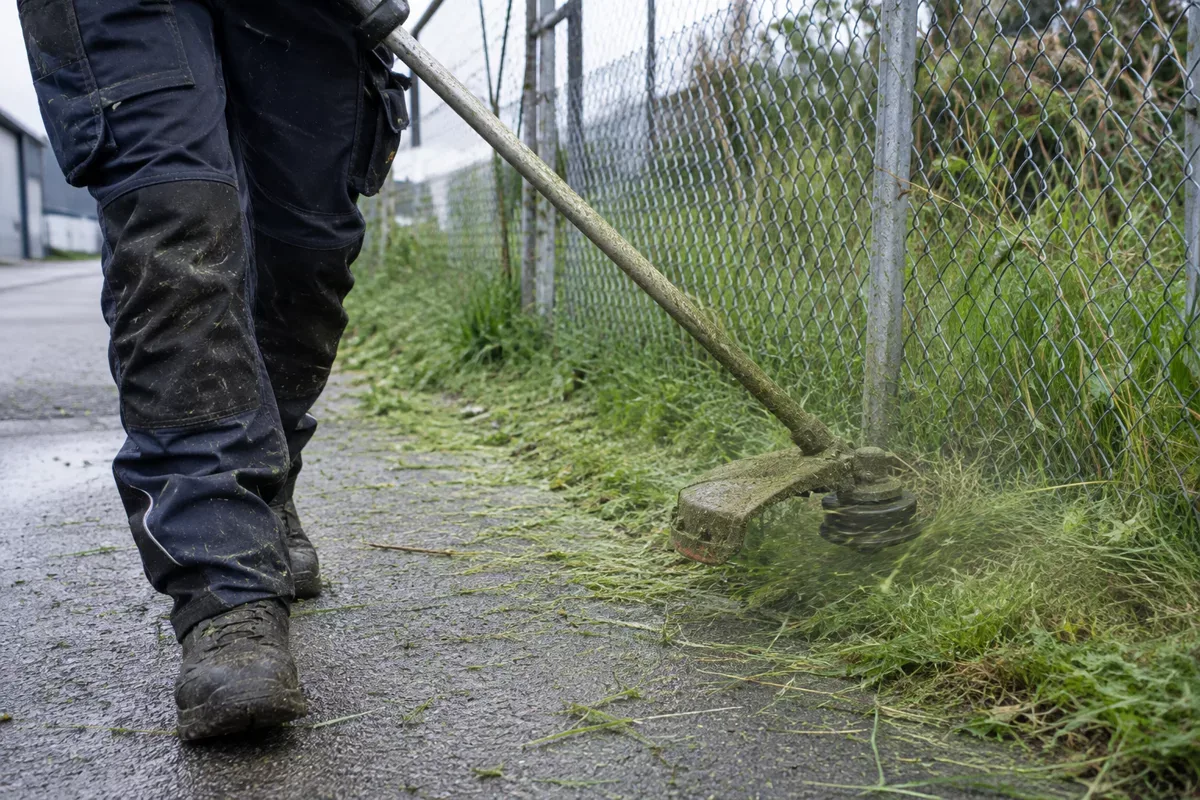
Services included: Mow, edge and clear clippings from hard surfaces.
Planned visits: 20
Visit frequency: Weekly, subject to the agreed rain policy
Rain and skip policy: Reschedule unsafe or rain-delayed visits by agreement. Charge only for completed visits.
Payment terms: Payment due after each completed visit.
Cancellation terms: Either party may end future visits with written notice. Completed visits remain payable.
Provider signature / date:
Customer signature / date:
Service: Mow, edge and clear clippings
What a lawn care contract needs
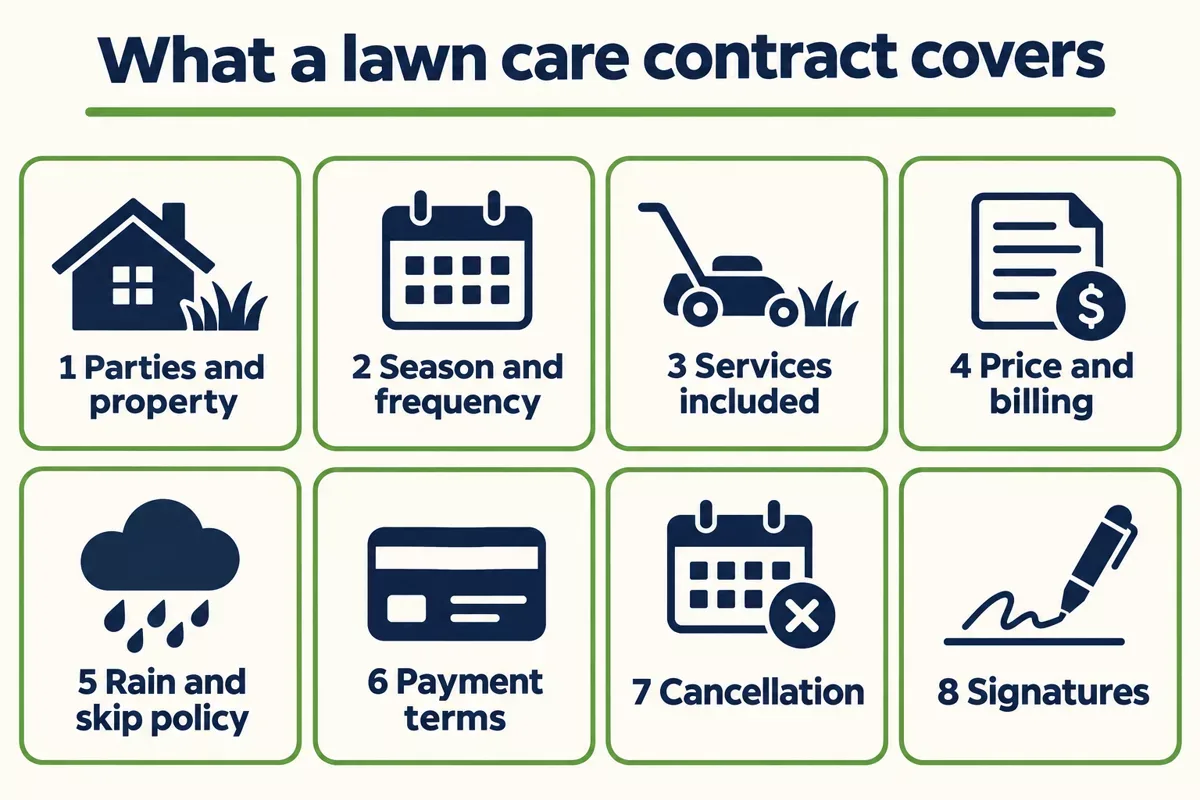
Eight sections cover almost every argument a lawn customer can start. Here is each one, the question it settles, and an example entry for a quarter-acre weekly mow.
| Section | The question it settles | Example entry |
|---|---|---|
| Parties and property | Who, and which lawn | Owner name, 41 Oak Ct, front, back and side strip |
| Season and frequency | When, and how often | Weekly, April 1 to October 31, about 30 visits |
| Services included | What one visit means | Mow, string-trim, edge walks and drive, blow clippings off hard surfaces |
| Price and billing | How much, and when you bill | $55 per visit, billed as $236 on the 1st of each month |
| Rain and skip policy | What happens when you do not mow | Rain: moved within 2 working days. Drought skip: no change to the monthly amount |
| Payment terms | When the money is due | Card on file, charged on the 1st; late after 10 days |
| Cancellation | How either side gets out | 14 days written notice; completed visits are owed |
| Signatures | Proof both sides agreed | Names, signatures, date |
Keep anything that is not part of an ordinary visit out of the services line: leaf cleanup, aeration, hedge trimming, mulch. Price those as separate one-off jobs so the customer cannot read "yard care" as "everything in the yard".
Per-visit or flat monthly billing?
Per-visit billing is simple to explain and fair in a wet year. Flat monthly billing smooths your income and turns skipped weeks into a scheduling question instead of a pay cut. For a recurring weekly customer, flat monthly is usually the better deal for the business, as long as the contract says so in plain words.
| Situation | Bill it | Why |
|---|---|---|
| Weekly mow, full season | Flat monthly | Same income in drought weeks; customer gets a predictable bill |
| Every-other-week mow | Per visit | Fewer visits, so a skipped one is a bigger share of the season |
| New customer, first season | Per visit for 30 days, then monthly | Lets both sides see the real visit length before committing |
| One-off cleanups and add-ons | Separate quote | Keeps the recurring amount clean |
Price the visit itself first. The lawn mowing price calculator works out a per-visit price from lawn size, mower width and your hourly target, and the labor cost calculator checks that hourly target against what a crew hour actually costs you.
Worked example: a quarter-acre weekly mow
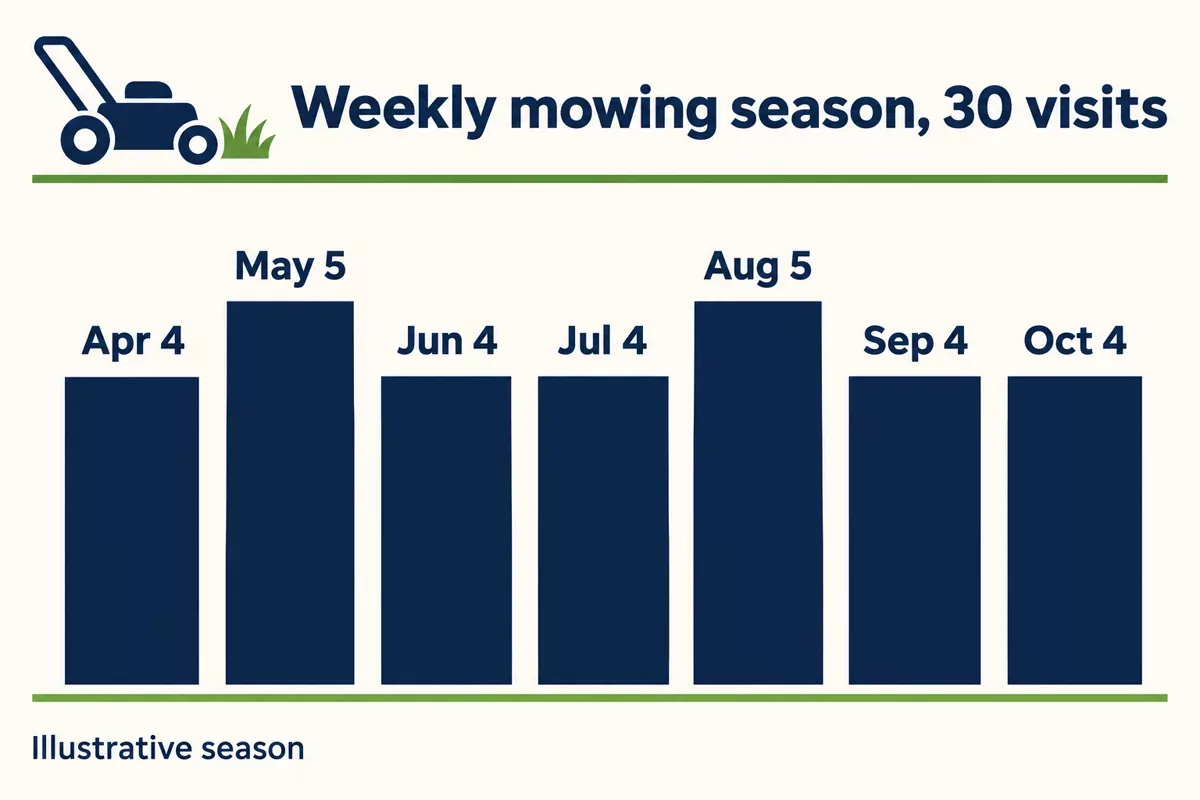
Here is the season for one quarter-acre lawn at $55 a visit (mow, trim, edge, blow). These are example inputs, not a local rate survey.
| Month | Planned weekly visits | Per-visit billing | Flat monthly billing |
|---|---|---|---|
| April | 4 | $220 | $236 |
| May | 5 | $275 | $236 |
| June | 4 | $220 | $236 |
| July | 4 | $220 | $236 |
| August | 5 | $275 | $236 |
| September | 4 | $220 | $236 |
| October | 4 | $220 | $236 |
| Season | 30 | $1,650 | $1,652 |
The flat amount is the season total divided by seven months and rounded up: $1,650 / 7 = $235.71, so $236. In a normal year the two methods earn the same. The difference shows up when weather cuts visits. Flat monthly billing also makes the winter cash gap in your business plan easier to see and to save for.
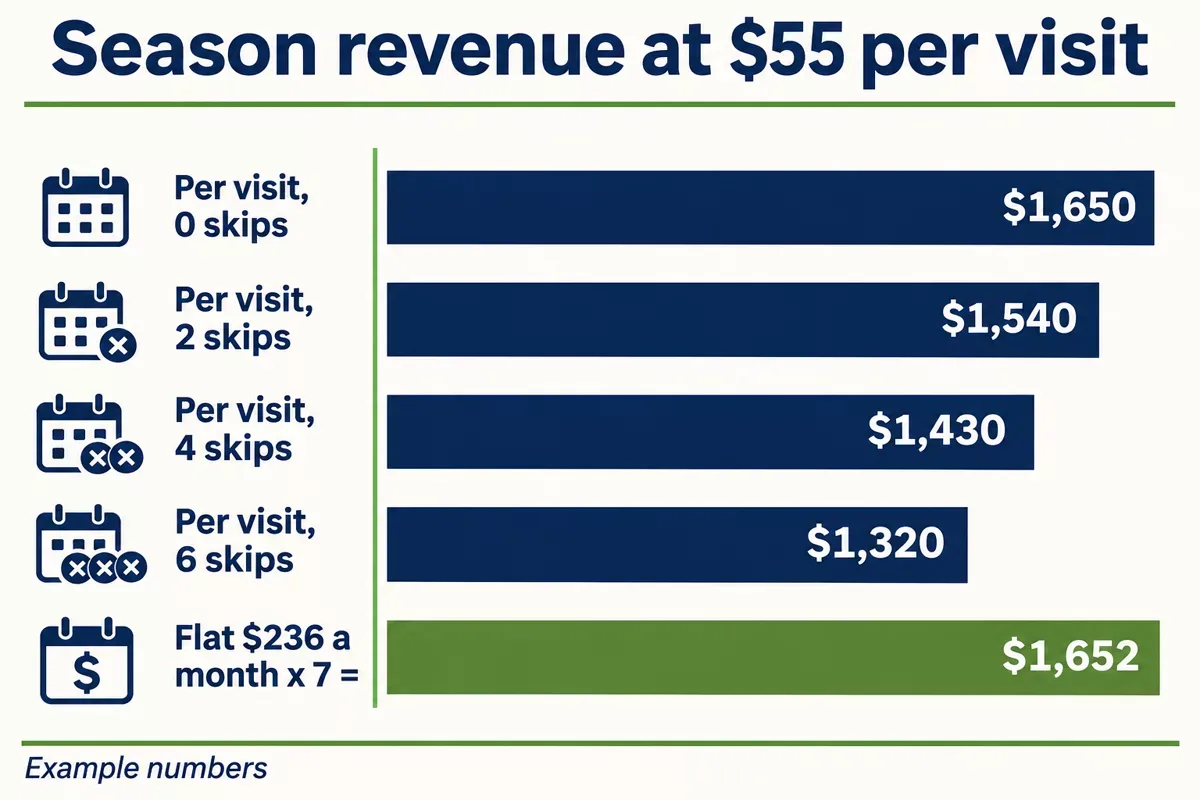
| Skipped visits (drought or dormancy) | Per-visit season total | Flat monthly season total |
|---|---|---|
| 0 | $1,650 | $1,652 |
| 2 | $1,540 | $1,652 |
| 4 | $1,430 | $1,652 |
| 6 | $1,320 | $1,652 |
Six skipped weeks in a dry August cost a per-visit operator $330 on one lawn. Across 40 lawns with the same dry spell, that is $13,200. On the monthly plan the customer still gets mowed whenever the grass grows, and you use the skipped weeks for cleanups and add-on work.
Rain, skip and cancellation clauses that hold up
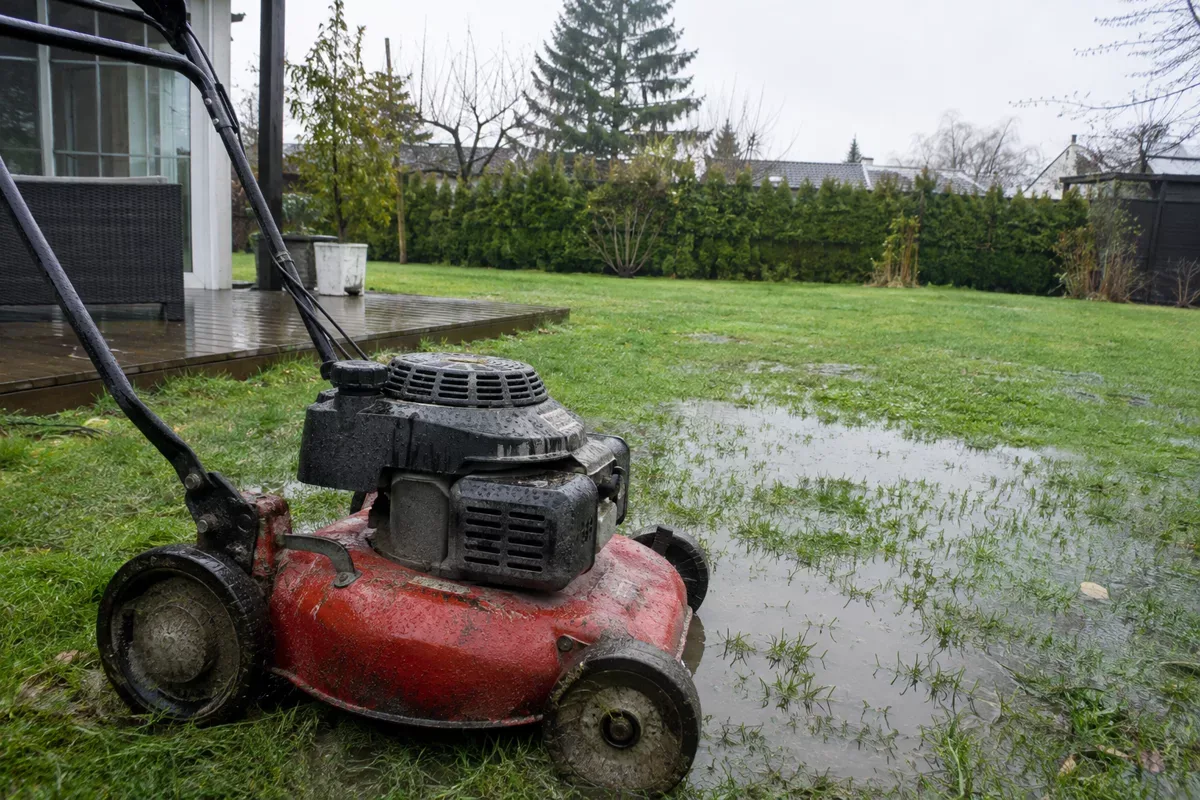
- Rain. Say who decides the lawn is too wet to mow (you) and when the visit moves to (within two working days). Mowing a soaked lawn ruts it and leaves clumps, so do not promise a fixed day regardless of weather.
- Skip. Say what triggers a skip (drought, dormancy, the customer's request) and what it does to the bill. On flat billing: nothing. On per-visit billing: that visit is not charged.
- Grass height. Most turf guidance is to cut no more than a third of the blade at one mowing. If a customer skips three weeks, the catch-up cut takes longer, so say whether an overgrown visit is charged extra.
- Cancellation. Ask for written notice, say completed visits are owed, and say what happens to a prepaid month.
- Signed at the customer's door? Federal rules give buyers three business days to cancel many sales of $25 or more made at their home, and require you to tell them so in writing. Read the FTC Cooling-Off Rule text and check your state's rules before you sign customers on the doorstep.

Seasonal add-ons like fall leaf cleanup belong on their own quote. The free estimate template handles a one-off job where the volume of leaves is still a guess.
When a paper contract stops being enough
A signed PDF works for ten lawns. At thirty, the wall is everything around it: remembering who is weekly and who is every other week, moving rain days, charging the 1st of the month, and keeping a record of each visit for the customer who says you never came. If you are starting out, the lawn care business startup guide covers the rest of the setup.
That is the wall Driveway Desk is built for: your route and recurring visits scheduled, reminders sent, invoices raised from the visits you actually did and paid into your own Stripe or Square account. If you are comparing it with the bigger tools, Jobber alternatives side by side shows what each one costs a small crew.
Price it once, then start your first quote from the driveway next time.
Price it once, then start your first quote from the driveway next time.
Before the first mow
Read the rain and skip clauses out loud with the customer. If they cannot tell you what happens in a dry August, rewrite them. Then confirm the season dates, the monthly amount and the cancellation notice, sign, and give them a copy. Your prices, remembered. Build your first quote on your phone in about two minutes, send it, and get paid into your own account.
Put the method to work
Lawn mowing price calculatorEstimate mowing minutes from turf area and deck width, then price trimming, travel, and repeat visits.
Frequently asked questions
Write down the property, the season dates and how often you will visit, what a visit includes, the price and how you bill it, what happens on rain days and skipped weeks, payment terms and how either side can cancel. Both sides sign and keep a copy. The template on this page has each section.
Estimate the minutes per visit from the lawn size and your mower width, add trimming, edging and drive time, and multiply by your hourly target, with a minimum per stop. The lawn mowing price calculator does the math; put that per-visit price in the contract.
It depends on the visits behind it. $200 a month for four weekly mows is $50 a visit; check that against your time per visit and your hourly target. On a large lot or a twice-a-month schedule the same $200 means something very different.
Cut no more than about a third of the grass blade height in a single mowing. Cutting more stresses the turf. In a contract it is the reason to say how you handle an overgrown lawn after a skipped visit.
Multiply three hours by your billable hourly rate, then add drive time and dump fees if they apply. At an example $60 an hour that is $180. Use the labor cost calculator to set the hourly rate from your real costs instead of guessing.
No. It is a drafting worksheet for the business terms of recurring lawn work. Contract rules vary by state, so have the finished agreement reviewed for your situation before you rely on it.
Put the method to work
Quote templateFill a quote with your own scope, quantities, prices, tax and deposit. Download a free PDF or print it directly from your browser.
Your prices, remembered.
Build your first quote on your phone in about two minutes, send it, and get paid into your own account.
Start your first quoteShare article
About the author
Field notes team
We write practical guides for home service crews of one to five. Our editorial standard is to show the calculation, state its assumptions, cite primary sources for factual claims and date competitor comparisons. We distinguish worked examples from market prices and correct errors when they are found. We do not claim trade licenses or credentials on behalf of the team.
More articles

Quotes and estimates · 11 min
House Cleaning Checklist PDF: Standard, Deep and Move-Out
A one-page house cleaning checklist PDF, room by room, for standard, deep and move-out cleans. Plus the not-included list that protects your price and how to send it with a quote.

Quotes and estimates · 13 min
How to Bid a Painting Job: 7 Steps and a Worked Bid
How to bid a painting job: walk it, measure the walls, estimate hours task by task, price the paint and write down what is not included. With a full $2,875 bid for a 1,000 sq ft interior, line by line.

Quotes and estimates · 10 min
Quote Template: Free Fillable Form and a Worked Example
A free fillable quote template with every field a small-job quote needs, a line-by-line worked example, and the exclusions line that keeps a fixed price fixed.

Quotes and estimates · 13 min
Estimate template: free fill-in PDF with a worked example
A free estimate template you fill in on your phone: labor and materials lines, a fixed total or range, a valid-until date and written assumptions, saved as a PDF. Includes a worked $388.50 job.

Pricing jobs · 12 min
Lawn mowing price calculator: price every mow by the minute
Turn lawn size, deck width, trimming and drive time into a per-visit mowing price, with a pricing chart by lawn size and a worked quarter-acre weekly mow.

Running a small crew · 7 min
How to Start a Lawn Care Business: Price Visits From Time
Start a lawn care business with the legal basics, equipment sized to your lawns, visit prices worked out from mowing and drive time, and seasonal agreements.