How Much Do Plumbers Charge per Hour? 2026 Rates and Math
Driveway Desk team 11 November 2026 14 min read
Your next job
Less time at the desk.
Build your price book, schedule the next visit and turn completed work into an invoice.
Start your first quoteIn this article
Plumbers charge about $45 to $150 an hour, with a $50 to $200 service call that usually covers the first hour, according to HomeGuide's plumber cost guide. A master plumber bills $75 to $125 an hour, and nights, weekends and holidays run $125 to $170. A one-person plumbing business that covers its van, stock, insurance and unpaid drive time needs about $94 an hour, and an owner with a helper about $143 per crew hour.
Short answer
Plumbers charge $45-$150 an hour, plus a $50-$200 service call that usually covers the first hour (HomeGuide, fetched 2026-11-11). A solo licensed owner who covers overhead and drive time needs about $94 an hour; an owner plus one helper needs about $143 per crew hour.
This guide is for the plumber setting the rate, not the homeowner paying it. You get the market ranges by license level, the wage data under them, the bill-rate build for a solo owner and a two-person crew, a toilet swap priced three ways, and the mistakes that quietly cost plumbers money on small jobs.
How much do plumbers charge per hour, by type of call?
The rate follows the license and the hour of the day. HomeGuide's averages put a residential plumber near $70 an hour and a commercial plumber near $85, with emergency work at double or triple time.
| Type of plumber or call | Typical hourly rate | What the customer is paying for |
|---|---|---|
| Helper or apprentice | $25-$45 | Supervised labor, billed with a licensed plumber on site |
| Plumber, average | $45-$150 (about $75 average) | Licensed labor before trip fees and materials |
| Master plumber | $75-$125 | Years as a journeyman plus the master license; can run jobs and supervise |
| Commercial plumber | About $85 | Stricter code work, often billed in 15-minute steps after the first hour |
| Emergency, weekend or holiday | $125-$170 | Double or triple time; weeknights usually time and a half |
| Service call (usually covers the first hour) | $50-$200 | Travel, setup and the first hour of labor |
Source: HomeGuide plumber cost guide (fetched 2026-11-11). HomeGuide also notes trip fees of $1 to $2 a mile after the first 10 miles, and that many plumbers set a minimum number of billed hours per call.
The ranges are wide because they mix rural shops and big metros, new licenses and thirty-year masters. Use them to sanity-check your number. Never use them as your number.
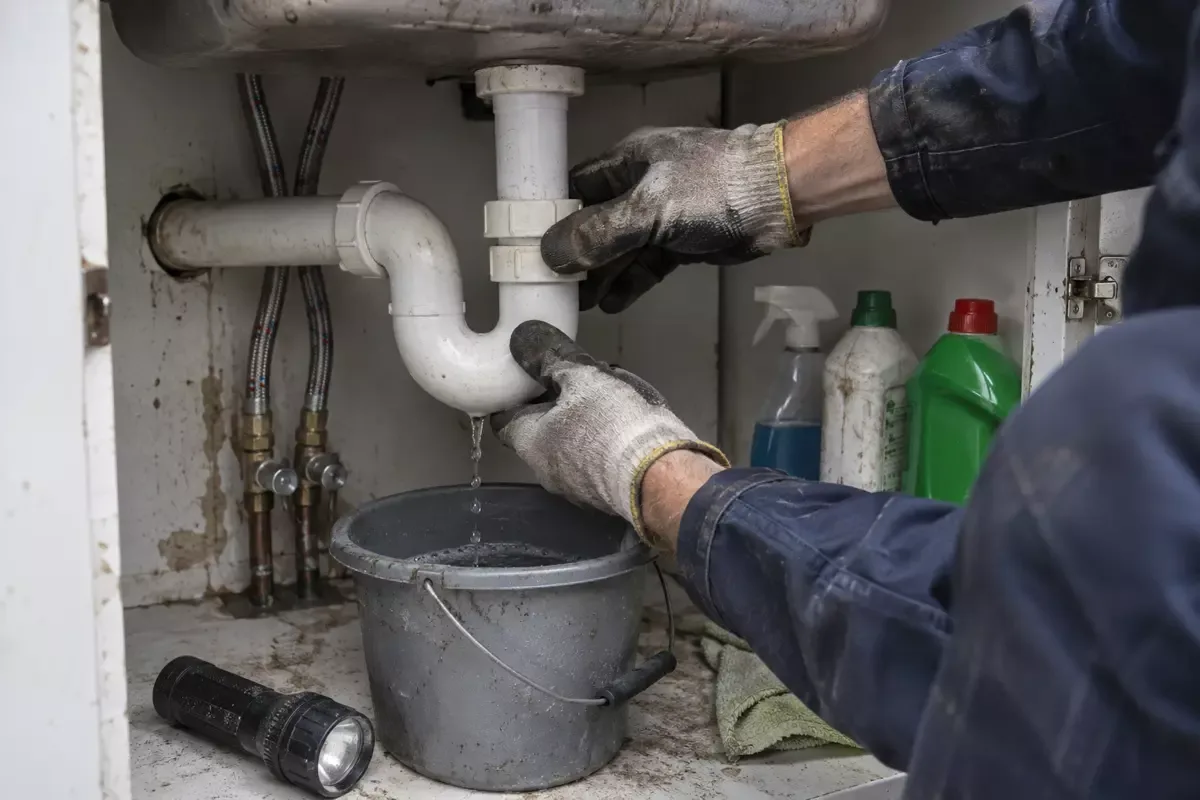
Hourly pay vs. hourly rate: what plumbers earn and what they charge
A plumber on someone else's payroll earns a median of $63,800 a year, according to the BLS plumbers pay data for May 2025. That is about $30.67 an hour over a 2,080-hour year. The top 10 percent earn more than $108,420, about $52 an hour. That is a wage. It is not what a plumbing business can bill.
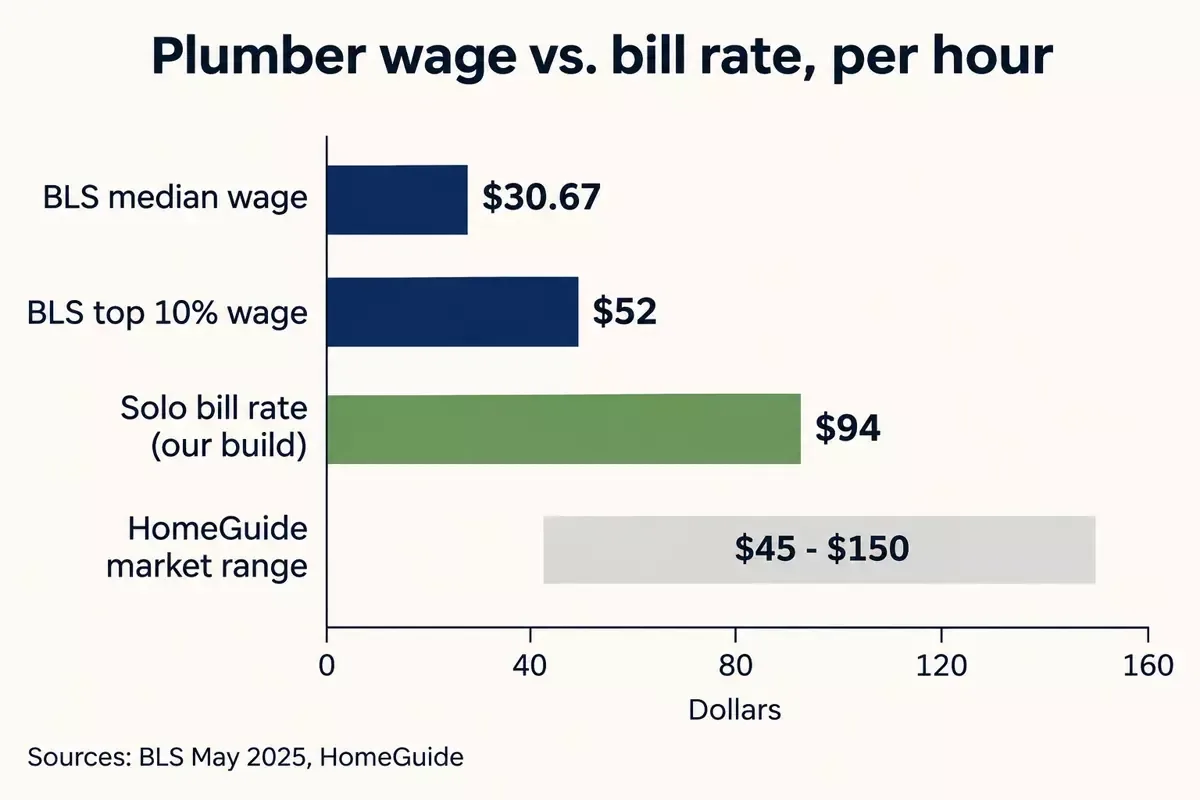
The gap between the two is the whole business. A shop that pays a plumber $32 and bills $110 is not gouging anyone. The other $78 pays for the van, the fittings on its shelves, the drain machine, insurance, the license, the hours nobody pays for, and a profit that keeps the doors open.
Your hourly rate is the number you build your prices from, not the number you put on most quotes. Homeowners call about a toilet, a water heater or a slow drain, and they want one price for it. Bill those by the clock and you get paid less every time you get faster, and you lose money on every short call because the drive and the supply house run cost the same whether the job takes 30 minutes or three hours.
How to set your plumber hourly rate: the solo build
Here is the build for a one-person licensed plumbing business. Every input is an assumption you should replace with your own.
| Line | Worked example | How it is calculated |
|---|---|---|
| Your pay per hour worked | $39.00 | Between the BLS median (about $30.67) and top 10% (about $52) |
| Share of hours you can bill | 65% | The rest is driving, supply runs, quoting and invoicing |
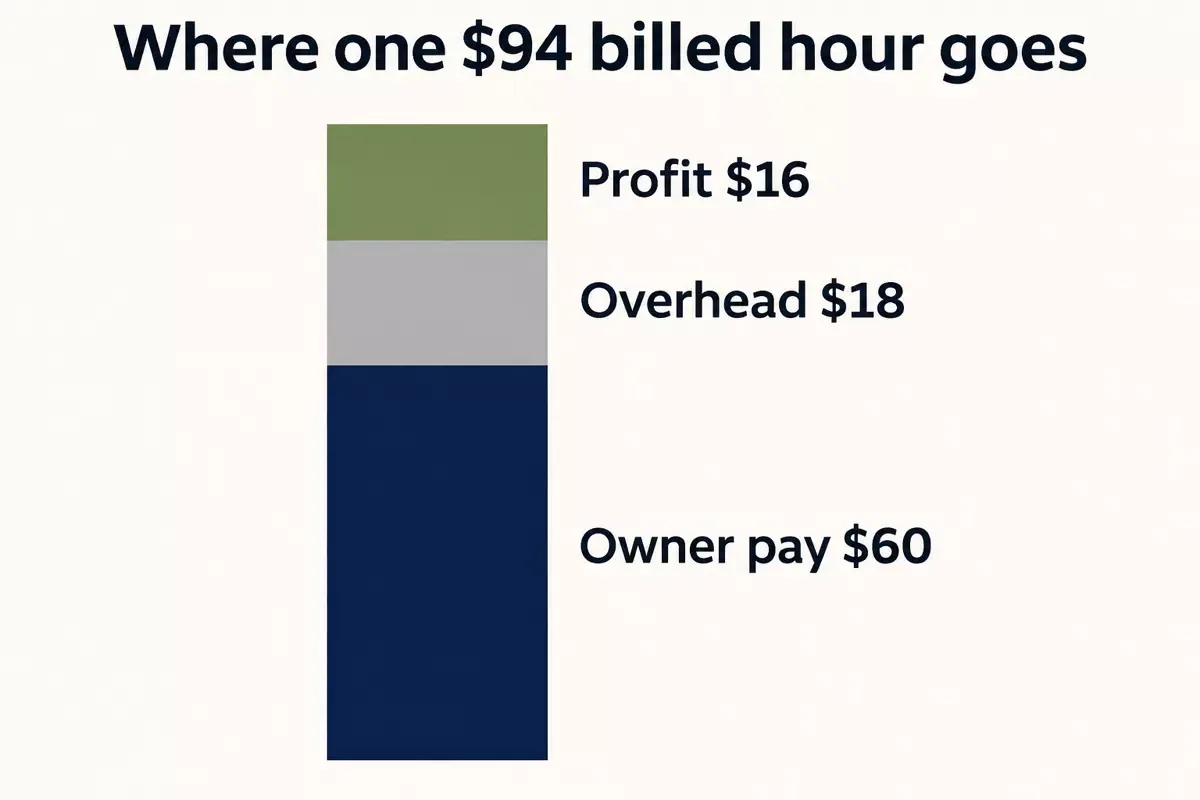
| Your pay per billed hour | $60.00 | $39 / 0.65 |
| Overhead per billed hour | $18.00 | $23,400 a year (van, van stock, drain machine, tools, insurance, license, fuel, phone) / 1,300 billed hours |
| Cost per billed hour | $78.00 | $60 + $18 |
| Profit at 20% | $15.60 | $78 x 0.20 |
| Bill rate | About $94 | Per hour on site |
Try your numbers
Example estimate of your job price. Before tax.
Your billable rate
To run your own inputs, start with what an hour of your time really costs. Then decide how you add the profit, because markup and margin are two different percentages, and mixing them up takes points off every job without you noticing.
The 65% billable share is our planning assumption for a residential service plumber. Track one ordinary week of your own: clock-in to clock-out, and the hours that ended up on an invoice. Your share is the number to use.
$94 sits in the middle of HomeGuide's master range and above its average. A licensed owner charging $60 an hour is paying themselves less than the BLS median wage once drive time is counted, with nothing put aside for the next van or the drain machine that dies in February.
How much should a plumber with a helper charge per hour?
Adding a helper does not double your rate. Overhead is shared, so the rate per person drops even though the crew hour costs the customer more. The helper's hours are still billable, because they are on site doing supervised work.
| Line | Owner | Helper |
|---|---|---|
| Pay per hour worked | $39.00 | $20.00 wage + 20% burden = $24.00 |
| Pay per billed hour (65% billable) | $60.00 | $36.92 |
| Overhead per billed crew hour | $22.00 ($28,600 a year / 1,300 hours) | |
| Cost per billed crew hour | $118.92 | |
| Profit at 20% | $23.78 | |
| Crew bill rate | About $143 per crew hour | About $72 per person |
The $20 helper wage is our assumption; apprentice pay rises as they progress, so update it each year. Labor burden (payroll taxes, workers' comp) commonly adds 15% to 25% on top of the wage, and workers' comp varies a lot by state, so get your own rate from your insurer.
$143 is a master rate plus a helper rate from HomeGuide's table ($75-$125 plus $25-$45), which is how two-person plumbing crews usually bill. If your market will not bear $143, the fix is more billed hours per day (fewer supply runs, tighter routes), not a lower rate.
If you are still working toward your own license, our guide on how to become a plumber covers the apprentice and journeyman hours each stage needs.
Which rate fits your situation?
| Your situation | Rate to start from | What to watch |
|---|---|---|
| Newly licensed, solo, residential service | $85-$100 an hour plus a service call | Do not price your time like a $31 wage |
| Established master, solo | $100-$125 an hour | Licensed to pull permits and supervise; price that in |
| Owner plus one helper | About $143 per crew hour | Say per person or per crew on every quote |
| Three to five people | Per-person cost x heads, plus profit | Drive time is paid once per person in the van |
| Emergency, nights and weekends | $125-$170 an hour (HomeGuide) | Set a written after-hours minimum |
| Toilets, faucets, water heaters | Price the job, not the hour | Fixture and parts on their own lines |
Worked example: a toilet replacement priced three ways
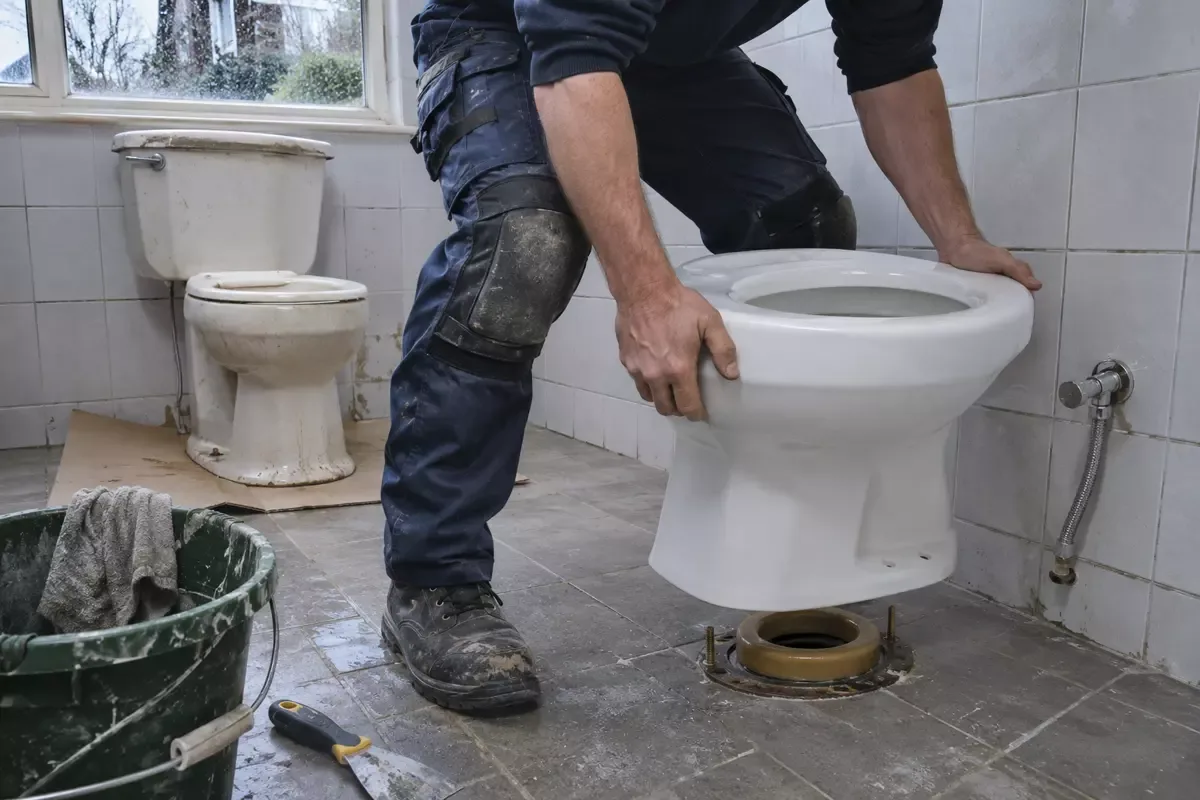
A homeowner wants an old toilet pulled and a new one set. The customer has bought the toilet. The times below are our planning assumptions for a typical swap; time your own and swap them in.
- 1.5 hours on site: shut off, pull, scrape the flange, new wax ring and supply line, set, test
- 40 minutes round-trip drive
- 15 minutes for the quote, invoice and payment
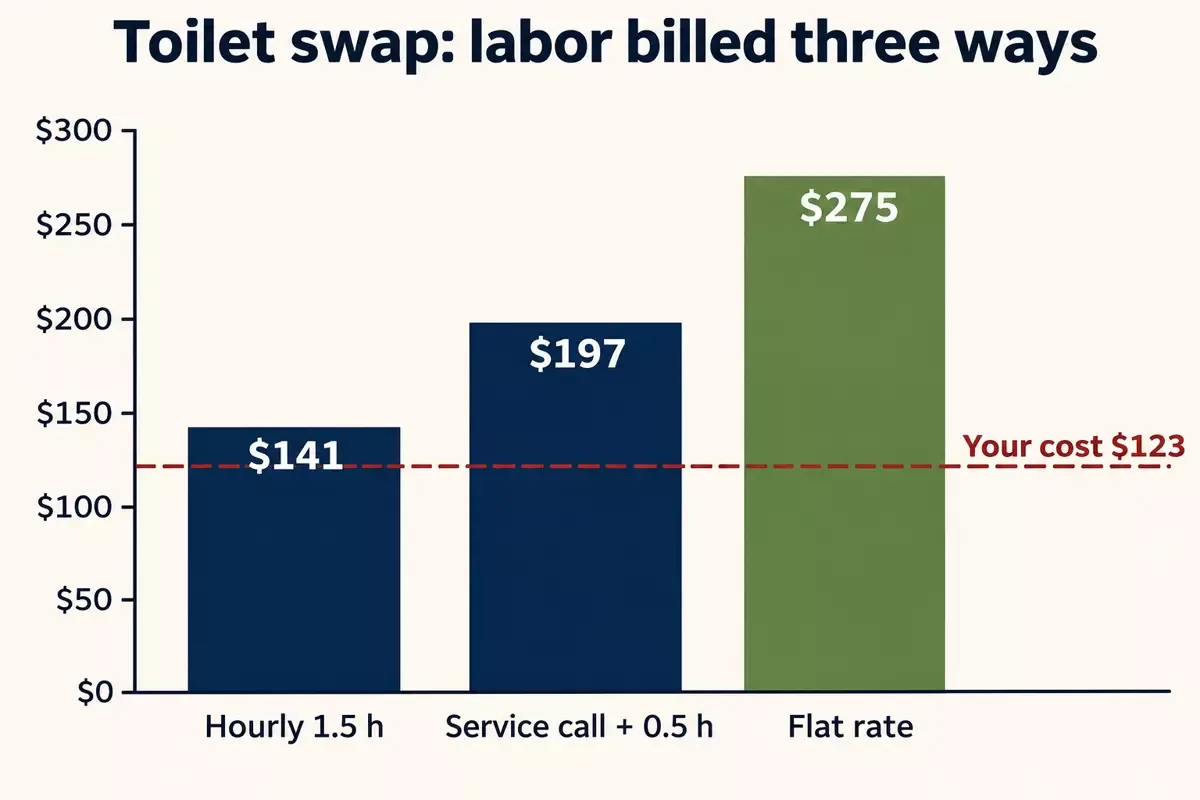
That is about 2 hours 25 minutes of your day. Your cost per hour worked is $50.70 ($39 pay plus $11.70 overhead, which is $23,400 over 2,000 hours worked), so the job costs you about $123 before the wax ring and supply line.
| Pricing method | Labor billed | Margin over your $123 cost |
|---|---|---|
| Straight hourly, 1.5 h at $94 | $141 | About $18 |
| $150 service call (first hour) plus 0.5 h at $94 | $197 | About $74 |
| Flat price for a toilet swap | $275 | About $152 |
The $275 flat price is our worked number, not a market quote. It lands inside HomeGuide's $250-$750 toilet installation range, so it is a normal price, not a high one. The wax ring, supply line and haul-away go on their own lines in every case. The straight hourly bill barely covers the drive, and it is the one many new plumbers send.
Price it once, then start your first quote from the driveway next time.
Hourly or flat rate: when to quote each
Homeowners like one number, and flat pricing pays you for being fast. HomeGuide notes that plumbers save time by setting a general price for common problems instead of building a new quote for every customer.
Keep the hourly rate as your internal math and sell most jobs at a fixed price:
- Repeat jobs (toilets, faucets, disposals, P-traps, supply lines): set a flat price per task built from your rate, your time and the parts. Write it in a price list and reuse it, the way our handyman price list does for small repairs.
- Diagnostic calls (a leak you cannot see, low pressure, a slow main): quote the service call plus hourly, with a not-to-exceed number the customer approves first. A clogged toilet sits in between, so price the toilet clog in tiers and quote all of them before you drive.
- Bigger jobs (water heaters, repipes, sewer lines): quote the whole job with labor, materials, permit and haul-away as separate lines on an estimate the customer can read line by line.
How to set your plumber hourly rate
- Pick your pay per hour worked
Start from what you would pay a licensed plumber to do your job, then add for running the business. The BLS median works out to about $30.67 an hour, so your number should sit above it.
- Measure your billable share
Track one normal week: total hours worked versus hours that ended up on an invoice. That share is the number your build uses.
- Add overhead per billed hour
Add up a year of van payments, fuel, van stock, the drain machine, tools, insurance, license fees and phone. Divide by the billed hours you expect in a year.
- Add profit
Put a profit percentage on top of cost. Check whether you are adding markup or margin; they are not the same.
- Set your service call and turn the rate into flat prices
Price the first hour so a 30-minute call still covers your drive and paperwork. Then build flat prices for your ten most common jobs from the rate, the time and the parts.
Mistakes that cost plumbers money
| Mistake | What it costs |
|---|---|
| Billing a wage, like $35 an hour | About $59 under the solo build on every billed hour |
| Billing short calls by the minute with no service call | Most of your small jobs lose money |
| Quoting "per hour" without saying per person or per crew | Half the job, or the customer's trust |
| Leaving the supply house run and haul-away off the quote | An hour or more per job, done for free |
| Retyping the same toilet, faucet and water heater prices on every quote | An evening a week at the kitchen table |
The last one is the quiet one. You work out a fair toilet price once, then rebuild it from memory on the next quote, and it drifts a little every time.
Keeping your plumbing prices consistent
The manual method works. A notebook, a calculator and a week of timed calls will get you a fair price on every job, and our guide on how to start a plumbing business covers the license, insurance and setup before you go out on your own. Where the manual method breaks is repetition: by the third call of the day you are retyping the same service call, toilet and faucet lines at night instead of sending the quote before you leave the driveway.
That is the part Driveway Desk handles. Your service call, minimum and per-job prices live in your price book, you build the quote on your phone in the customer's driveway, and when the job is done the invoice goes out in one tap and gets paid into your own Stripe or Square account. One flat price for the whole crew, no contract. If you are weighing the bigger tools, here is what Jobber costs by plan.
Price it once, then start your first quote from the driveway next time.
The bottom line on what plumbers charge per hour
The market says $45-$150 an hour, with $50-$200 for a service call that usually covers the first hour and $125-$170 after hours. Your number comes from your own pay, your billable share and your overhead, and for most solo licensed owners that lands near $94 an hour, with an owner plus helper near $143 per crew hour. Charge a real service call on short jobs, put parts and haul-away on their own lines, and sell toilets, faucets and water heaters at a flat price. Electricians run into the same unbilled-hours problem; what electricians charge by the hour walks through their version.
Your prices, remembered. Build your first quote on your phone in about two minutes, send it, and get paid into your own account.
Put the method to work
Labor cost calculatorDivide paid-hour costs by the billable-hours ratio, then allow for your target margin to find a selling rate.
Frequently asked questions
Plumbing labor runs $45-$150 an hour, about $75 on average, before trip fees and materials, per HomeGuide. A master plumber bills $75-$125 an hour, and most small jobs like a toilet, sink or faucet repair come to $125-$350 in total.
Build it from your own costs: your pay per hour worked, divided by the share of hours you bill, plus overhead per billed hour and a profit percentage. With $39 pay, 65% billable, $23,400 a year of overhead and 20% profit, a solo plumber lands near $94 an hour.
At HomeGuide's $45-$150 range, three hours of labor costs $135-$450, plus any service call or trip fee and the parts. At the $94 solo rate in this guide, it is about $282 in labor.
HomeGuide puts a toilet installation at $250-$750, depending on the toilet and the condition of the flange. In our worked example, a flat $275 for labor on a customer-supplied toilet covers the drive and paperwork with a healthy margin.
A plumber's service call runs $50-$200 and usually covers the first hour of work, per HomeGuide. Some plumbers charge a trip fee of $1-$2 a mile after the first 10 miles instead, then bill every hour on top.
Yes, but most employed plumbers do not. The BLS median is $63,800 a year, and the top 10 percent earn more than $108,420. A solo owner who bills 1,300 hours at $94 takes in about $122,000, which leaves about $99,000 after the $23,400 of overhead in our build.
Put the method to work
Markup and margin calculatorMarkup divides profit by cost; margin divides profit by selling price. Convert either percentage before quoting.
Your prices, remembered.
Build your first quote on your phone in about two minutes, send it, and get paid into your own account.
Start your first quoteShare article
About the author
Field notes team
We write practical guides for home service crews of one to five. Our editorial standard is to show the calculation, state its assumptions, cite primary sources for factual claims and date competitor comparisons. We distinguish worked examples from market prices and correct errors when they are found. We do not claim trade licenses or credentials on behalf of the team.
More articles

Pricing jobs · 12 min
How Much Do Plumbers Charge to Unclog a Toilet? 2026 Prices
Plumbers charge $100-$275 to unclog a toilet, plus a $50-$200 service call. Here is the price by where the clog sits, what a 30-minute clog call really costs a solo plumber, three tiers priced from a worked rate, and how to quote them on the phone.

Pricing jobs · 11 min
How Much Is Gutter Cleaning? 2026 Prices by House Height
Gutter cleaning costs about $137-$240 for a typical 215-foot house, close to $1 a linear foot. Here is why the same gutters cost $145, $235 or $325 depending on height, and how to quote the job from your own hours.

Pricing jobs · 13 min
How Much Do Electricians Charge per Outlet? 2026 Prices
Electricians charge $80-$150 to replace an outlet and $150-$350 to add one, plus a trip fee or one-hour minimum. Here are the prices by outlet type, what one outlet call really costs a solo electrician, and a first-outlet-plus-each-extra price list that wins the ten-outlet job.

Pricing jobs · 13 min
How Much Do Electricians Charge Hourly? 2026 Rates and Math
Electricians charge about $50-$130 an hour, plus a $100-$200 service call that covers the first hour. Here is the rate by license level, the bill-rate build for a solo owner and an owner with an apprentice, and a 45-minute call priced three ways.

Pricing jobs · 13 min
How Much Do Landscapers Charge Per Hour? Rates and the Math
Landscapers charge about $25-$50 per person per hour, or $50-$100 for a two-person crew. Here is where those numbers come from, the bill-rate build for a solo owner and a crew, and a mulch job priced both ways.

Pricing jobs · 11 min
How Much Do Painters Charge in 2026? Rates and the Math
Painters charge about $25-$50 an hour, $1.50-$3.50 a square foot or $300-$800 a room. Here is where those numbers come from, a 12x12 room priced three ways, and how to set a bill rate that actually pays you.