How to Become a Plumber: 5 Steps and Real Timelines
Driveway Desk team Updated 11 November 2026 12 min read
Your next job
Less time at the desk.
Build your price book, schedule the next visit and turn completed work into an invoice.
Start your first quoteIn this article
Short answer
To become a plumber, get a high school diploma or GED. Next, get hired as an apprentice under a licensed plumber and finish a 4 or 5 year apprenticeship of about 2,000 paid hours a year. Then pass your state's journeyman exam. To run your own plumbing business, most states also want a master or contractor license and insurance on top of that.
That is the whole path, and the Bureau of Labor Statistics describes it the same way: most plumbers learn on the job through an apprenticeship, and most states require a license. What the guides skip is when the clock starts.
Your hours only count from the day you are registered, not from the day you start working. In Texas, the plumbing board says it plainly: hours worked before you register as a plumber's apprentice do not count toward the journeyman exam. Six months as an unregistered helper is six months you do again. Registering costs $15.
This guide walks the path in order, with real hours and fees from Texas, and what changes when you stop working for a plumber and start being one.
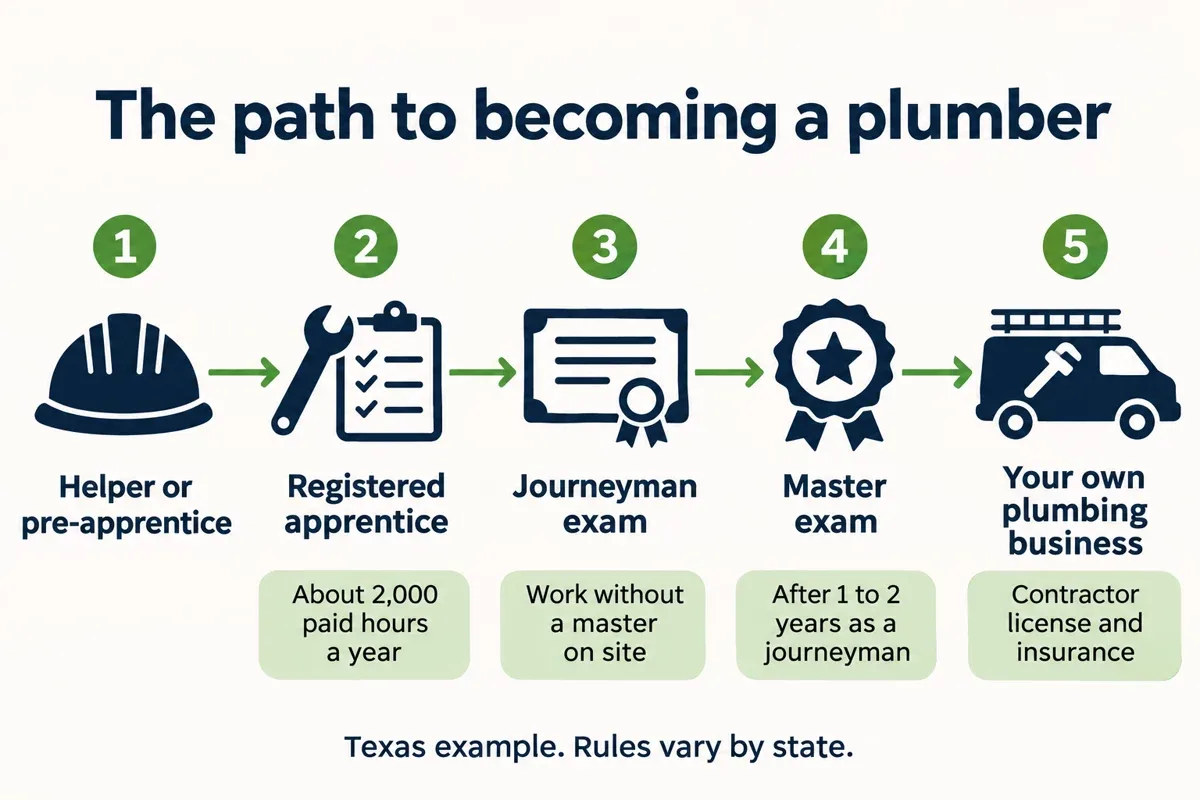
The 5 steps at a glance
How to become a plumber
- Meet the basics
Finish high school or a GED, get a driver's license and brush up on practical math: fractions, measuring and simple geometry.
- Get hired and register as an apprentice
Find a union program, a trade association program or a local plumbing shop that will sponsor you. Register with your state board the same week you start.
- Log your apprenticeship hours
Work about 2,000 paid hours a year under a licensed plumber for 4 or 5 years, plus classroom instruction. Get every employer to sign off on your hours.
- Pass the journeyman exam
Once you have the hours and the required training, apply for your state's journeyman exam. Passing it lets you do plumbing work without a licensed plumber standing next to you.
- Go for master or contractor if you want your own business
Most states want more years and another exam before you can pull permits and sell work under your own name.
How long does it take to become a plumber?
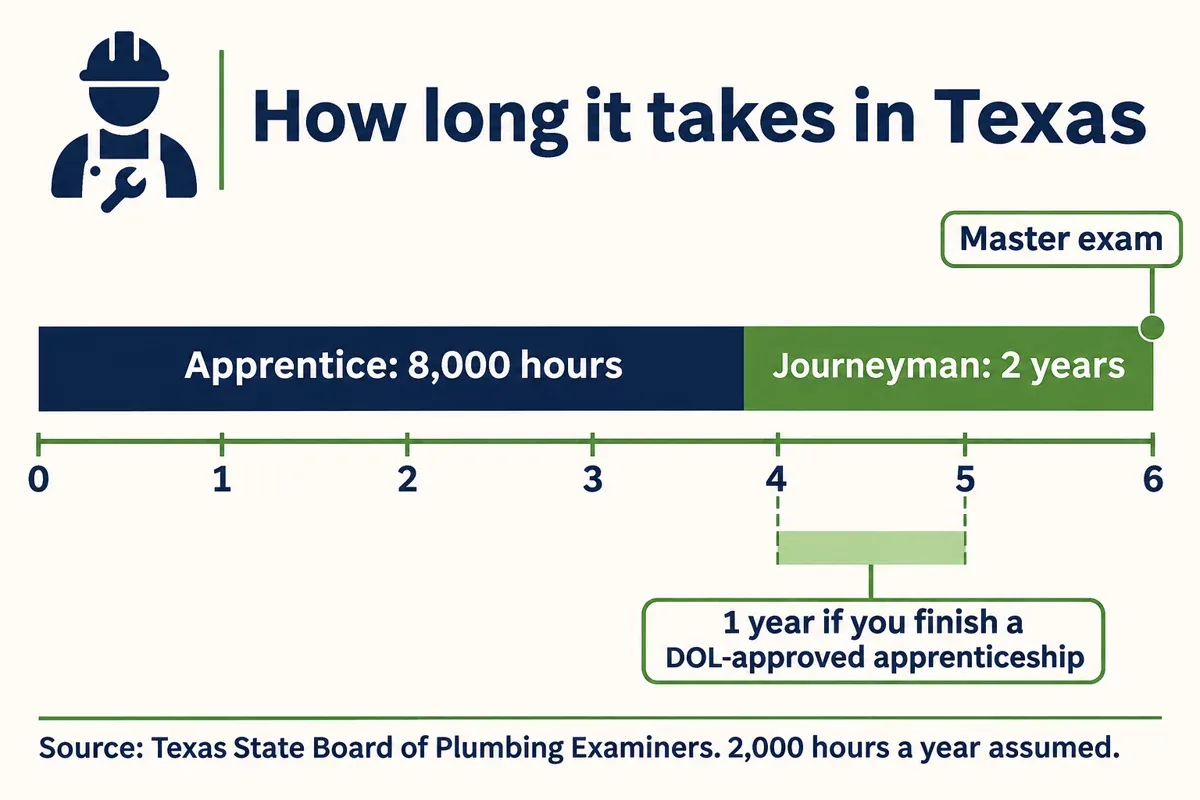
Plan on 4 to 5 years to reach journeyman. In Texas, the master exam comes about 5 to 6 years in. The apprenticeship sets the pace: about 2,000 paid hours a year for 4 or 5 years, per BLS. School can help, but it does not replace those hours.
| Stage | Typical time | What gates it |
|---|---|---|
| Apprentice | 4 to 5 years, about 2,000 paid hours a year | BLS Occupational Outlook Handbook |
| Journeyman exam (Texas) | 8,000 hours as a registered apprentice, plus a 48-hour approved course or a DOL-approved program | Texas State Board of Plumbing Examiners |
| Master exam (Texas) | 2 years holding a journeyman license, or 1 year if you completed a DOL-approved apprenticeship | TSBPE |
| Working on your own (most states) | 2 to 5 years of experience plus an exam | BLS |
Texas is a useful example because its board publishes the exact numbers. Your state will differ. Read your own board's page before you plan around any of these.
Step 1: The basics you need before anyone hires you
BLS lists a high school diploma or equivalent as the typical entry requirement. In Texas you can register as a plumber's apprentice at 16. Most employers also want a driver's license, because the job happens in a truck between houses.
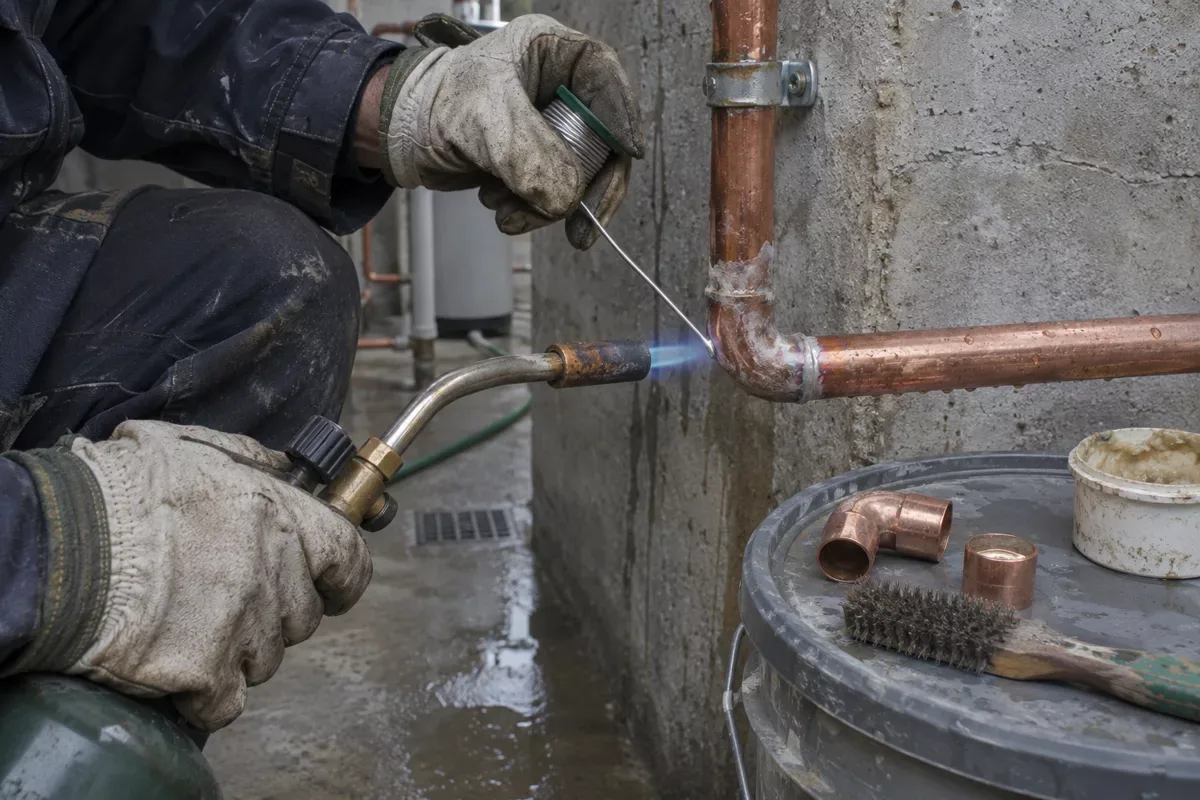
The math is practical, not academic. You measure and cut pipe to the sixteenth of an inch, work out offsets, and read drain slope as fractions of an inch per foot. Apprenticeship classes also cover local plumbing codes, blueprint reading, safety and some applied physics and chemistry, per BLS.
Step 2: Get hired as an apprentice, then register the same week
Apprenticeships are sponsored by unions, trade associations and businesses, according to BLS. Most apprentices go straight into a program. Some start as a helper or finish a pre-apprenticeship first. Apprentices are paid for their on-the-job hours.
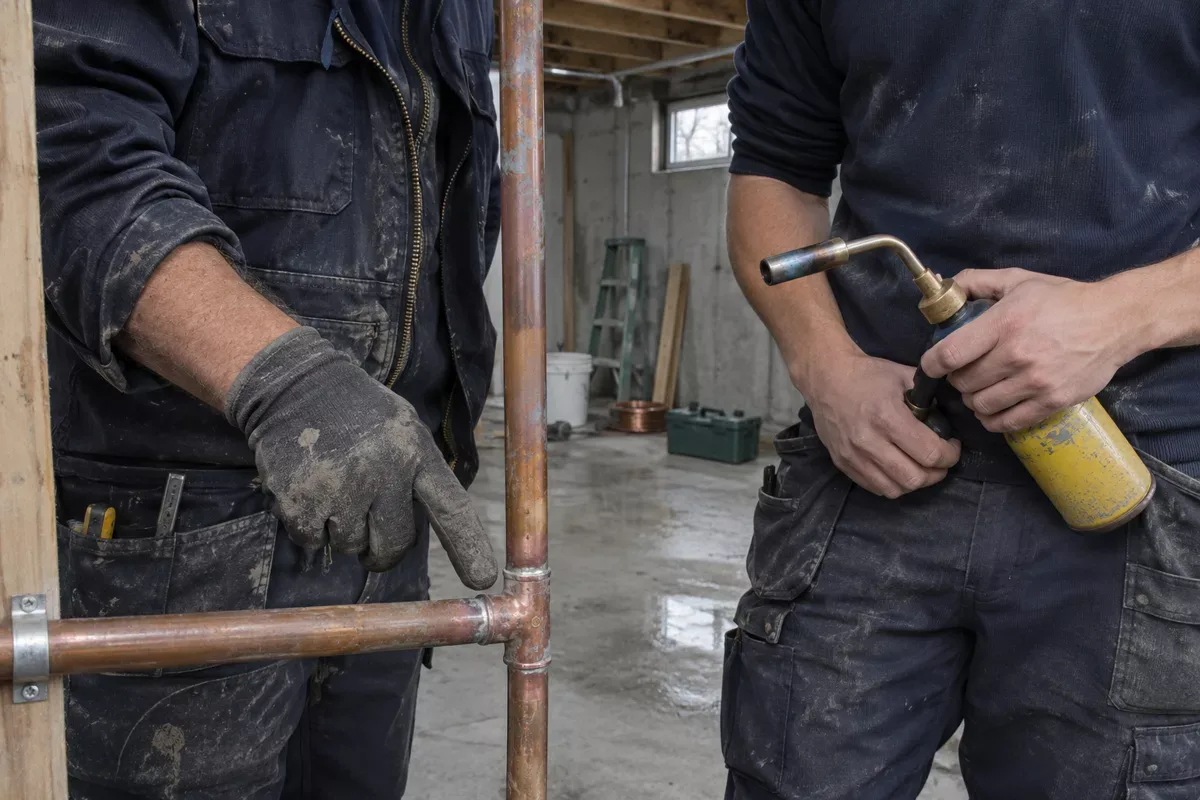
Which route fits depends on where you are starting from:
| Your situation | Best route | Why |
|---|---|---|
| Just out of high school, few bills | Union or trade association apprenticeship | Structured classes, set pay raises, a sponsor who handles the paperwork |
| 25 or older with rent to pay | Paid apprentice job at a local residential shop | You start earning in week one instead of paying tuition first |
| Already doing handyman or helper work | Register as an apprentice now | Unregistered hours do not count in Texas, so every week you wait is lost |
| Licensed journeyman in another state | Check your new state's board | Texas lets out-of-state journeymen sit its exam without the 48-hour course |
Then register. In Texas, the plumber's apprentice registration costs $15 and requires fingerprints. A registered apprentice may only do plumbing work with a licensed plumber on the job site at all times. Without one present, an apprentice is limited to manual tasks like digging trenches.
Step 3: Log your hours like you will need to prove them
You will. In Texas, the journeyman application needs an Employer Certification Form from each employer, and the board recommends asking for a signed form every time you change jobs. A boss who retired or closed shop three years ago is hard to get a signature from.
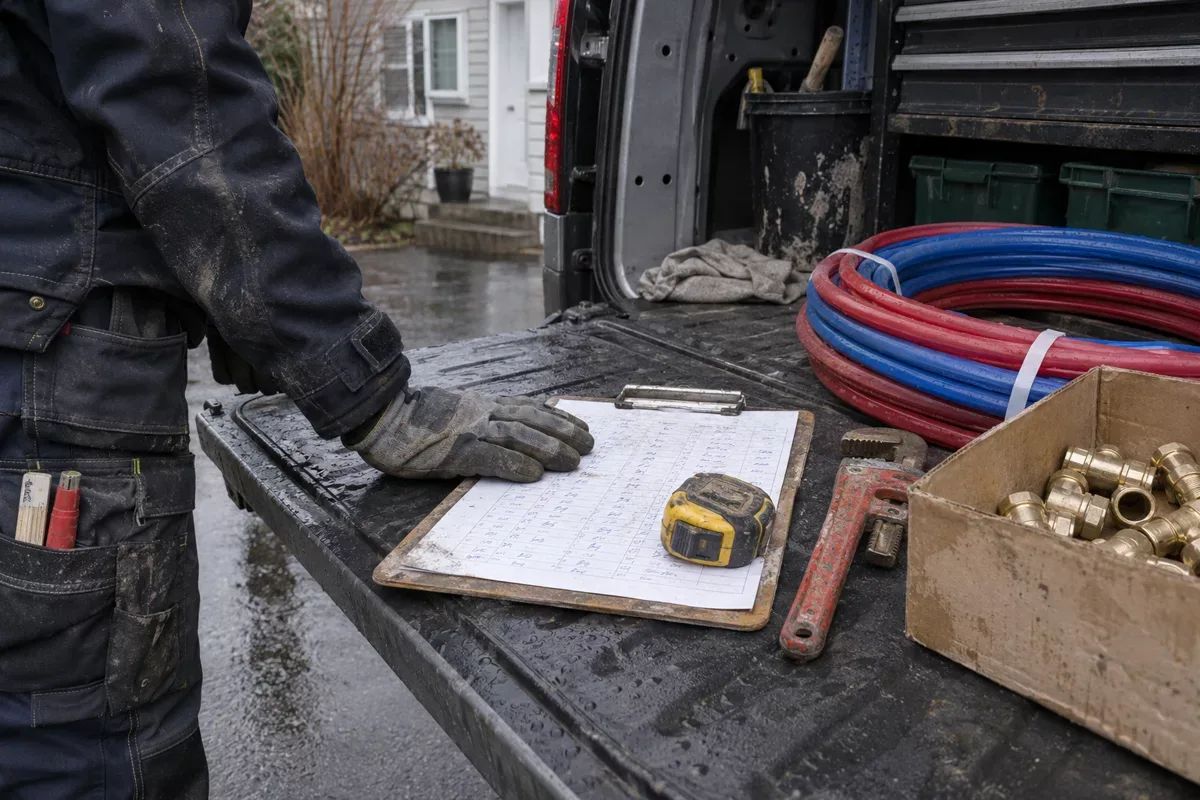
Keep your own record from the first week:
- the date, the address and the job type (service call, rough-in, water heater, drain)
- the hours on that job
- the licensed plumber you worked under and their license number
- your pay stubs, which back up the hours
When it is time to apply, you hand each employer a clean list to sign instead of asking them to remember four years.
How to become a licensed plumber: the journeyman exam
Once you have the hours and the training, you apply for the journeyman exam. In Texas that means 8,000 hours of plumbing experience as a registered apprentice, plus a 48-hour course approved by the board or enrollment in a Department of Labor approved apprenticeship. The exam fee is $40 and the license is another $40.
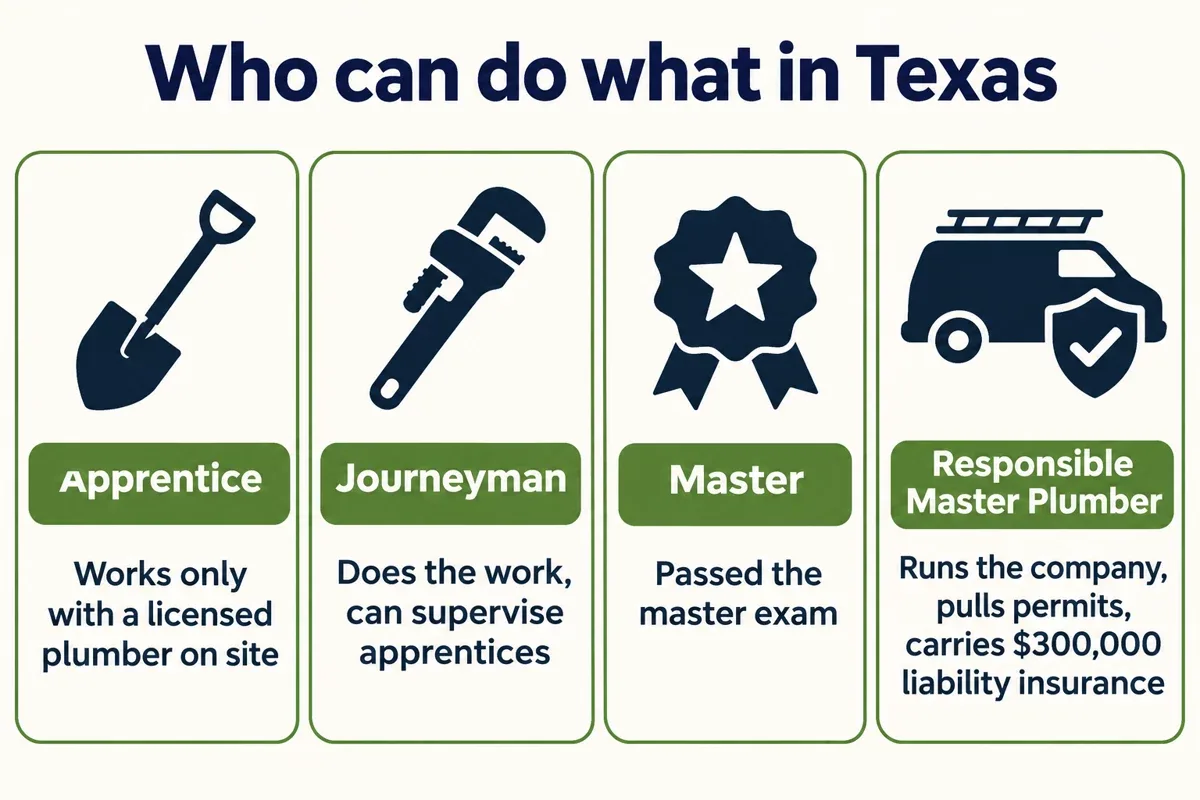
A journeyman does the work and can supervise apprentices. In Texas, a journeyman still works under a Responsible Master Plumber, the license holder who answers for the company. That is the next wall if you want your own trucks.
| Texas license step | Fee | Requirement |
|---|---|---|
| Plumber's apprentice registration | $15 | Age 16 or older, fingerprints |
| Journeyman exam and license | $40 exam, $40 license | 8,000 hours plus approved training |
| Master exam and license | $25 processing, $128.50 exam, $75 license | 2 years as a journeyman, or 1 after a DOL-approved apprenticeship |
| Responsible Master Plumber designation | $225, then $300 to renew | Master license plus at least $300,000 of commercial liability insurance |
Fees are from the TSBPE license pages, checked November 2026. The board fees for the whole path add up to $548.50 before insurance. The insurance premium is the number that grows, and it arrives before your first customer does.
Going from journeyman to your own plumbing business
The master license proves you know the trade. The Responsible Master Plumber designation in Texas is what lets you run a company: you carry the liability insurance, pull the permits, request the inspections and make sure everyone on your jobs holds a current license or registration. Other states call it a contractor license and add a bond.
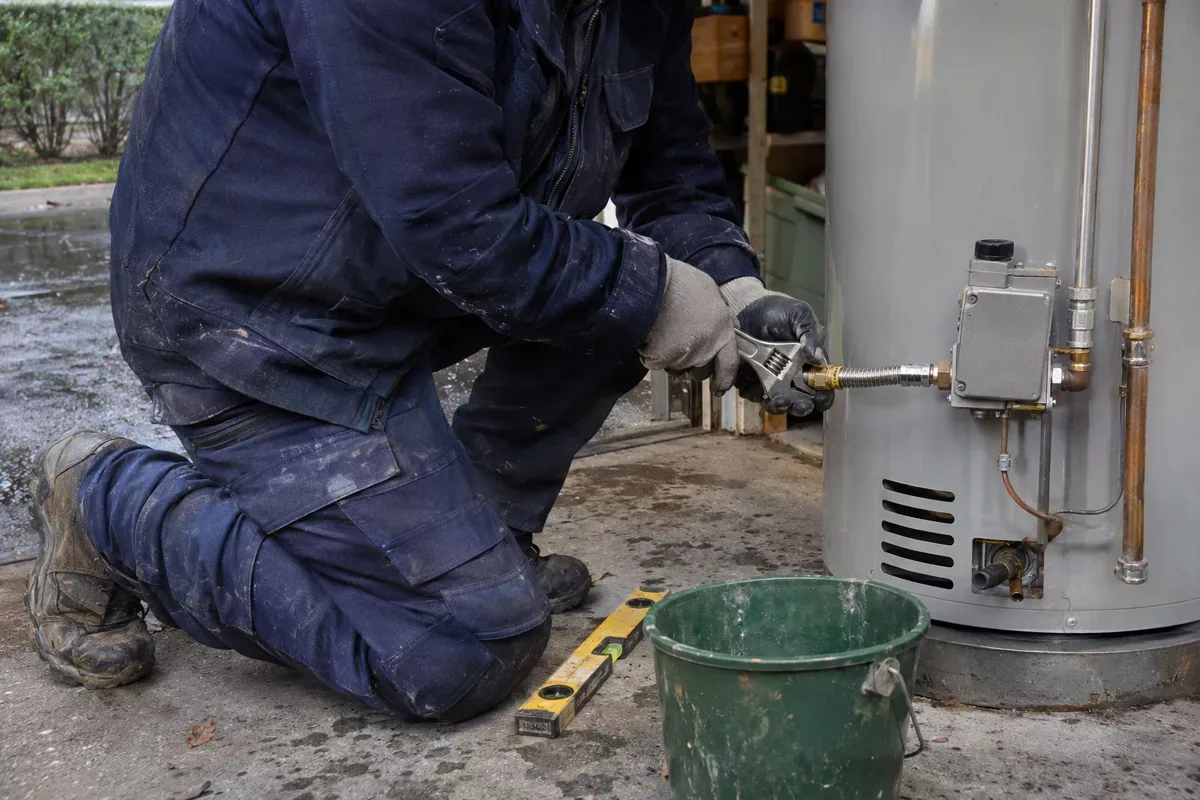
This is also where the pay ceiling moves. BLS puts the median for plumbers, pipefitters and steamfitters at $63,800 in May 2025, with the top 10 percent above $108,420. Getting into that top slice is less about speed with a torch and more about pricing every job from real costs. When you are ready to go out on your own, our guide on starting a plumbing business walks through the license, the truck and a rate built from the hours you can actually bill, and the going hourly rates for licensed plumbers show what that rate competes with.
Mistakes that cost new plumbers a year or more
- Working as an unregistered helper. In Texas those hours never count. Register the week you start.
- Not getting hours signed when you change jobs. Chasing a signature years later stalls the application.
- Picking a shop that only does one kind of work. A residential service shop and a new construction crew teach different halves of the trade. Ask what jobs apprentices actually do before you say yes.
- Pricing your first jobs like an employee. Your old hourly wage leaves out insurance, the truck, license renewals and the hours of paperwork. Work out what an hour of your time really costs before you quote anything.
- Skipping the margin on parts. Selling a water heater at cost means you install it for free. Check your markup and margin on materials first.
When the license is in hand: the office work starts
A license lets you sell plumbing. It does not write the quote, chase the invoice or remember what you charged the same customer last spring. Most new owners do that part at the kitchen table after the last call, retyping prices into a blank estimate template or a spreadsheet.
That holds for the first ten customers. It breaks when you are standing in a garage quoting a 50-gallon water heater swap and need your parts and labor prices on your phone, not in a file at home. Driveway Desk is built for that wall: your price book remembered, the quote drafted in the driveway, the invoice sent in one tap and paid into your own Stripe or Square account. If you are weighing other tools, see what a Jobber alternative looks like for a small crew.
Price it once, then start your first quote from the driveway next time.
Price it once, then start your first quote from the driveway next time.
The business setup is close to the same across trades. Our guides on starting a lawn care business and starting a pressure washing business cover registration, insurance and the first price sheet. If your crew adds heating and cooling later, the HVAC license guide walks that separate path. Once jobs come in, put each one on a simple work order and send customers a written quote they can approve.
Register first, then start counting
Get the diploma, get hired, and register as an apprentice the same week, because in Texas no hour counts before that. Then log every job, get every employer to sign, pass the journeyman exam and decide whether you want your own trucks. Check your own state board for the exact rules, price the insurance early and quote your first jobs from real costs, not your old wage.
Put the method to work
Labor cost calculatorDivide paid-hour costs by the billable-hours ratio, then allow for your target margin to find a selling rate.
Frequently asked questions
Most plumbers train through a 4 or 5 year apprenticeship with about 2,000 paid hours a year, according to BLS. In Texas you need 8,000 hours as a registered apprentice before the journeyman exam, then 1 or 2 more years as a journeyman before you can sit the master exam.
Yes, but it is the top end. BLS reports a median of $63,800 for plumbers, pipefitters and steamfitters in May 2025, and the highest 10 percent earned more than $108,420. Reaching that usually takes a master license, steady overtime or running your own business with jobs priced from real costs.
No. Apprenticeships hire adults, and the Texas apprentice registration only asks that you be at least 16. Starting at 25, a 4 or 5 year apprenticeship puts you at journeyman around 30. The main difference is money: pick a paid apprentice job over unpaid school so you can cover your bills while you learn.
Not in most states if you want a license. States usually require years of supervised experience before the exam. In Texas the journeyman exam needs 8,000 hours as a registered apprentice plus a 48-hour approved course or a DOL-approved program, so trade school alone is not enough. Check your own state board.
Practical math: fractions, measuring to the sixteenth of an inch, working out offsets with simple geometry and reading slope in inches per foot. BLS notes that apprentices study mathematics, applied physics and chemistry in their technical instruction, alongside codes and blueprint reading.
By license level, there are apprentices, journeymen and master plumbers, and in Texas a Responsible Master Plumber who runs the company. By work, most plumbers do residential service, new construction or commercial work. BLS groups plumbers with pipefitters and steamfitters, who work mostly on industrial and high-pressure piping.
Put the method to work
Labor cost calculatorDivide paid-hour costs by the billable-hours ratio, then allow for your target margin to find a selling rate.
Your prices, remembered.
Build your first quote on your phone in about two minutes, send it, and get paid into your own account.
Start your first quoteShare article
About the author
Field notes team
We write practical guides for home service crews of one to five. Our editorial standard is to show the calculation, state its assumptions, cite primary sources for factual claims and date competitor comparisons. We distinguish worked examples from market prices and correct errors when they are found. We do not claim trade licenses or credentials on behalf of the team.
More articles

Running a small crew · 13 min
How to Start a Plumbing Business: 6 Steps and the Math
Start a plumbing business in order: hold the license that lets you contract, register and insure the business, stock one truck, and set your rate from the hours you will actually bill, not the hours you work.

Running a small crew · 11 min
Basic House Cleaning Checklist: 12 Tasks, Every Visit
A basic house cleaning checklist of 12 tasks you finish on every visit: kitchen, bathrooms, dusting, beds and floors, in the right order, with real timings for a 3 bed, 2 bath house and how to price it.

Running a small crew · 13 min
What Do I Need to Start a Mobile Detailing Business? Full Checklist
The mobile detailing startup checklist: paperwork and insurance, the wash and interior kit for the services you sell first, how many towels to stock, and the quote, work order and payment setup.

Running a small crew · 13 min
Roofing Company Business Plan: 7 Parts + Cash Flow Example
A roofing company business plan in seven short sections, with a worked example: one reroof priced line by line, revenue by month, and how much cash a busy June ties up before homeowners pay.

Running a small crew · 11 min
How to Get Clients as a Realtor: 5 Channels That Work
How to get clients as a realtor: start with your sphere and past clients, build referral partners among the trade pros already inside homes, then add open houses and one farm area. Includes a 90-day plan and the commission math.

Running a small crew · 14 min
How to Get Bookkeeping Clients: 6 Ways That Actually Work
How to get bookkeeping clients: start with people you know and local tax preparers, sell a fixed-price cleanup first, then pick one niche, such as trade contractors, and become the bookkeeper its owners refer.