Business Plan for a Landscaping Company: 7 Parts + Example
Driveway Desk team Updated 21 November 2026 15 min read
Your next job
Less time at the desk.
Build your price book, schedule the next visit and turn completed work into an invoice.
Start your first quoteIn this article
A business plan for a landscaping company covers seven things: a one-page summary, your services and prices, the customers and area you will serve, your equipment and how a week runs, how you will find clients, who does the work, and the numbers. Keep it short and build the numbers around your slowest month, because a landscaping company earns most of its money in seven or eight months and still pays the truck note and insurance in January.
Short answer
Write one page per section, price every service from time, project revenue month by month, and plan a winter fund before you buy equipment. In the example below, a two-person crew bills $112,137 a year but earns nothing from December to February, so it sets aside about $2,000 a month all summer.
What goes in a landscaping business plan?
A landscaping business plan has seven parts, and each one answers a question a lender, a partner or you at 10 pm in February will ask. The SBA describes two formats: a traditional business plan or a lean one-page plan, and says to use the sections that make sense for your business rather than a fixed outline.
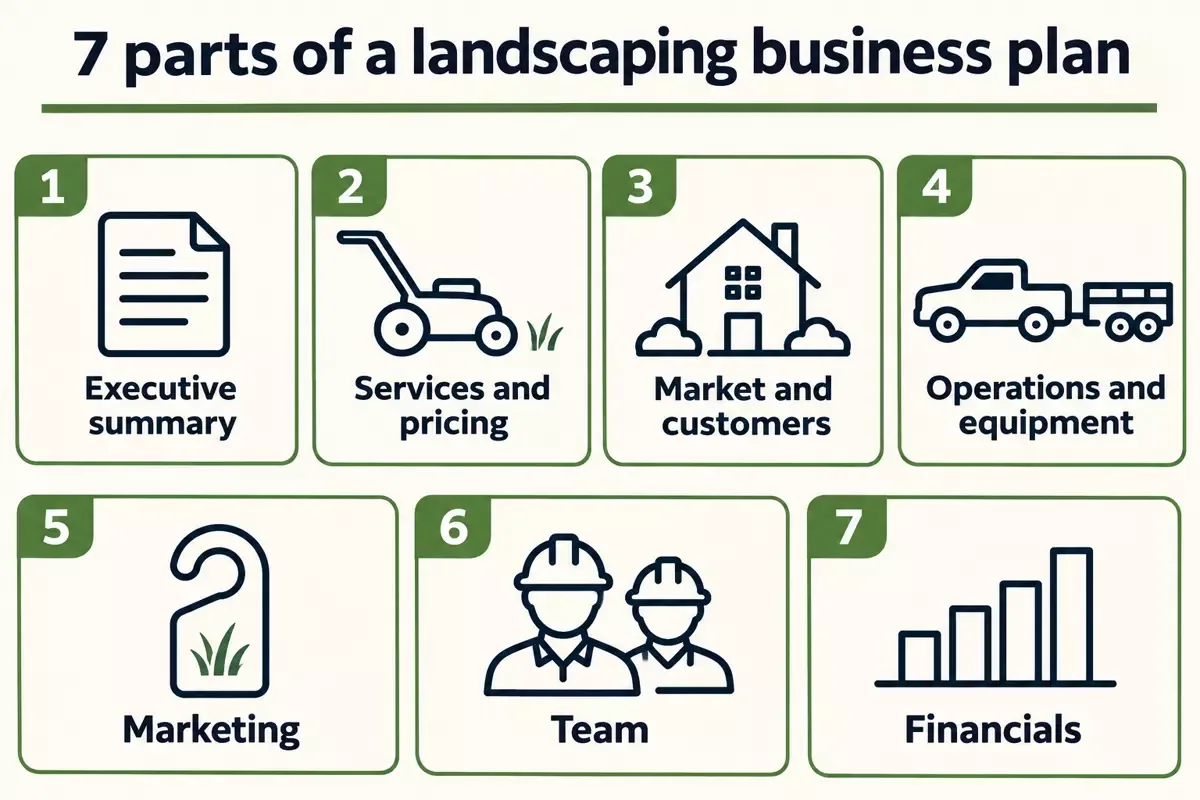
| Section | The question it answers | What to write for a landscaping company |
|---|---|---|
| 1. Executive summary | What is this business and why will it work? | Trade, area, services, crew size, first-year revenue goal, money needed |
| 2. Services and pricing | What do you sell and for how much? | Weekly mowing, cleanups, mulch, installs, how each is priced |
| 3. Market and customers | Who pays you and where are they? | Neighborhoods, lot sizes, homeowners vs property managers, local competitors |
| 4. Operations and equipment | How does a week run? | Truck, trailer, mowers, routes, stops per day, dump site, storage |
| 5. Marketing | How do clients find you? | Door hangers, Google Business Profile, referrals, local groups |
| 6. Team | Who does the work? | Owner, helpers, when you hire, what each person costs per hour |
| 7. Financials | Does the math work every month? | Startup costs, monthly revenue, costs, winter fund, owner pay |
Most free templates stop at the list. The part that decides whether your company survives is section 7, and it only works if sections 2 and 4 are honest.
Which plan fits your situation?
Not every landscaper needs a 30-page document. Pick the format by what the plan has to do.
| Your situation | Plan format | What matters most |
|---|---|---|
| Solo, first season, mowing only | Lean one-page plan | Price per visit, stops per day, winter cash |
| Owner plus one helper, mowing and installs | Lean plan plus a monthly projection | Helper cost, seasonal revenue, winter fund |
| Asking a bank or the SBA for a loan or equipment financing | Traditional plan | Startup costs, repayment from cash flow, your experience |
| Buying an existing mowing route | Lean plan plus the route's history | Which accounts renew, what the route really bills |
| Adding snow removal or holiday lighting | One extra section | Whether winter work covers the winter costs |
If you are still choosing between mowing only and full landscaping, start with the step-by-step guide to starting a lawn care business, then come back to plan the bigger operation.
Plan for your slowest month, not your best one
The number that kills new landscaping companies is not a slow summer. It is a January with a truck payment, insurance and no grass to cut. A plan that averages your yearly revenue over 12 months hides this. A plan that projects every month shows it, and tells you how much to save while the money is coming in.
Here is an example two-person crew: the owner plus one helper, in a region where mowing runs from April through October. Every figure below is an illustrative assumption. Replace each one with your own prices and costs.
| Revenue line | How it is built | Year |
|---|---|---|
| Weekly mowing | 45 accounts x $60 a visit x 30 weeks, April to October | $80,997 |
| Spring and fall cleanups | 30 cleanups x $638 (15 in March and April, 15 in October and November) | $19,140 |
| Mulch and small installs | 10 jobs x $1,200, May to September | $12,000 |
| Total | $112,137 |
The $60 visit is our calculator's price for a 5,000 sq ft lawn ($57.68), rounded up. The $638 cleanup is the two-person crew price worked out in what landscapers charge per hour: four crew hours at $104, plus mulch and disposal. Spread across the year, it looks like this.
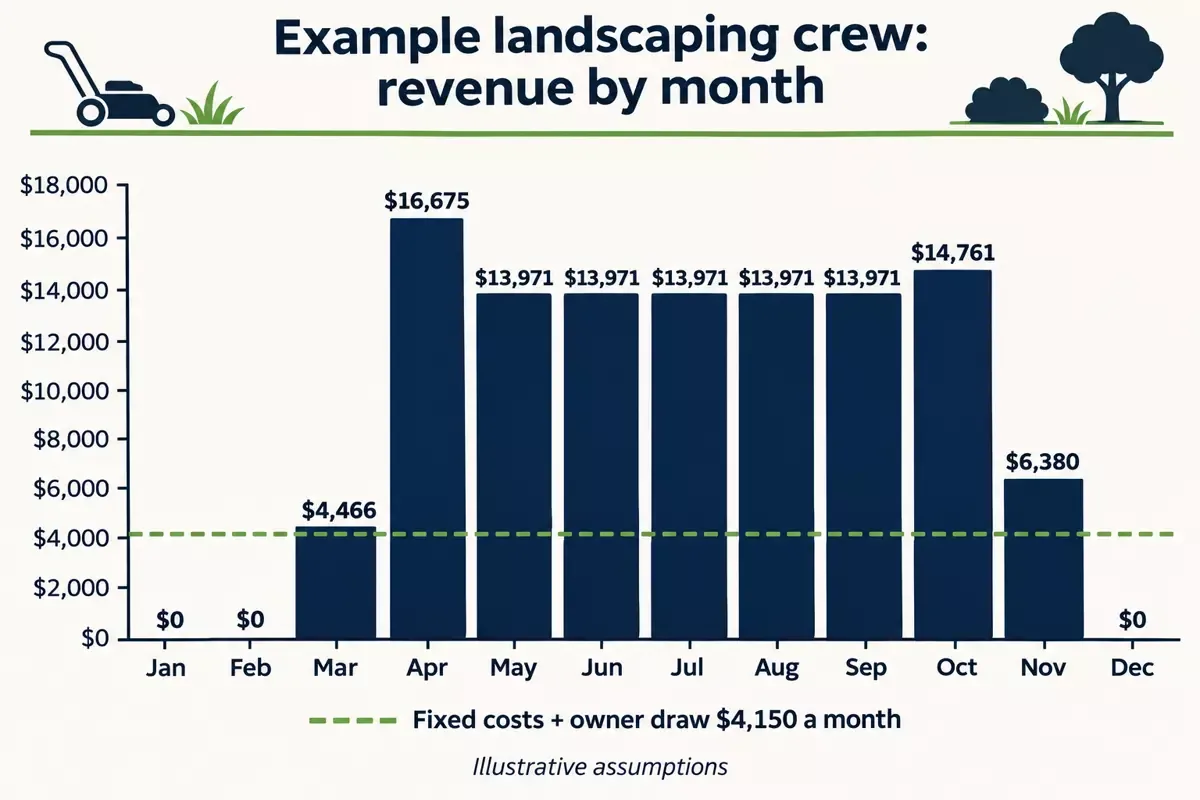
The dashed line is what the business costs every month whether the grass grows or not: $1,150 of overhead (truck, trailer, mower, insurance, phone, fuel; $13,800 a year) plus a $3,000 owner draw.
| Month | Revenue | Fixed costs and draw | Part-time helper | Gap to cover |
|---|---|---|---|---|
| December | $0 | $4,150 | $0 | $4,150 |
| January | $0 | $4,150 | $0 | $4,150 |
| February | $0 | $4,150 | $0 | $4,150 |
| March | $4,466 | $4,150 | $1,824 | $1,508 |
| Winter fund needed | $13,958 |
So the plan says: put about $2,000 a month aside from April to October ($14,000), and do not spend it in August. That one line is worth more than any mission statement. Other trades break in a different place: in a roofing business plan the squeeze comes in the busiest month, when several roofs are paid for and not yet paid.

Some crews close the gap with snow removal, holiday lighting or winter tree and shrub pruning. Put that in the plan as its own line with its own costs. A plow, salt and on-call nights cost real money, so winter work only helps if it covers more than it adds.
Where the money goes in a year
Once revenue is projected, take out what the work costs. In the example, the helper earns $19 an hour, which costs the business $22.80 with a 20% allowance for payroll taxes and workers' comp. They work 40 hours a week for 30 weeks and 20 hours a week in March and November.
| Cost line | How it is built | Year |
|---|---|---|
| Helper wages | 30 weeks x 40 h + 8 weeks x 20 h, at $22.80 | $31,008 |
| Overhead | Truck, trailer, mower, insurance, phone, fuel | $13,800 |
| Materials and disposal | $190 per cleanup (4 yd of mulch at $40, $30 dump fee) + $500 per install | $10,700 |
| Left for the owner, before tax | $112,137 minus $55,508 | $56,629 |
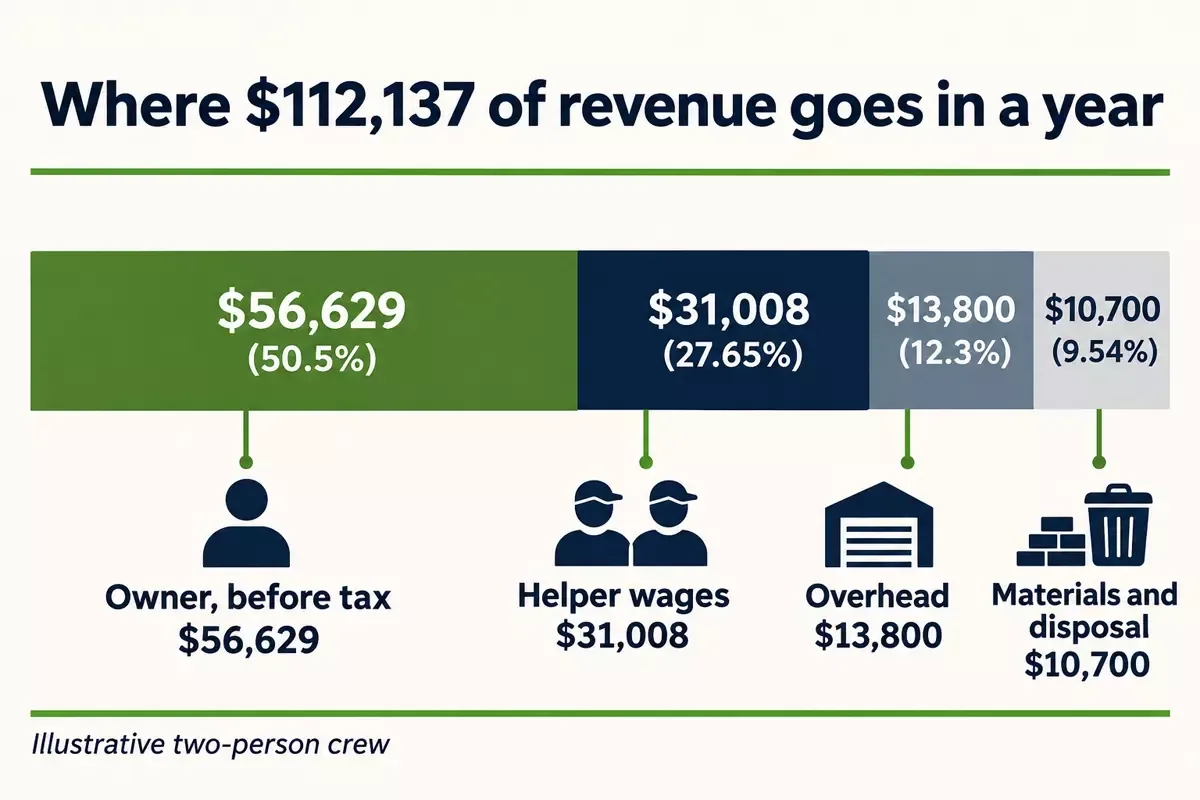
That $56,629 is not profit. It pays for the owner's own labor too. If you value your hours at $26 each, the same rate used in the hourly rate build, 1,600 hours a year costs $41,600, which leaves about $15,000 of real profit, roughly 13% of revenue. Self-employment tax comes out of the owner's share as well; the IRS explains how self-employment tax works.
Services and pricing: price every job from time
The services section is where most plans go vague ("we offer full-service landscaping at competitive prices"). Write each service, how you price it, and the number.

- Weekly and every-other-week mowing: a fixed price per visit, worked out from mowing time, trimming and drive time.
- Cleanups and mulch: crew hours times your crew rate, plus materials and disposal as their own lines.
- Installs (beds, edging, small plantings): priced as a job, with materials marked up, never as an open hourly tab.
- Seasonal contracts: a monthly price for the season, so revenue arrives evenly. A written lawn care contract spells out visits, skips and payment terms.
For mowing, the price comes from minutes, not from what the guy down the road charges.
| Mowable area | Price per visit |
|---|---|
| 2,500 sq ft | $46.34 |
| 5,000 sq ft | $57.68 |
| 10,000 sq ft | $80.35 |
| 21,780 sq ft (half acre) | $133.78 |
Try your numbers
Example estimate of your job price. Before tax.
Your example price
Price it once, then start your first quote from the driveway next time.
Market and customers: draw the map
Name the neighborhoods, not "homeowners in the metro area". Drive them and note lot sizes, how many lawns are already kept, and which ones look like they need help. A plan that says "45 weekly accounts within 15 minutes of my yard, mostly quarter-acre lots" is a plan you can check against reality in June.
Write down who else serves the area and what they seem to sell: mowing only, full service, or design and build. You are not trying to undercut them. You are looking for the gap, like crews that will not do small lots or will not quote within a week.
Operations and equipment: how a week runs
This section turns the revenue line into days. Forty-five weekly stops is nine stops a day, five days a week, with installs fitted around them. Write where the equipment lives, where you dump debris, and which days cover which streets.
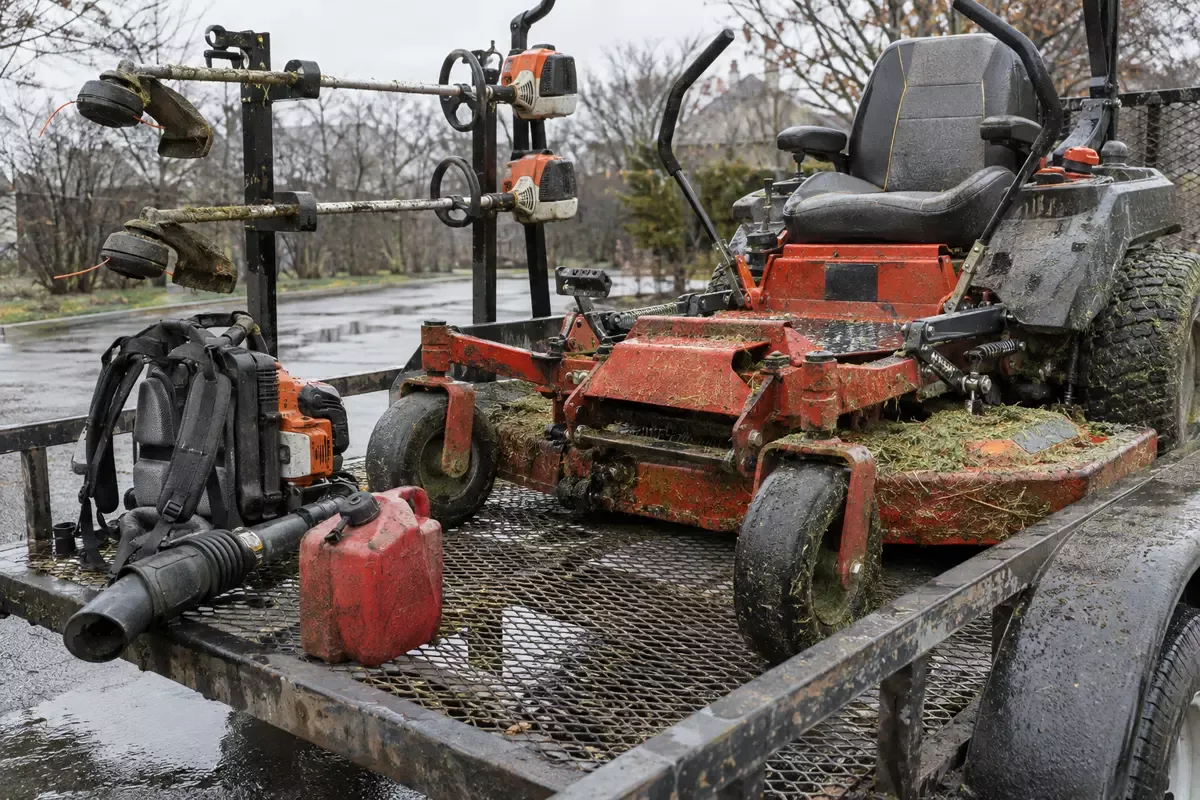
List the startup items with the price you were actually quoted, not a figure from a template.
| Startup item | Why the plan needs it | Where the number comes from |
|---|---|---|
| Truck | Hauls the crew, trailer and debris | Your loan offer or the cash price of the truck you found |
| Utility trailer | Carries mowers and materials | Dealer quote |
| Mowers sized to your lots | A deck that will not fit through gates is dead money | Dealer quote for the deck widths your map calls for |
| Trimmers, blower, edger, hand tools | Every stop needs them | Store prices, plus a spare trimmer |
| Insurance | General liability, commercial auto, workers' comp once you hire | Written quotes from two agents |
| Business registration and license | Rules vary by state and city | Your state and city websites |
| Marketing to start | Door hangers, cards, a simple site | Printer quote |
Licensing for landscaping and pesticide application differs by state, and some states license landscape contractors for install work above a dollar amount. Check your state board before you put installs in the plan.
Marketing: how the first 45 accounts find you
Dense routes are the cheapest marketing you have. Every time you win a lawn, put door hangers on the houses on either side and across the street that same day. A second lawn two doors down adds no drive time.
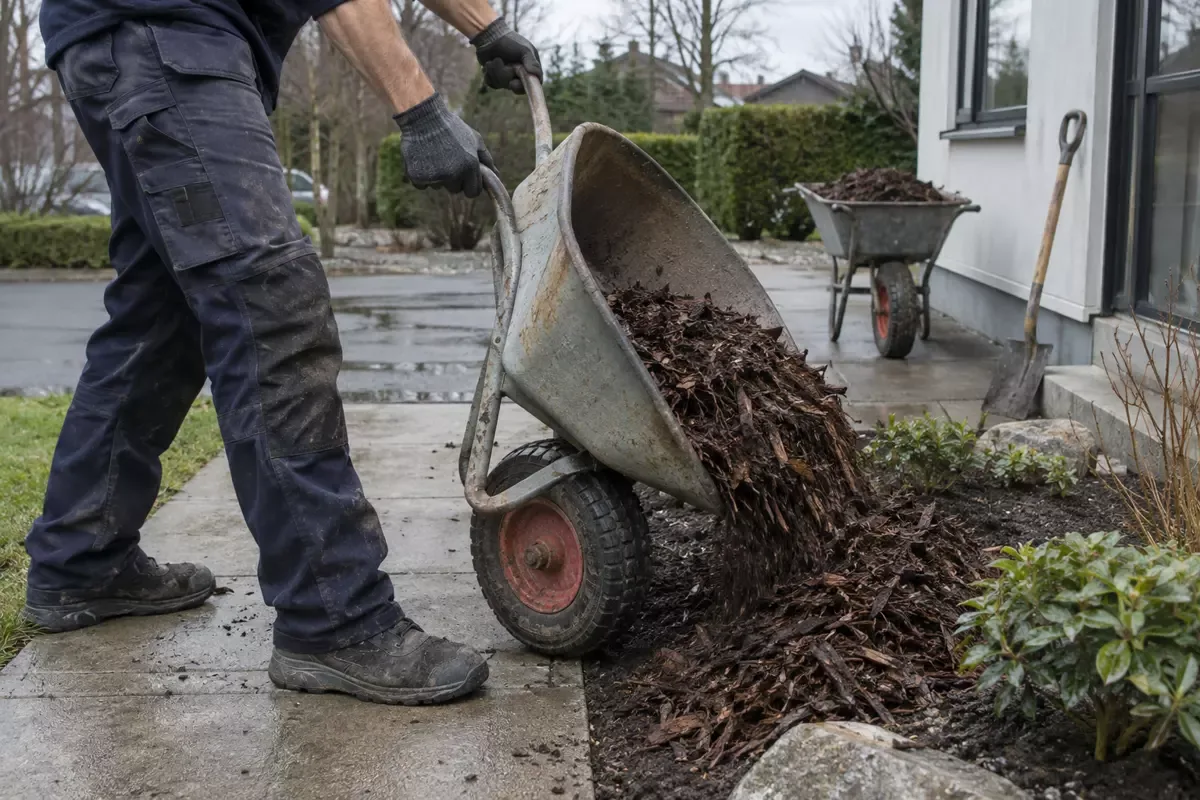
In the plan, write the channels in the order you will use them: people you know, local Facebook and Nextdoor groups, a verified Google Business Profile with reviews, door hangers around every client, then paid lead sites once your price and reviews can carry a lead. If you text clients for reviews or reminders, get their consent first; the TCPA covers business texts.
Put a target next to each channel, like "10 accounts from door hangers by June". A number you can miss is more useful than a list of ideas.
Team: when to hire the first helper
A solo landscaper caps out on hours. The plan should say when you hire and what that person costs, including payroll taxes and insurance, not just the wage. In the example, the helper costs $31,008 a year and lets the crew run 45 weekly stops plus installs. Work out the crew rate first with our labor cost calculator, so every quote after the hire covers two people.
How to write it in one weekend
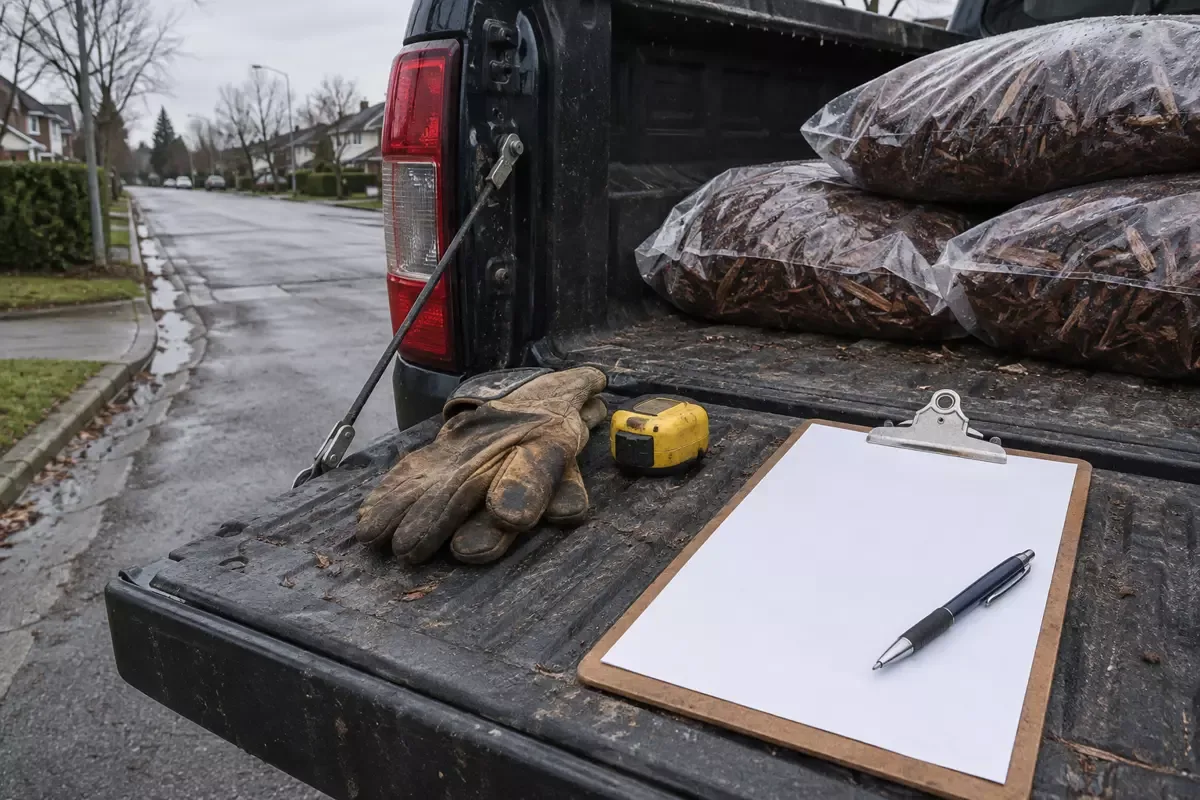
How to write a landscaping business plan
- Pick your services and price each one
List mowing, cleanups, mulch and installs, and work out a price for each from time, crew rate and materials.
- Draw your service area
Name the neighborhoods, the typical lot size and how many accounts fit in a day's route.
- List startup costs from real quotes
Truck, trailer, mowers, tools, insurance, registration and first marketing, each with a quote.
- Project revenue month by month
Weekly accounts times price times weeks, plus cleanups and installs in the months they happen.
- Subtract costs and find the winter gap
Helper wages, overhead and materials, then add up the months where costs beat revenue.
- Set the winter fund and your owner pay
Divide the gap by your busy months and save that much every month. What is left is your pay.
- Write the summary last
One page: what you do, where, for whom, the revenue goal and the money you need.
Mistakes that sink landscaping plans
| Mistake | What it costs |
|---|---|
| Averaging revenue over 12 months | You run out of cash in January with a "profitable" plan |
| Pricing below the crew's real cost | Every extra lawn makes you poorer |
| Buying equipment before you have the accounts | A truck note with nothing to cut |
| Leaving disposal and dump runs off cleanup quotes | $30 or more per job, done for free |
| No written contract for the season | Clients pause in July and you have no say |
| Forgetting self-employment tax | A spring tax bill paid from the winter fund |
Keep the plan alive once the season starts
A plan written in February is only useful if June's numbers go back into it. Keep a spreadsheet with your accounts, prices and monthly totals, and compare them with the projection every month. Use a markup and margin calculator to check that mulch and plant prices still cover what you pay.
The spreadsheet hits a wall around 20 or 30 accounts. You re-type the same mowing and mulch prices into every written quote at night, lose track of who is weekly and who is every other week, and invoices for cleanups sit unsent while you mow. Driveway Desk keeps your price book, so a quote for the neighbor is a few taps from their driveway. Weekly visits go on the schedule with reminders, invoices go out in one tap and get paid into your own Stripe or Square account, and one flat price covers the whole crew with no contract. If you are weighing the bigger apps, here is how Jobber and Housecall Pro compare for a small crew.
Price it once, then start your first quote from the driveway next time.
The plan is the winter, written down
A good landscaping business plan is short. Seven sections, one page each, and a monthly projection that shows the months with no grass. Price every service from time, list startup costs from real quotes, and save enough in the busy months to carry the truck, the insurance and your own pay through the winter. Then check the plan against your real numbers every month. Start with the crew rate that every price in the plan depends on.
Put the method to work
Labor cost calculatorDivide paid-hour costs by the billable-hours ratio, then allow for your target margin to find a selling rate.
Frequently asked questions
Write seven short sections: executive summary, services and pricing, market and customers, operations and equipment, marketing, team and financials. Price every service from time, list startup costs from real quotes and project revenue month by month. Write the one-page summary last, once the numbers are done.
For a landscaping company: an executive summary, services and pricing, market and customers, operations and equipment, marketing, team, and financials. The SBA lists more sections for a traditional plan used for loans, but these seven cover what a small crew needs to decide and to show a lender.
It depends on your prices, route density and winter months. In the illustrative two-person example above, $112,137 of revenue leaves $56,629 for the owner before tax. After paying the owner $26 an hour for 1,600 hours, about $15,000 is real profit, roughly 13% of revenue.
The owner takes what is left after helper wages, overhead and materials, and that share also pays for their own hours on the mower. In the example plan, that is $56,629 a year before income and self-employment tax. Your number moves most with your price per visit and how many stops fit in a day.
A truck, a utility trailer, mowers sized to the lots on your route, string trimmers, a blower, an edger and hand tools like shovels, rakes and a wheelbarrow. Add insurance before the first job. Buy for the lawns you will actually cut, and price each item from a real quote in your plan.
It can draft the wording of each section quickly. It cannot know your prices, your route, your insurance quotes or how many accounts you can win, and those numbers are the plan. Write the numbers yourself from real quotes, then let any tool help with the wording.
Put the method to work
Labor cost calculatorDivide paid-hour costs by the billable-hours ratio, then allow for your target margin to find a selling rate.
Your prices, remembered.
Build your first quote on your phone in about two minutes, send it, and get paid into your own account.
Start your first quoteShare article
About the author
Field notes team
We write practical guides for home service crews of one to five. Our editorial standard is to show the calculation, state its assumptions, cite primary sources for factual claims and date competitor comparisons. We distinguish worked examples from market prices and correct errors when they are found. We do not claim trade licenses or credentials on behalf of the team.
More articles

Running a small crew · 11 min
Basic House Cleaning Checklist: 12 Tasks, Every Visit
A basic house cleaning checklist of 12 tasks you finish on every visit: kitchen, bathrooms, dusting, beds and floors, in the right order, with real timings for a 3 bed, 2 bath house and how to price it.

Running a small crew · 13 min
What Do I Need to Start a Mobile Detailing Business? Full Checklist
The mobile detailing startup checklist: paperwork and insurance, the wash and interior kit for the services you sell first, how many towels to stock, and the quote, work order and payment setup.

Running a small crew · 13 min
Roofing Company Business Plan: 7 Parts + Cash Flow Example
A roofing company business plan in seven short sections, with a worked example: one reroof priced line by line, revenue by month, and how much cash a busy June ties up before homeowners pay.

Running a small crew · 11 min
How to Get Clients as a Realtor: 5 Channels That Work
How to get clients as a realtor: start with your sphere and past clients, build referral partners among the trade pros already inside homes, then add open houses and one farm area. Includes a 90-day plan and the commission math.

Running a small crew · 14 min
How to Get Bookkeeping Clients: 6 Ways That Actually Work
How to get bookkeeping clients: start with people you know and local tax preparers, sell a fixed-price cleanup first, then pick one niche, such as trade contractors, and become the bookkeeper its owners refer.

Running a small crew · 13 min
How to Start a Mobile Detailing Business: Water, Kit, Prices
Start a mobile detailing business in order: pick your first customers, sort licenses and insurance, solve water before buying a polisher, price by your real hours plus the drive, and book the maintenance wash.