House Cleaning Business Plan: 7 Parts and the One Number That Matters
Driveway Desk team 15 November 2026 14 min read
Your next job
Less time at the desk.
Build your price book, schedule the next visit and turn completed work into an invoice.
Start your first quoteIn this article
A house cleaning business plan covers seven things: a one-paragraph summary, the cleans you sell, who you clean for and where, your prices, how you get clients, how the work runs, and the numbers. For a one-person business that pays for itself, one or two pages is enough. Write the long version only if a bank or lender asks for it.
Short answer
Write seven short parts: summary, services, customers and area, prices, getting clients, operations, numbers. Then work out the one figure the plan turns on: how many recurring clients cover your costs and your pay. In our illustrative example it is 12 every-two-weeks clients.
What goes in a house cleaning business plan?
A house cleaning business plan answers seven questions, one part each. The Small Business Administration describes the same core parts in its guide to writing a business plan: what you do, who buys it, how you reach them, how you run it and how the money works.
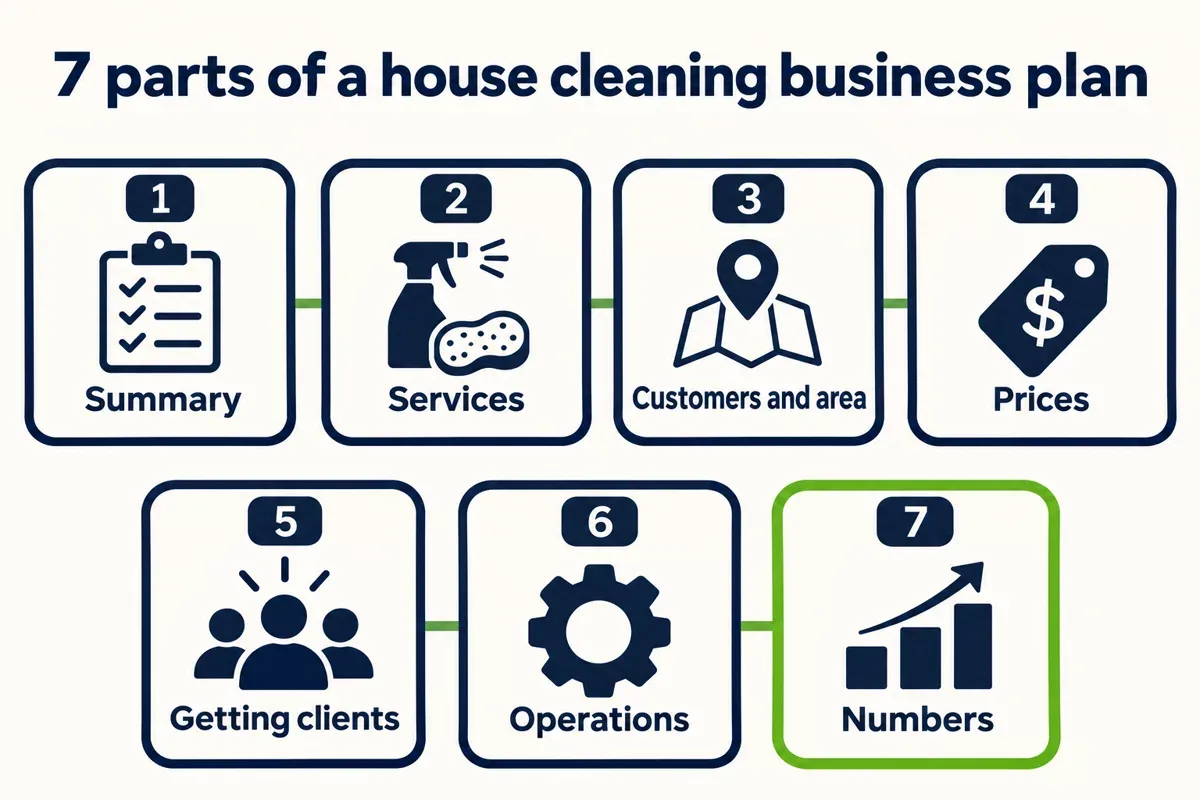
Here is what each part needs to say for a house cleaning business, and how long it should be.
| Part | What to write | Length for a solo cleaner |
|---|---|---|
| 1. Summary | What you clean, where, for whom, and your goal for year one | One paragraph |
| 2. Services | Standard, deep, move-out and any add-ons, with what each includes | A short list |
| 3. Customers and area | The homes you want (size, recurring or one-time) and the ZIP codes you cover | Three or four lines |
| 4. Prices | Your price per clean by home size, your minimum, and your recurring price | One table |
| 5. Getting clients | The three channels you will use first and what each costs | A short list |
| 6. Operations | Insurance, registration, supplies, schedule, how you get paid | A checklist |
| 7. Numbers | Startup costs, monthly costs, and how many recurring clients you need | Two small tables |
The first six parts are quick. The seventh is the one that decides whether the business works, so most of this guide is about it.
Which plan do you need: one page or the full version?
Your situation decides how long the plan should be. A plan nobody reads is wasted nights.
| Your situation | Plan to write | Why |
|---|---|---|
| Solo, self-funded, cleaning houses next month | One page | You are the only reader. You need the numbers, not the prose |
| Solo, borrowing for a car or equipment | One page plus a cash flow table | A lender wants to see the payments fit inside your revenue |
| Applying for a bank or SBA loan | Full plan, 10 to 20 pages | Lenders expect every section written out with projections |
| Growing to a crew of two to five | One page per year, updated | Labor becomes your biggest cost and the math changes |
| Adding office or building work | A separate section | Commercial cleaning is a different sale, covered in how to get commercial cleaning contracts |
Most people searching for a cleaning company business plan are in the first row. Write the one page, start cleaning, and expand it when someone asks for more.
The one number your cleaning business plan turns on
A house cleaning business plan comes down to one number: how many recurring clients it takes to cover your monthly costs and your pay. The summary, the market section and the marketing plan all exist to get you to that number and past it.
Start with what a month of running the business costs you. These are illustrative inputs, not market prices. Replace each one with your own quotes.
| Monthly cost | Illustrative input |
|---|---|
| Liability insurance | $80 |
| Car share: gas and wear for work miles | $250 |
| Supplies: chemicals, cloths, bags, mop heads | $150 |
| Phone and software | $60 |
| Marketing: door hangers, cards, ads | $100 |
| Business costs | $640 |
| Your pay before tax | $4,000 |
| What the business must bring in | $4,640 |
Now the revenue side. Using the starting input of our house cleaning price calculator, a standard clean of a 2,000 sq ft home is $180. A client you clean every two weeks books 26 cleans a year, so they bring in $4,680 a year, or $390 a month.
$4,640 divided by $390 is 11.9. Round up: 12 every-two-weeks clients cover the costs and the pay in this example.
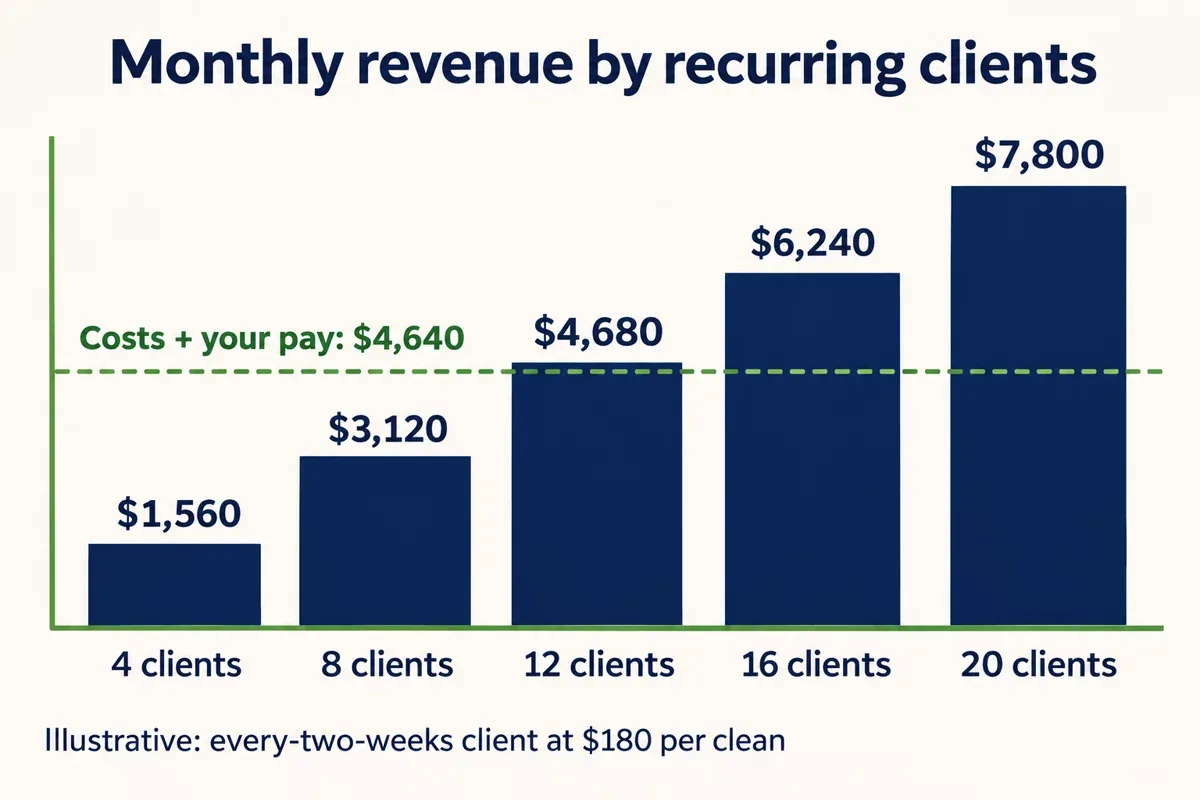
That is about six cleans a week, so the business covers itself well before your week is full. Every recurring client past 12 is profit and growth. This is also why one-time cleans make a weak plan: a single deep clean is a day's revenue, a recurring client is a year of it. The guide to getting cleaning business clients shows how to turn the first one into the second. Plan seasonal work the same way: spring cleaning jobs fill March to May, and each one is a chance to book a recurring client.
How to write a house cleaning business plan in 7 steps
Write it in this order. The numbers come last because they depend on everything above them.
How to write a house cleaning business plan
- Write the summary last, in one paragraph
What you clean, where, for whom, and one goal for the first year, such as "12 recurring clients by month six". Write it after the other parts so it matches them.
- List your services and what each includes
Standard, deep and move-out cleans, plus add-ons like inside the oven or inside the fridge. Write down what each clean includes, room by room, so your quotes match your plan.
- Name your customers and your area
The type of home you want (for example, two to four bedrooms, recurring) and the ZIP codes you will cover. A tight area keeps drive time down.
- Set your prices
A price per clean by home size, a first-visit price, a recurring price and a minimum visit. Put it in one table.
- Pick three ways to get clients
People you know, local groups and a Google Business Profile are free. Write down which three you will start with and what each costs in time or money.
- Write the operations checklist
Registration, insurance, supplies, how you book, how you get paid and what you do if a client cancels.
- Run the numbers
Startup costs, monthly costs, your pay, and the number of recurring clients that covers all of it.
The sections below fill in steps 4, 6 and 7, the ones most plans get wrong.
Prices: the part of the plan clients see
Your plan needs a price for every clean you sell, by home size. Here are the starting inputs of our calculator: $0.09 per sq ft for a standard clean, deep cleans at twice that, move-outs at three times. They are a starting point for your own numbers, not a market survey.
| Home size | Standard | Deep | Move-out |
|---|---|---|---|
| 1,000 sq ft | $90 | $180 | $270 |
| 1,500 sq ft | $135 | $270 | $405 |
| 2,000 sq ft | $180 | $360 | $540 |
| 2,500 sq ft | $225 | $450 | $675 |
Try your numbers
Example estimate of your job price. Before tax.
Your example price
Three rules make a price list work in a real week:
- Price the first visit as a deep clean. A home that has not been cleaned professionally takes longer. Quote the deep price first, then the recurring standard price. Put the tasks on the quote too: this deep cleaning house checklist is a ready-made scope.
- Set a minimum visit. A small home still costs you the drive and the setup.
- Check what you keep per hour. A $180 clean that takes three hours plus 40 minutes of driving pays less per hour than it looks. Run your real cost through what an hour of your time really costs before you print the list.
Send every price as a written quote with the rooms and tasks listed, so the client knows what is included and you can point to it when they ask for more.
Price it once, then start your first quote from the driveway next time.
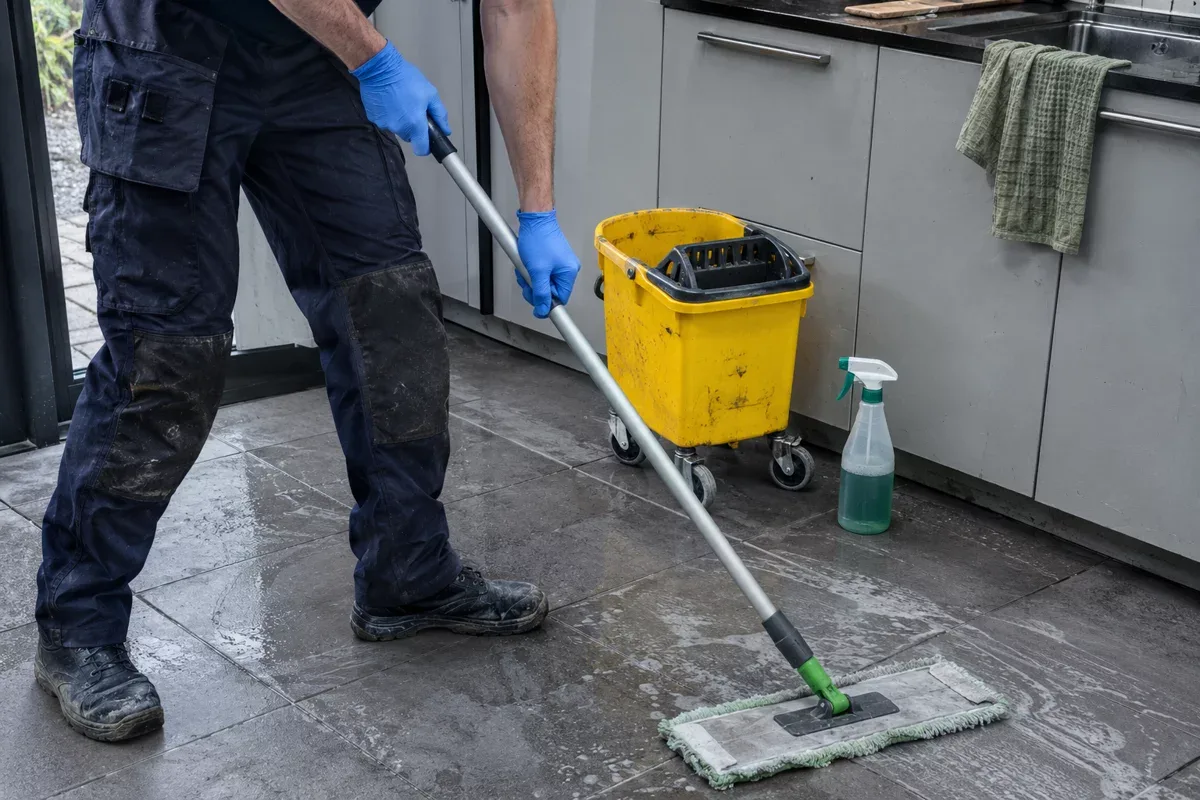
Startup costs and operations
A house cleaning business is one of the cheapest service businesses to start: you need a car, supplies and insurance, not a shop or a truck full of tools. Here is an illustrative first-month budget. Get real quotes for your area before you put these in your plan.
| Startup item | Illustrative budget |
|---|---|
| Vacuum (upright or backpack) | $300 |
| Starter supplies: chemicals, cloths, mops, caddy | $200 |
| First month of liability insurance | $80 |
| Door hangers and business cards | $100 |
| Phone plan and software, first month | $60 |
| State and local registration | Varies by state |
| Total before registration fees | $740 |
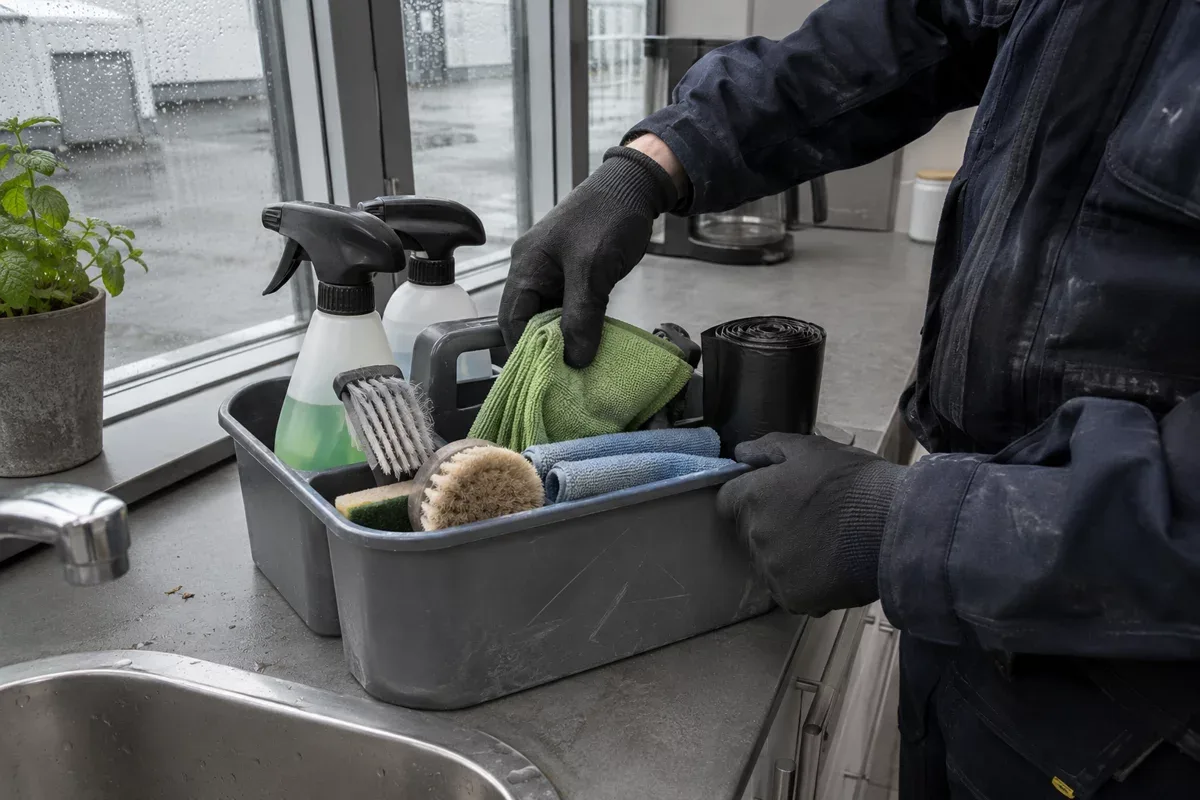
Your operations checklist covers the rest:
- Registration. Rules for business names, LLCs and local licenses vary by state and city. Check your state and city with the SBA's licenses and permits guide before you take your first paid job.
- Insurance. General liability covers damage in a client's home. Many clients ask for proof before you start. Get quotes from two or three insurers.
- Supplies. One caddy per cleaner, restocked weekly. Track what you use per clean so you know your real cost.
- Booking and reminders. A fixed day per client every two weeks keeps your route tight. Send a reminder the day before, and get the client's consent before you text them.
- Getting paid. Card or bank transfer on the day of the clean. Decide your cancellation fee and write it in the plan.
The cleaning business startup checklist walks through the registration and insurance steps in order.
Goals: what to aim for in the first 12 months
A plan needs goals you can check. Make each one specific, measurable and dated: "12 recurring clients by month six" beats "grow the business". Here is a simple first-year path for a solo cleaner, based on the example numbers above.
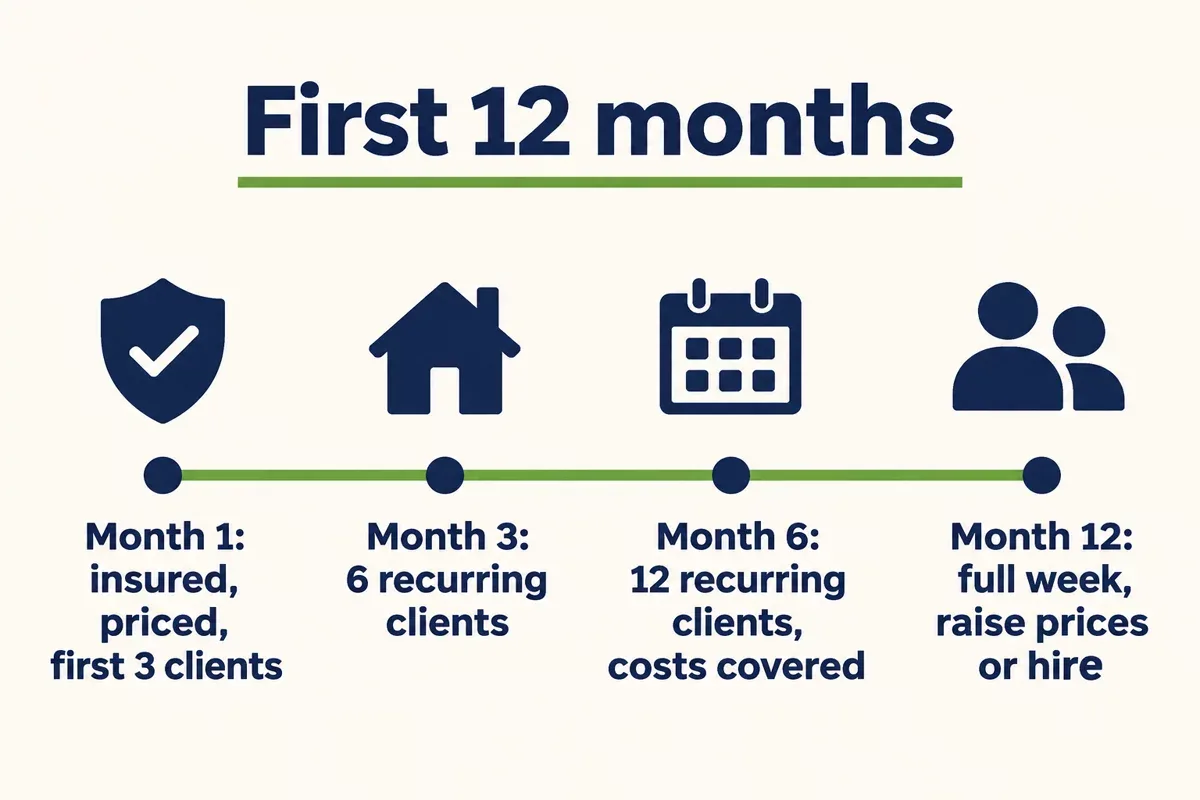
| Month | Goal | How you check it |
|---|---|---|
| 1 | Registered, insured, prices set, first 3 clients | Insurance certificate, price table, three booked cleans |
| 3 | 6 recurring clients | Six clients on a fixed every-two-weeks or weekly slot |
| 6 | 12 recurring clients, costs and pay covered | Monthly revenue at or above $4,640 |
| 12 | A full week | Raise prices for new clients or hire a helper |
Hit month six and the plan has done its job. From there, the decision is whether to raise prices, take on deep and move-out work, or add a second cleaner. If you add carpets later, carpet cleaning as an add-on has its own startup math.
Example: a one-page house cleaning business plan
Here is the whole plan for a made-up solo cleaner, on one page. Copy the shape and put your own numbers in.
| Part | Example |
|---|---|
| Summary | Solo residential cleaner covering three ZIP codes. Recurring standard cleans for two- to four-bedroom homes. Goal: 12 every-two-weeks clients by month six |
| Services | Standard clean, deep clean, move-out clean. Add-ons: inside oven, inside fridge |
| Customers and area | Families and working couples in homes of 1,500 to 2,500 sq ft, within 15 minutes of home |
| Prices | $0.09 per sq ft standard, deep at 2x, move-out at 3x, first visit priced as a deep clean, minimum visit set |
| Getting clients | People I know, two local Facebook groups, Google Business Profile, door hangers around every client |
| Operations | Registered with the state, liability insured, booking by fixed day, paid by card on the day |
| Numbers | $740 to start, $640 a month to run, $4,000 a month pay, 12 recurring clients to cover it |
That fits on a page and answers every question a lender, a partner or you at 10 p.m. will ask.
Keep the plan in your phone, not a drawer
A spreadsheet and a notebook hold the plan fine. The wall comes when you run it: you re-type the same prices into every quote at night, lose track of who is every two weeks and who is monthly, and can't tell in March whether you are on track for 12 recurring clients. Driveway Desk keeps your price book, so a quote for a new home is a few taps from their driveway. Recurring cleans go on the schedule with reminders, invoices get paid into your own Stripe or Square account, and your customer list shows how many recurring clients you actually have. If you are weighing the bigger apps, here is what Jobber costs for a small crew.
Price it once, then start your first quote from the driveway next time.
Mistakes that sink a cleaning business plan
- Writing 20 pages nobody asked for. If no lender is reading it, the prose is wasted nights. Write the numbers.
- Planning around one-time cleans. A plan that needs 50 deep cleans a month is a plan for a stressful year. Plan around recurring clients.
- Leaving out your own pay. A plan where the business breaks even but pays you nothing is a hobby.
- Covering too wide an area. Every client 25 minutes out adds unpaid driving to every visit.
- Using someone else's prices. Prices in a sample plan are for their area and costs. Work out your own.
- Never opening it again. Check the client count against the month-six goal every month.
Write one page, then count clients
A house cleaning business plan is seven short parts and one number. Write the summary, services, area, prices, client channels and operations in a page. Then work out how many recurring clients cover your costs and your pay, and set a date to reach it. In our example that is 12 every-two-weeks clients by month six. Check the count every month and expand the plan only when someone asks for more. Price your homes by size and clean type with the calculator below.
Put the method to work
House cleaning price calculatorPrice a house clean from floor area, room adjustments, cleaning depth, and the discount you choose.
Frequently asked questions
It can be, because startup costs are low and recurring clients pay all year. In the illustrative example above, 12 every-two-weeks clients at $180 a clean cover $640 a month of costs and $4,000 a month of pay. Whether yours is profitable depends on your prices, your costs and how many recurring clients you keep.
At $180 every two weeks, one client brings in $4,680 a year, so $100,000 of revenue takes about 22 recurring clients. Weekly clients at the same price bring $9,360 a year each, so about 11. That is revenue, not take-home pay: costs and taxes come out of it.
Price by home size and clean type, then check what you keep per hour. Our calculator starts at $0.09 per sq ft for a standard clean, twice that for a deep clean and three times for a move-out. Quote the first visit as a deep clean and set a minimum visit price.
A good plan for a solo cleaner fits on one page: a summary, services, customers and area, prices, how you get clients, operations and the numbers. The example table above is one. It is good because it ends in a number you can check: recurring clients needed and the date to reach them.
Goals that are specific, measurable and dated. For example: "12 recurring clients by month six", "every first visit quoted as a deep clean starting this month" or "five Google reviews by month three". Each one can be checked with a yes or no on the date.
A small share of the home, the kitchen, bathrooms and floors, decides most of how clean it feels to the client. In a business plan it also applies to clients: a small share, usually the recurring ones, brings in most of the revenue. Plan around those clients.
Put the method to work
Labor cost calculatorDivide paid-hour costs by the billable-hours ratio, then allow for your target margin to find a selling rate.
Your prices, remembered.
Build your first quote on your phone in about two minutes, send it, and get paid into your own account.
Start your first quoteShare article
About the author
Field notes team
We write practical guides for home service crews of one to five. Our editorial standard is to show the calculation, state its assumptions, cite primary sources for factual claims and date competitor comparisons. We distinguish worked examples from market prices and correct errors when they are found. We do not claim trade licenses or credentials on behalf of the team.
More articles

Running a small crew · 11 min
Basic House Cleaning Checklist: 12 Tasks, Every Visit
A basic house cleaning checklist of 12 tasks you finish on every visit: kitchen, bathrooms, dusting, beds and floors, in the right order, with real timings for a 3 bed, 2 bath house and how to price it.

Running a small crew · 12 min
House Cleaning Checklist Printable: Free Room-by-Room Sheet
A free printable house cleaning checklist, room by room, with daily, weekly and monthly columns. Plus the supplies you need and how a cleaning business turns the same sheet into a recurring quote.

Running a small crew · 15 min
Deep Cleaning House Checklist: Room by Room, With Times
A room-by-room deep cleaning house checklist: what a deep clean adds to a standard one, the order of work, a one-day plan, how long it takes for a 2,000 sq ft home, and how cleaners can turn the list into a quote.

Running a small crew · 13 min
Spring House Cleaning Checklist: 7 Areas, Plus How to Price It
A spring house cleaning checklist room by room: windows and tracks, fans, baseboards, behind appliances, inside the fridge and oven, entryway salt. Plus how a cleaning business should quote it and turn it into a recurring client.

Running a small crew · 13 min
How to Get Cleaning Business Clients: 7 Free and Paid Ways
How to get cleaning business clients: start with the people you know and local groups, verify a Google Business Profile, hang door hangers around every client and ask for referrals. Count recurring clients, not leads.

Running a small crew · 12 min
How to Get Commercial Cleaning Contracts: 7 Steps and the Bid Math
How to get commercial cleaning contracts: start with small local offices, get insured and bonded, win the walkthrough, price the visit from your own timed hours and send a one-page proposal with a 30-day trial the next day.