Roofing Company Business Plan: 7 Parts + Cash Flow Example
Driveway Desk team 21 November 2026 13 min read
Your next job
Less time at the desk.
Build your price book, schedule the next visit and turn completed work into an invoice.
Start your first quoteIn this article
A roofing company business plan covers seven things: a one-page summary, your services and prices, the customers and area you serve, how jobs and crews run, how you get leads, who does the work, and the numbers. For a roofer, the numbers have to include cash flow job by job, because you pay for shingles, a dumpster and a crew before the homeowner pays you the balance.
Short answer
Write one short page per section, price every roof from squares and real costs, project revenue month by month, and work out how much cash your busiest month ties up. In the example below, a small roofing company bills $639,700 a year and still needs about $29,000 of working cash in June.
What goes in a roofing company business plan?
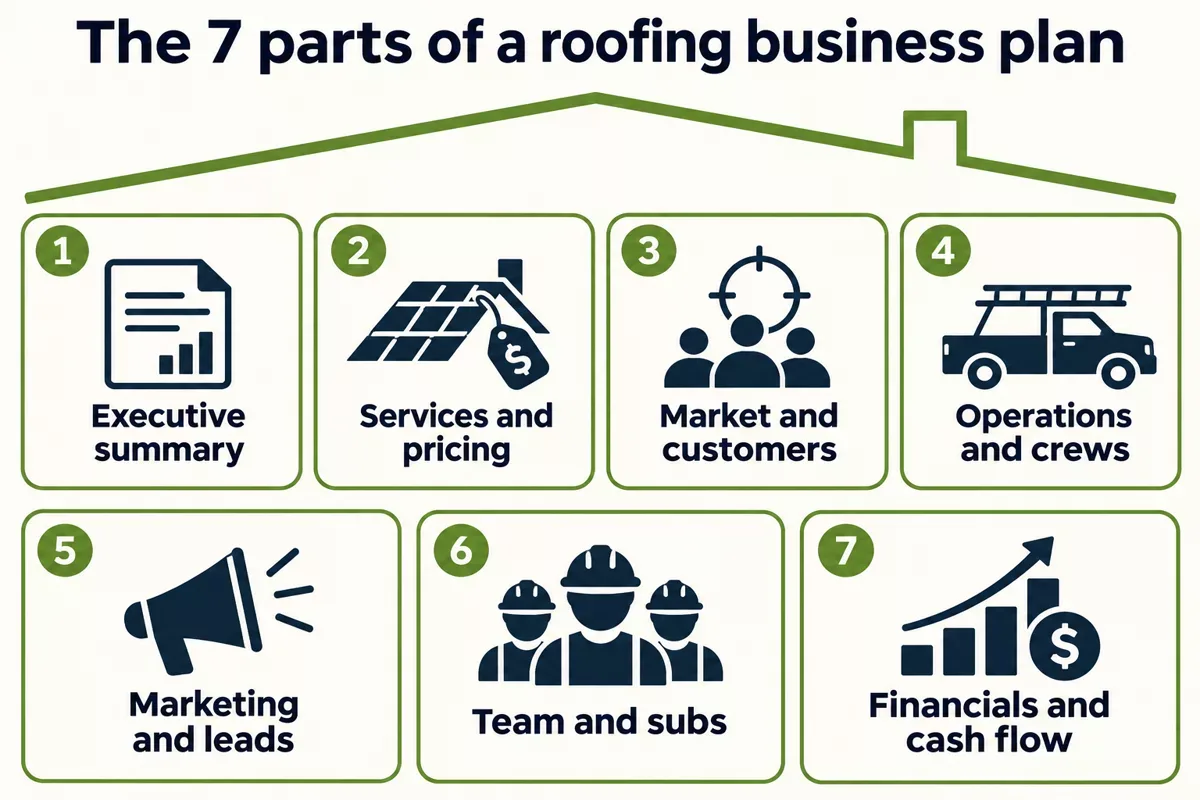
A roofing business plan has seven parts, and each one answers a question a lender, a supplier giving you a credit account or you at 10 pm in February will ask. The SBA describes two formats, a traditional plan or a lean one-page plan, and says to use the sections that fit your business rather than a fixed outline.
| Section | The question it answers | What to write for a roofing company |
|---|---|---|
| 1. Executive summary | What is this business and why will it work? | Area, services, crew setup, first-year revenue goal, money needed |
| 2. Services and pricing | What do you sell and for how much? | Reroofs, repairs, inspections, gutters, how each is priced per square or per job |
| 3. Market and customers | Who pays you and where? | Neighborhoods, roof ages, retail vs insurance work, local competitors |
| 4. Operations and crews | How does a job run? | Measuring, ordering, delivery, tear-off, install, cleanup, final inspection |
| 5. Marketing and leads | How do homeowners find you? | Referrals, yard signs, Google Business Profile, door knocking, lead sites |
| 6. Team and subs | Who does the work? | Owner, helper, install crew on payroll or subbed per square, what each costs |
| 7. Financials and cash flow | Does the math work every month and on every job? | Startup costs, monthly revenue, job costs, overhead, cash tied up per job |
Free templates and sample plans stop at the list. For a roofer, section 7 decides whether the company lasts, and it only works if section 2 prices every roof from real costs.
Which plan fits your situation?
Not every roofer needs a 30-page document. Pick the format by the job the plan has to do.
| Your situation | Plan format | What matters most |
|---|---|---|
| Solo roofer, repairs and a few small reroofs | Lean one-page plan | Price per square, cash per job, insurance cost |
| Owner who sells and subs out installs | Lean plan plus a monthly cash projection | Sub price per square, margin, working cash |
| Mostly storm and insurance work | Lean plan plus a claims timeline | How long checks take, depreciation holdback |
| Asking a bank, the SBA or a supplier for credit | Traditional plan | Startup costs, repayment from cash flow, your experience |
| Adding gutters, siding or windows | One extra section per service | Whether the new line needs new crews or tools |
If you are still working out licensing and whether to start as a general contractor or a roofing-only company, read how to become a general contractor first. Roofing license rules vary by state: Florida licenses roofing contractors at the state level (Florida contractor license steps), while Texas has no state roofing license and leaves it to cities. Check your state and city before the plan promises any start date.
Price every roof from squares and real costs
Roofers price by the square, 100 square feet of roof surface. The services section should show how one typical job is built, line by line. Here is an example reroof: a 25-square asphalt shingle tear-off and replace. Every figure is an illustrative assumption. Replace each one with your supplier's prices and your crew's rate.
| Cost line | How it is built | Example |
|---|---|---|
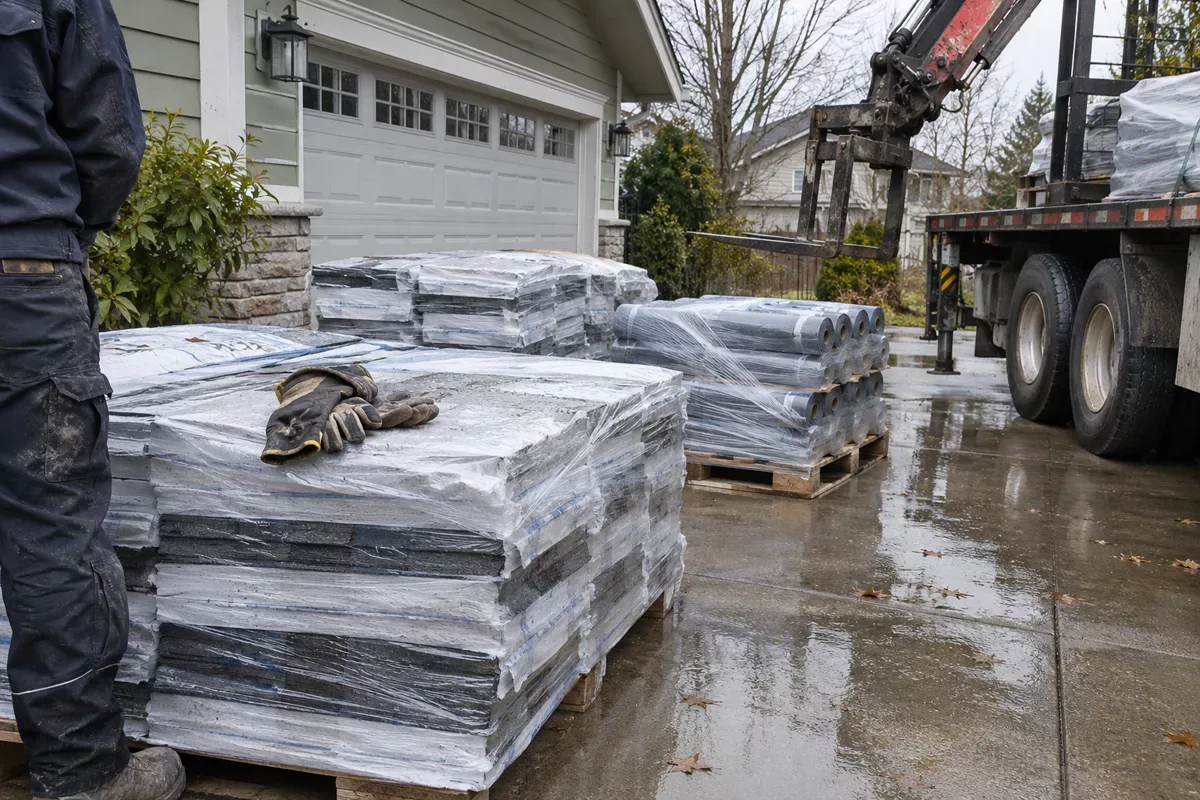
| Materials | Shingles, underlayment, starter, ridge cap, drip edge, nails, 10% waste | $4,200 |
| Install crew | 25 squares x $90 a square, tear-off and install | $2,250 |
| Dumpster and disposal | One roll-off, dump fees included | $550 |
| Permit | Your city's fee | $250 |
| Job cost | $7,250 | |
| Price at 40% gross margin | $7,250 / 0.60, rounded | $12,100 |
| Gross profit | $12,100 - $7,250 | $4,850 |
A 40% margin is not a 40% markup. Adding 40% on top of $7,250 gives $10,150, which is only a 28.6% margin, and that missing $1,950 per roof is your overhead and your pay. Check your own numbers with the calculator below.
Try your numbers
Example estimate of your job price. Before tax.
Your example price
Price it once, then start your first quote from the driveway next time.
Plan for cash per job, not just profit per year
A roofing company is most likely to run out of cash in its busiest month, not its slowest one. Every roof you sell costs you thousands before it pays you, and in June you have several of them open at once. A plan that only shows yearly profit hides this. A plan that walks one job day by day shows it.
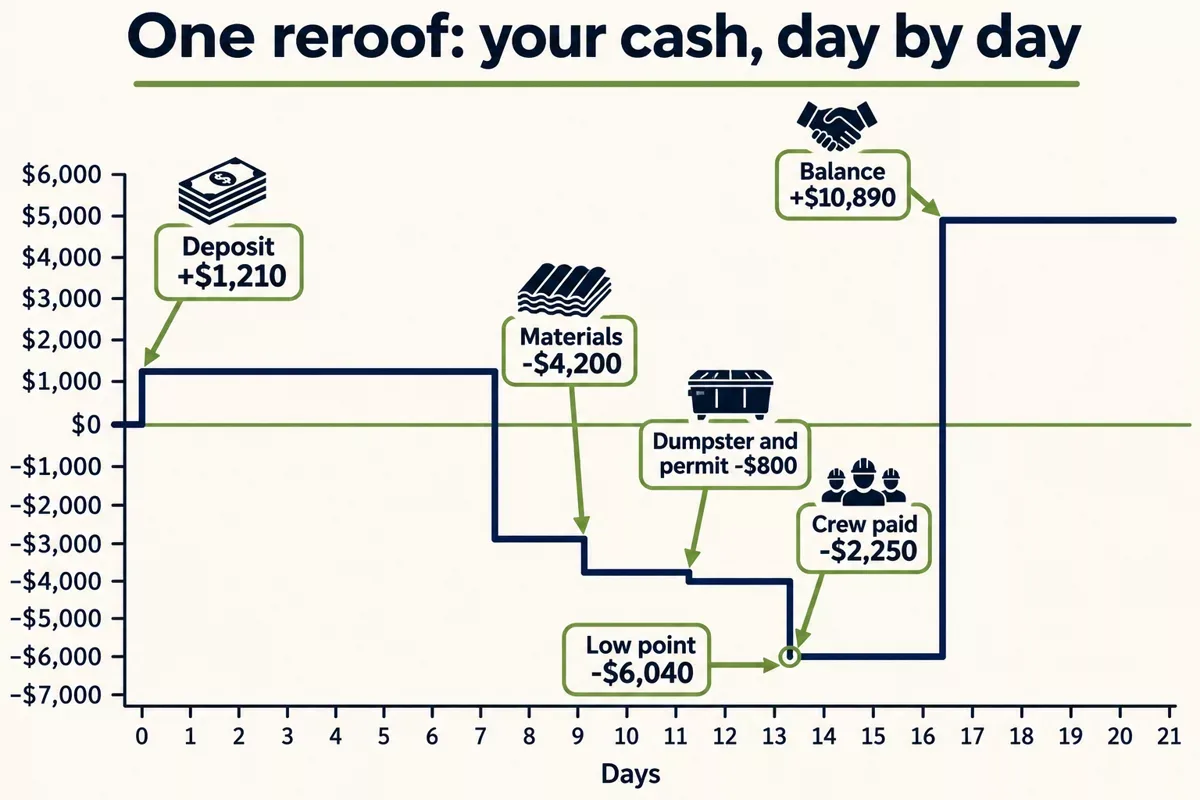
Here is the same $12,100 retail reroof, with a 10% deposit at signing. Some states cap how much deposit a home improvement contractor can take, so check your state's rule before you write a bigger one into the plan.
| Day | What happens | Cash | Running total |
|---|---|---|---|
| 0 | Contract signed, 10% deposit | +$1,210 | $1,210 |
| 7 | Materials delivered and paid | -$4,200 | -$2,990 |
| 9 | Dumpster dropped, permit pulled | -$800 | -$3,790 |
| 13 | Roof done, install crew paid | -$2,250 | -$6,040 |
| 16 | Balance collected | +$10,890 | $4,850 |
Insurance jobs stretch this out. The insurer usually pays the claim in parts, and on many policies the depreciation held back from the first check is only released after you finish and send the completion paperwork. Plan on waiting weeks for that last part, and write down how you will follow it up.
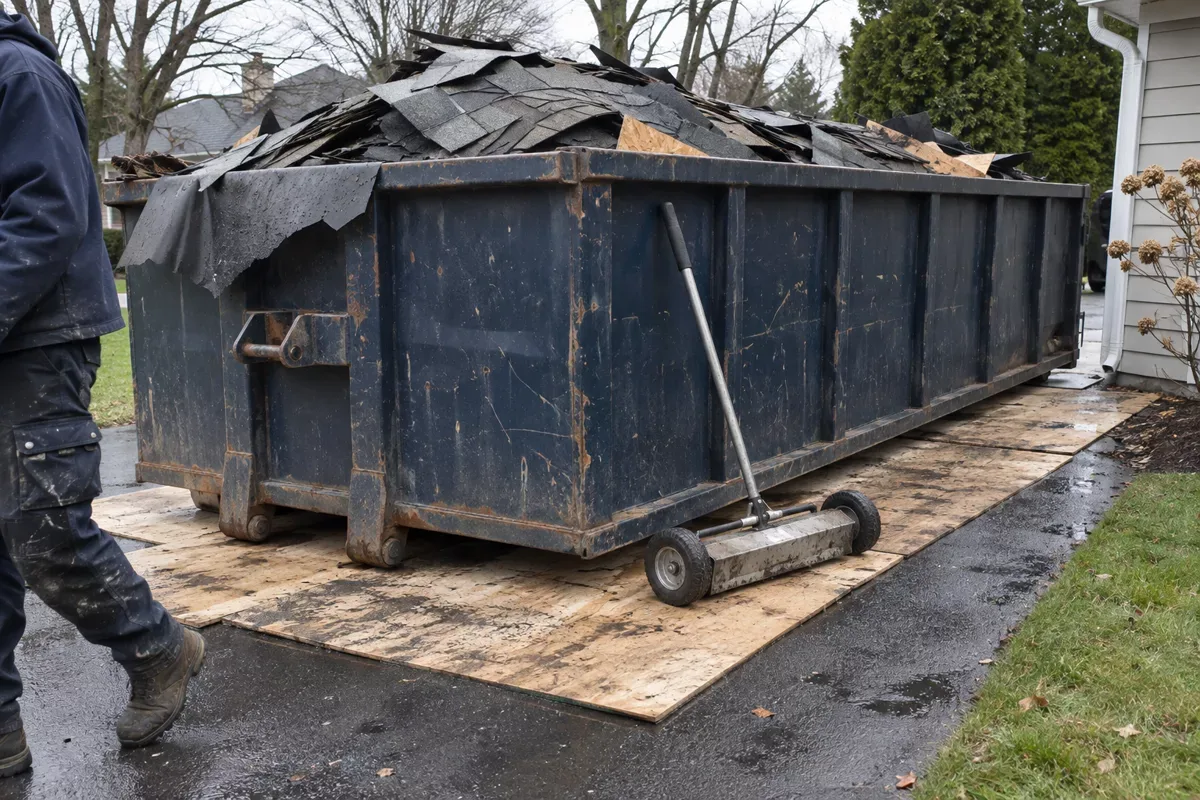
Now add up a busy June for the example company, which sells six reroofs a month in season, half retail and half insurance.
| Cash tied up in a busy month | How it is built | Amount |
|---|---|---|
| Two retail jobs between materials and balance | 2 x $6,040 (one slow payer overlaps the next job) | $12,080 |
| Three insurance jobs waiting on depreciation | 3 x $2,400 held back for about 30 days | $7,200 |
| One month of fixed costs | Helper, overhead and marketing | $9,400 |
| Working cash needed | $28,680 |
So the plan says: have about $29,000 in the bank or on a supplier account before May, and do not spend it on a second truck in April. That line is worth more than any mission statement.
Revenue by month for an example roofing company
The example is an owner who sells, measures and manages every job, one full-time helper for repairs, tear-off support and cleanup, and an install crew subbed at a price per square. Work slows in winter but does not stop.
| Revenue line | How it is built | Year |
|---|---|---|
| Reroofs | 49 jobs x $12,100 (1 a month in Dec to Feb, 3 in Mar and Nov, 5 in Apr and Oct, 6 from May to Sep) | $592,900 |
| Repairs | 72 repairs x $650 average ticket, 6 a month | $46,800 |
| Total | $639,700 |
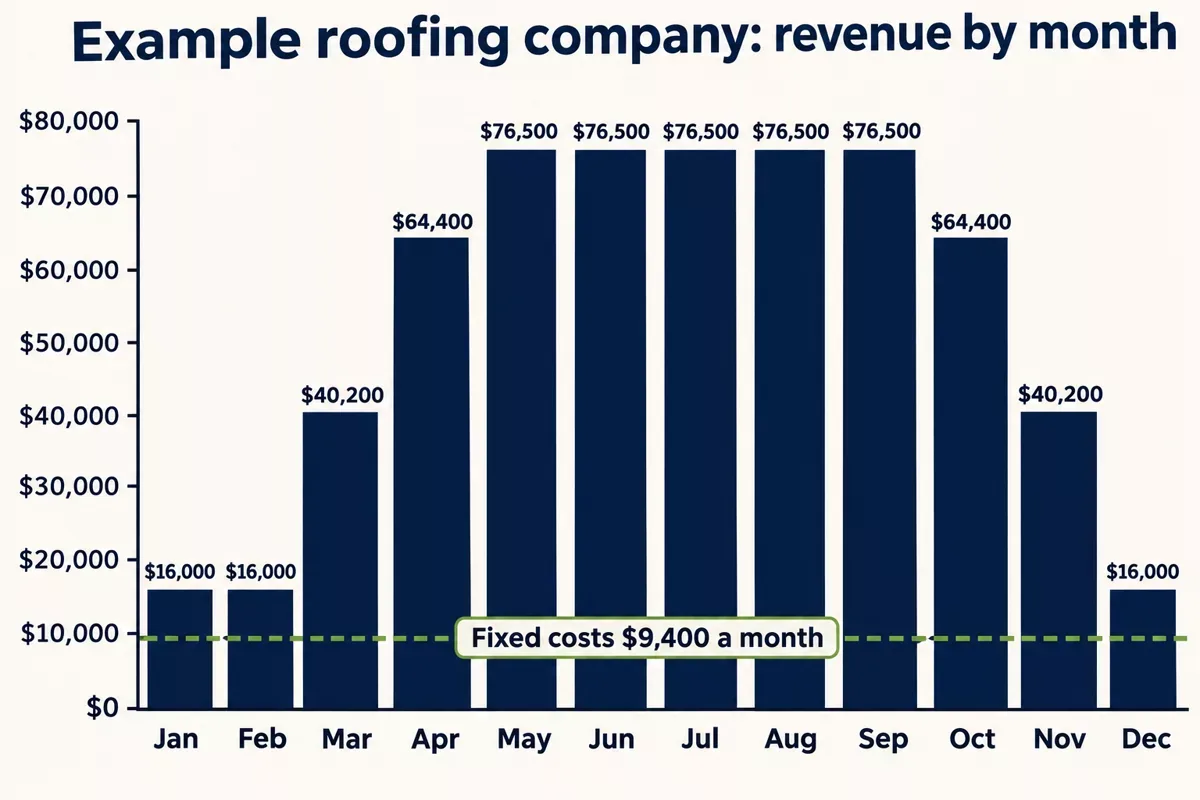
The dashed line is the $9,400 the company spends every month whether roofs sell or not: $4,400 for the helper, $3,500 of overhead and $1,500 of marketing. In January the one reroof and six repairs bring in $16,000, but the reroof's own $7,250 job cost, $720 of repair materials and that $9,400 add up to more. Winter runs a small loss before the owner takes any pay, so the busy months have to carry it.
Where the money goes in a year
| Cost line | How it is built | Year |
|---|---|---|
| Reroof job costs | 49 x $7,250 materials, crew, dumpster and permit | $355,250 |
| Repair materials | 72 x $120 | $8,640 |
| Helper | $22 an hour + 20% for payroll taxes and workers' comp, 2,000 hours | $52,800 |
| Overhead | Truck, dump trailer, ladders, insurance, phone, fuel, software | $42,000 |
| Marketing | Signs, Google Business Profile, door hangers, some paid leads | $18,000 |
| Warranty fund | 1% of reroof revenue for callbacks and leaks | $5,929 |
| Left for the owner, before tax | $639,700 - $482,619 | $157,081 |
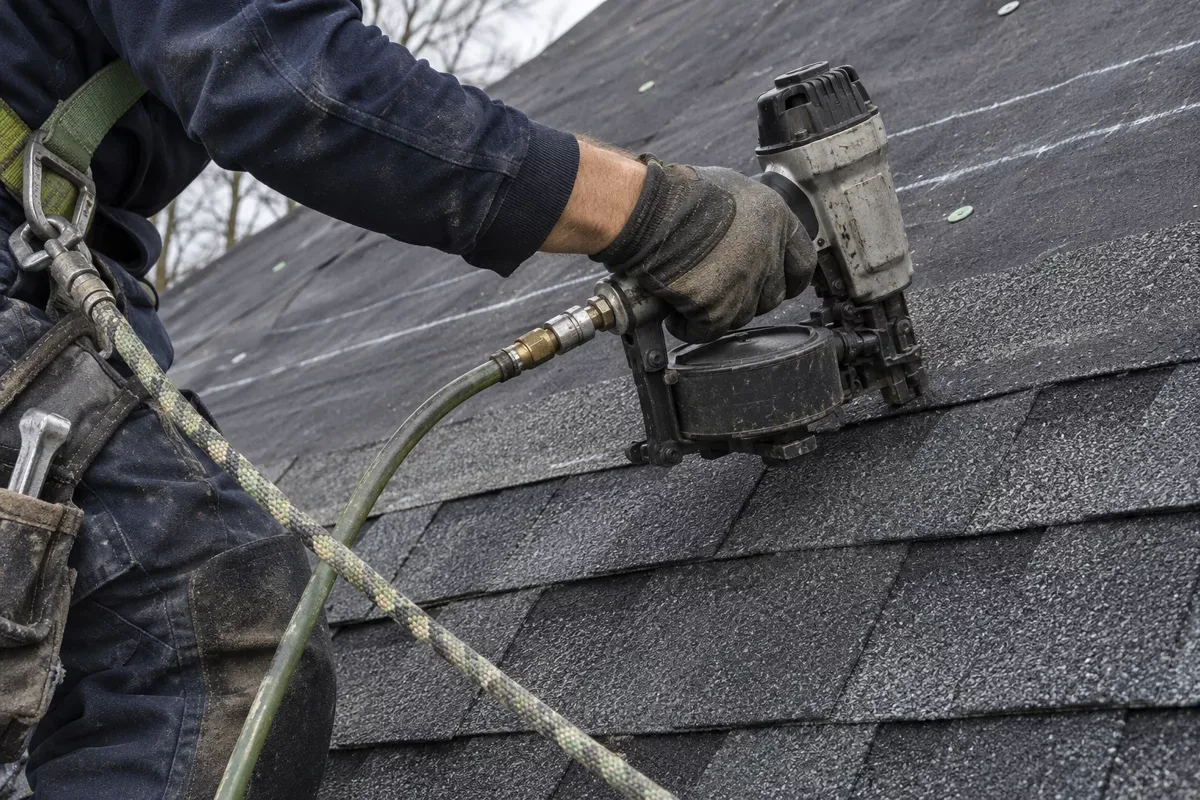
That $157,081 is not profit. It pays for the owner's own hours selling, measuring and running every job. Value 2,400 hours a year at $35 and that is $84,000, which leaves about $73,000 of real profit, roughly 11% of revenue or about $1,500 a roof. Work out what an hour of your time costs the business with our labor cost calculator before you set that rate. Self-employment tax comes out of the owner's share too; the IRS explains how self-employment tax works.
Market, operations and team: the rest of the plan
Market. Name the neighborhoods and the age of their roofs, not "homeowners in the metro area". Subdivisions built 20 to 25 years ago are where asphalt reroofs come from. Write down whether you will chase storm work, which pays in bursts and depends on insurance checks, or retail work, which pays on your schedule.
Operations. Write how a job runs from the first call to the final inspection: measure, quote, sign, order, deliver, tear off, install, clean up with a magnet sweep, collect. Name your supplier and your dump site, and how many jobs a week your crew can actually finish when it rains on Tuesday.
Team and subs. Most small roofing companies start with the owner selling and managing and an install crew paid per square. The plan should say who carries the insurance for that crew, whether it is general liability, workers' comp or both, and what your written agreement with them says about callbacks.
Marketing. Put a target next to each channel, like "15 reroofs from referrals and yard signs by August". If you text homeowners for reviews or appointment reminders, get their consent first; the TCPA covers business texts. More channels, with numbers, are in how to get clients for a service business.
How to write it in one weekend
How to write a roofing company business plan
- Price one typical roof line by line
Materials with waste, crew price per square, dumpster, permit, then a price at your target margin.
- Draw your service area
Name the neighborhoods, the roof ages, and whether you will chase retail or insurance work.
- List startup costs from real quotes
Truck, trailer, ladders, safety gear, insurance, licensing and first marketing, each with a written quote.
- Project revenue month by month
Reroofs per month times your price, plus repairs, with the slow winter months shown honestly.
- Walk one job day by day
Find the low point between paying for materials and collecting the balance, then multiply by your busy month.
- Set your working cash and owner pay
Hold enough for the busiest month, add a warranty fund, and what is left is your pay.
- Write the summary last
One page: what you do, where, for whom, the revenue goal and the money you need.
Mistakes that sink roofing plans
| Mistake | What it costs |
|---|---|
| Confusing markup with margin | $1,950 less per roof than you planned on a $7,250 job |
| Planning yearly profit but not cash per job | A "profitable" June you cannot pay for |
| Treating insurance depreciation as paid on completion | Weeks of payroll floated on money you have not received |
| Leaving disposal and permits off the quote | $800 or more per roof, done for free |
| No written agreement with the install crew | Callbacks and leaks with nobody responsible |
| No warranty fund | A leak repair two years later paid from this month's cash |
| Forgetting self-employment tax | A spring tax bill paid from the working cash |
Keep the plan alive once roofs start selling
A plan written in winter is only useful if June's numbers go back into it. Keep a spreadsheet of every job with its squares, cost, price and the dates you paid and got paid, and compare it with the projection each month. A clear written estimate with line items keeps the price you quoted tied to the costs you planned.
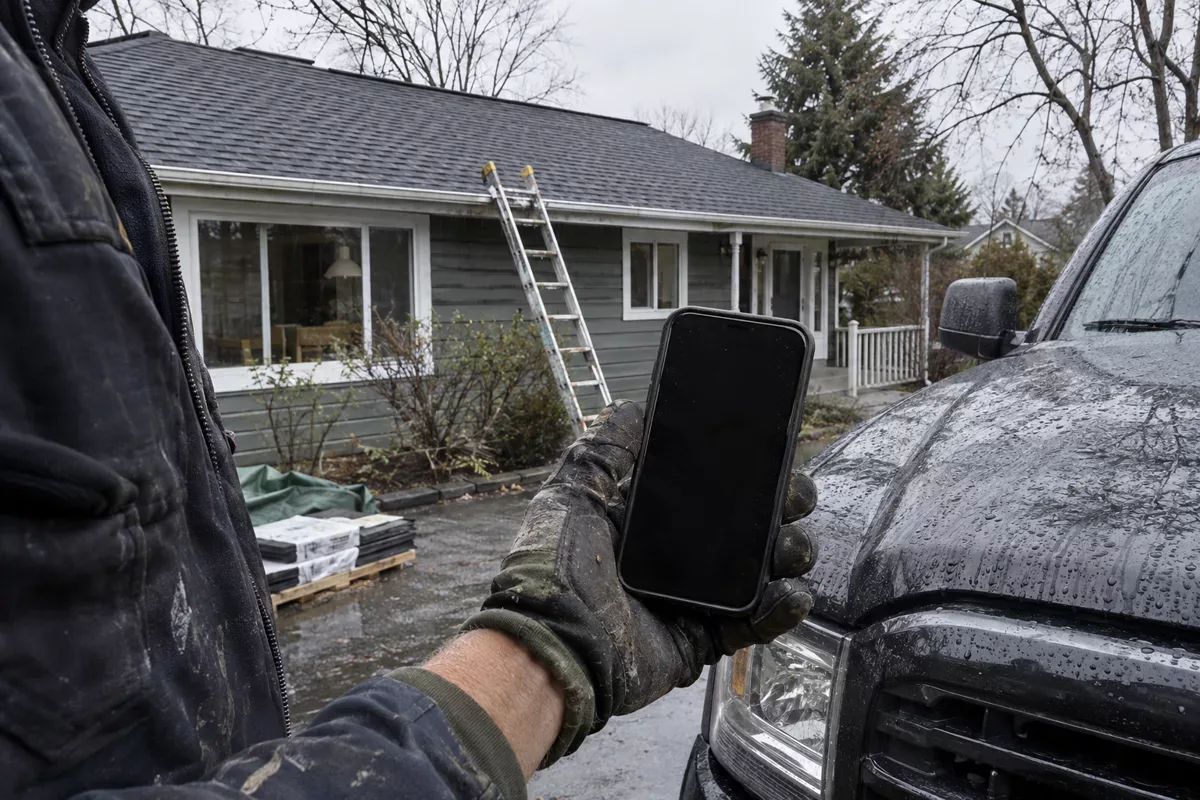
The spreadsheet hits a wall around ten open jobs. You re-type the same shingle, underlayment and per-square prices into every quote at night, lose track of which deposits came in, and the balance invoice for last week's roof sits unsent while you measure the next one. Driveway Desk keeps your price book, so a quote for the neighbor is a few taps from their driveway. Jobs go on the schedule with reminders, the invoice goes out in one tap when the roof is done and gets paid into your own Stripe or Square account, and one flat price covers the whole crew with no contract. If you are weighing the bigger apps, here is what to look at in a Jobber alternative for a small crew.
Price it once, then start your first quote from the driveway next time.
The plan is the cash, written down
A good roofing company business plan is short. Seven sections, one page each, a price for a typical roof built from real costs, a monthly projection, and one job walked day by day so you know how much cash your busiest month needs. Price from margin, not markup, keep a warranty fund, and check the plan against your real jobs every month. Start with the estimate every number in the plan comes from.
Put the method to work
Estimate templateCreate a free estimate with separate materials and labor, a fixed total or range, validity and assumptions. Save the finished document as a PDF.
Frequently asked questions
It usually refers to a building code rule: if you repair or replace more than 25% of a roof within 12 months, the whole roof has to be brought up to current code. Florida is the best-known example and changed its version in 2022 for roofs already built to the newer code. Check your local building department, and put any rule that affects how you quote repairs into your services section.
For a roofing company: an executive summary, services and pricing, market and customers, operations and crews, marketing and leads, team and subs, and financials with cash flow. The SBA lists more sections for a traditional plan used for loans, but these seven cover what a small roofing company needs to decide and to show a lender or supplier.
It depends on your price, job costs and overhead. In the illustrative example above, a 25-square reroof sold at $12,100 leaves $4,850 of gross profit. After overhead and paying the owner $35 an hour for their own time, real profit works out to about $1,500 a roof.
Check your state and city licensing rules, set up the business and insurance, price one typical roof from real supplier and crew costs, and line up an install crew or helper. Then write the plan above with a monthly projection and a cash-per-job walk-through, so you know how much working cash you need before the first busy month.
Put the method to work
Labor cost calculatorDivide paid-hour costs by the billable-hours ratio, then allow for your target margin to find a selling rate.
Your prices, remembered.
Build your first quote on your phone in about two minutes, send it, and get paid into your own account.
Start your first quoteShare article
About the author
Field notes team
We write practical guides for home service crews of one to five. Our editorial standard is to show the calculation, state its assumptions, cite primary sources for factual claims and date competitor comparisons. We distinguish worked examples from market prices and correct errors when they are found. We do not claim trade licenses or credentials on behalf of the team.
More articles

Running a small crew · 13 min
What Do I Need to Start a Mobile Detailing Business? Full Checklist
The mobile detailing startup checklist: paperwork and insurance, the wash and interior kit for the services you sell first, how many towels to stock, and the quote, work order and payment setup.

Running a small crew · 11 min
How to Get Clients as a Realtor: 5 Channels That Work
How to get clients as a realtor: start with your sphere and past clients, build referral partners among the trade pros already inside homes, then add open houses and one farm area. Includes a 90-day plan and the commission math.

Running a small crew · 14 min
How to Get Bookkeeping Clients: 6 Ways That Actually Work
How to get bookkeeping clients: start with people you know and local tax preparers, sell a fixed-price cleanup first, then pick one niche, such as trade contractors, and become the bookkeeper its owners refer.

Running a small crew · 13 min
How to Start a Mobile Detailing Business: Water, Kit, Prices
Start a mobile detailing business in order: pick your first customers, sort licenses and insurance, solve water before buying a polisher, price by your real hours plus the drive, and book the maintenance wash.

Running a small crew · 13 min
How to Get Clients for Your Home Service Business: 7 Ways
How to get clients for a home service business: tell everyone you know, verify a free Google Business Profile, ask for reviews, work the street around every job, and follow up every quote you already sent before you buy a single lead.

Running a small crew · 13 min
How to Get a Contractor License in Texas: Who Needs One
Texas licenses the trade, not the title. General contractors, remodelers and roofers need no state license, just city registration. Electrical, A/C and plumbing contractors need TDLR or TSBPE licenses, experience, an exam and $100,000 to $300,000 insurance.