How to Become an Apprentice Electrician: Union vs Non-Union, Pay, Hours
Driveway Desk team 6 November 2026 13 min read
Your next job
Less time at the desk.
Build your price book, schedule the next visit and turn completed work into an invoice.
Start your first quoteIn this article
Short answer
To become an apprentice electrician, you either apply to a union training center (a JATC run by the IBEW and NECA) or get hired by a non-union contractor that enrolls you in an IEC, ABC or in-house program. Most programs want you to be 17 or 18, have a high school diploma or GED with a passing algebra credit, and pass an aptitude test or interview. You are paid from day one and train for about 4 to 5 years.
Most guides make it sound like school: fill in a form, wait for a letter. It works more like getting a job, because that is what it is. The fastest way into an apprenticeship is usually a helper job, not an application. Non-union shops enroll the helpers they already trust, and union training centers fast-track people who show up with real hours in the trade.
This guide covers the two doors, what each one asks for, how to apply, what you get paid while you learn and how your week splits between the job and the classroom. If you want the whole career path from first day to master license, our broad guide covers that. This one stays on the apprenticeship itself.
How do you become an apprentice electrician?
You become an apprentice electrician by getting accepted into a registered apprenticeship program, union or non-union, and starting work under a licensed electrician. Pick the door, meet the basic requirements, apply or get hired, then register with your state if it licenses apprentices.
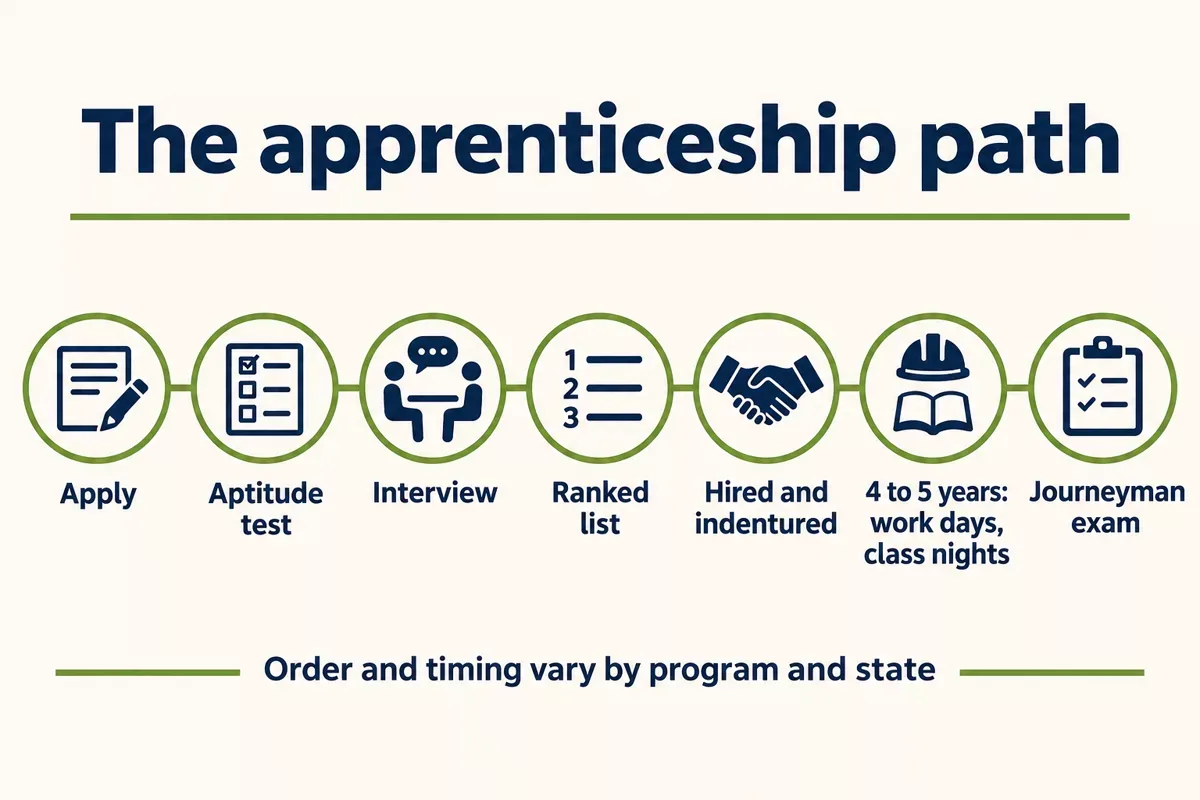
The steps look the same on paper in every state. The order is what differs: union programs test you first and place you with a contractor later, non-union programs hire you first and test you through the classes.
How to become an apprentice electrician
- Pick union, non-union or both
Look up your local IBEW/NECA training center and the IEC or ABC chapter near you. Nothing stops you from applying to the union program and working as a non-union helper while you wait.
- Check the basic requirements
Typical minimums are age 17 or 18, a high school diploma or GED, one year of algebra, a valid ID and the right to work in the US. Some programs also ask for a driver's license. Read the program's own qualifications page before you spend money on anything.
- Gather your documents
Have your ID, Social Security card or birth certificate, an official sealed transcript, your diploma or GED and, for veterans, your DD-214. Union centers will not move your application without the transcript.
- Apply, test and interview
Union centers schedule an aptitude test (algebra and reading comprehension) and then an interview, and rank applicants by the combined score. Non-union shops interview you for the job and enroll you once you are on the payroll.
- Register as an apprentice with your state
Many states license or register apprentices. Texas, for example, issues an apprentice license online with no exam, and Delaware requires you to be enrolled in a board-approved program first. Your program will tell you what your state wants.
Union vs non-union apprenticeships
The union route goes through a Joint Apprenticeship Training Committee (JATC), run together by the IBEW and the contractors' association NECA. The non-union route goes through a contractor plus a training sponsor such as an Independent Electrical Contractors (IEC) chapter, an Associated Builders and Contractors (ABC) chapter or the shop's own registered program.
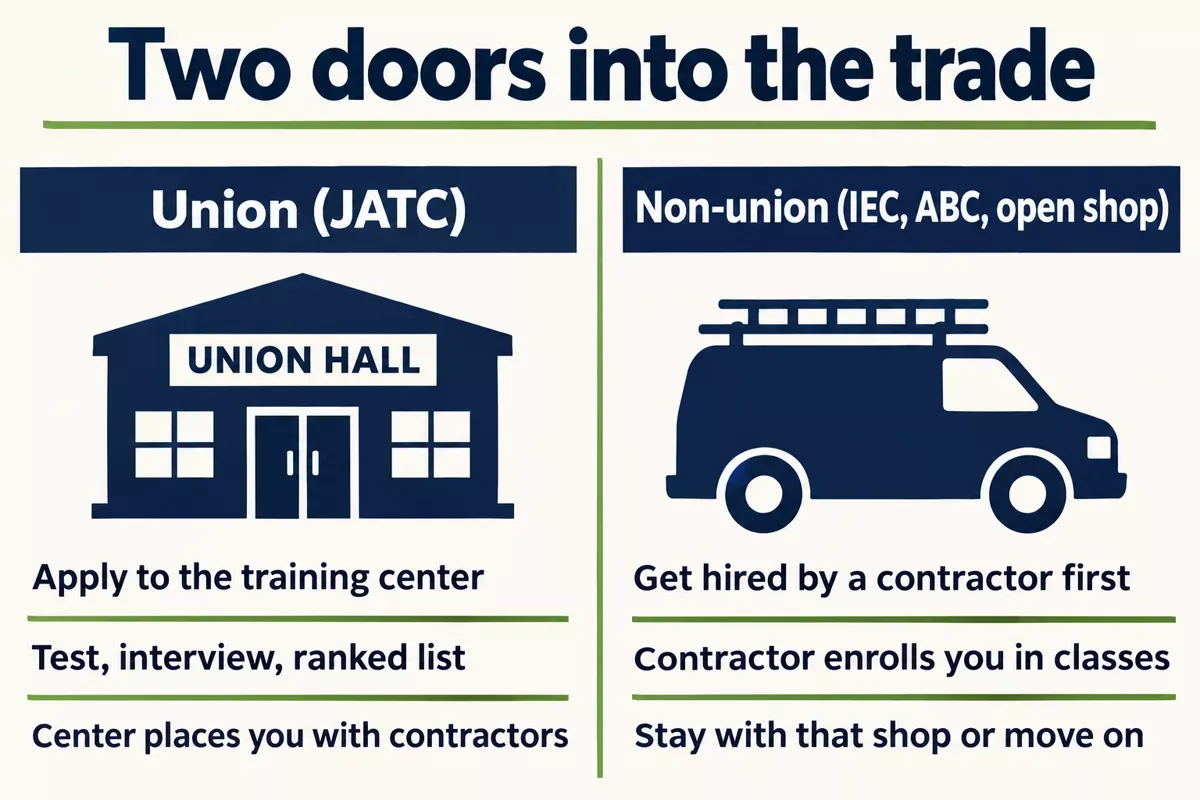
| Union (IBEW/NECA JATC) | Non-union (IEC, ABC, open shop) | |
|---|---|---|
| How you get in | Apply to the training center, test, interview, wait to be ranked and selected | Get hired by a contractor, who enrolls you |
| What decides it | Your aptitude test and interview score | Whether a shop wants you on its crew |
| How fast | Depends on how many openings the center has each intake | As fast as you can land the job |
| Pay while training | Percentage of the local journeyman rate, set by the agreement | Set by your employer, rising as you progress |
| Classes | At the training center, set schedule | Chapter classes, often one or two nights a week |
| Moving between jobs | The center places you with signatory contractors | You can change shops, but check that your hours transfer |
| Best for | People who can wait and want a fixed pay scale | People who need a paycheck now |
There is no wrong answer here, but there is a wrong reason. Do not wait a year for a union intake while doing nothing. Work as a helper in the meantime: the hours make you a stronger union applicant and they may count toward a non-union program if the union does not call.
Electrician apprenticeship requirements
The requirements are short and mostly paperwork. What sinks applicants is the math, not the eligibility.

| Requirement | Typical rule | What to do about it |
|---|---|---|
| Age | 17 or 18 minimum, no listed maximum | Apply as soon as you meet it |
| Education | High school diploma or GED | Order your sealed transcript now, it takes weeks |
| Math | One year of algebra with a passing grade | Retake algebra at a community college if you failed it |
| Aptitude test | Algebra and reading comprehension (union centers) | Practice with a test prep book for a few weeks |
| Documents | ID, Social Security card or birth certificate, transcript, diploma | Keep copies in one folder |
| Driver's license | Required by many contractors and some programs | Fix a suspended license before you apply |
| Drug test | Common before you start work | Assume it will happen |
The South Texas JATC lists the basics plainly: 17 years old, high school graduate with an Algebra 1 credit and no experience required (South Texas Training Center qualifications page, fetched 2026-11-04). Its list also shows the shortcut this guide turns on: 2,000 hours worked in electrical construction qualifies you for a direct interview, and so does a recognized pre-apprenticeship, Job Corps electrical training or the right military service.
How to find and apply to an electrician apprenticeship
Start with the official finder, then go local. The Department of Labor apprenticeship finder lists registered programs by occupation and zip code, including electrician programs from union and non-union sponsors.

- Search the finder for "electrician" in your zip code and write down every sponsor within driving distance.
- Call the union training center and ask when the next application window opens. Many accept applications only on set days or months.
- Call the IEC and ABC chapters and ask which member contractors are hiring apprentices or helpers this season.
- Walk into electrical contractors' shops in the morning, when the crews are loading vans. Ask for helper work. Bring your ID and say you plan to enroll in classes.
- Take any helper job that puts you on a site. Log your hours from day one, with the dates, the job addresses and the name of the electrician supervising you.
That last step matters more than it looks. Hours you cannot prove do not help you. The same habit pays off years later when you run your own jobs: the electricians who keep clean records of every job are the ones who can price the next one.
How much do apprentice electricians make?
Apprentice electricians are paid from the first day, on a schedule that rises as they gain hours and pass classes. Federal rules for registered programs require "a progressively increasing schedule of wages" and an entry wage no lower than the federal minimum wage (29 CFR 29.5).
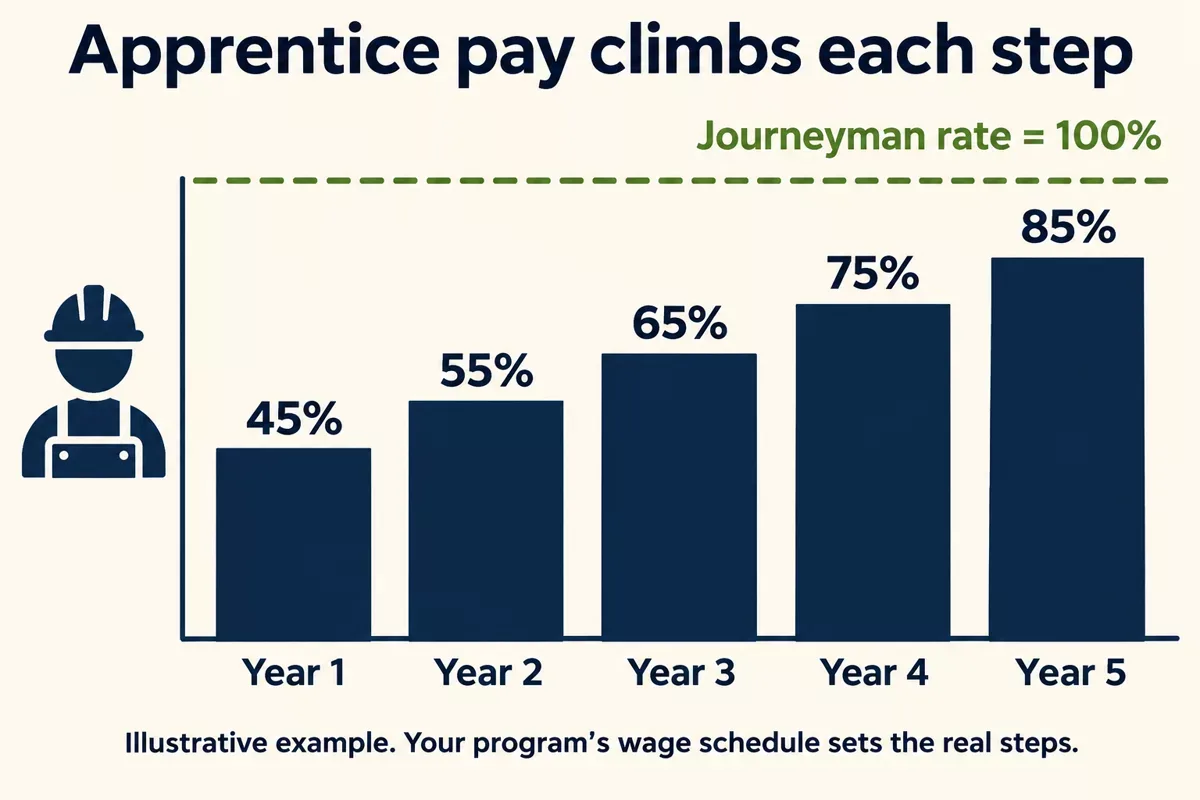
Union programs usually express apprentice pay as a percentage of the local journeyman rate and raise it at each step. Non-union pay is set by the contractor and varies more from shop to shop. Neither one has a national number we can give you honestly, because the journeyman rate itself differs from city to city.
| What to ask | Why it matters |
|---|---|
| What is the starting rate? | Sets your first year's budget |
| How often does it step up, and what triggers it? | Hours, classes passed or both |
| Who pays for books and tuition? | Some programs charge, some employers cover it |
| Are health insurance and retirement included? | Union packages often include both; shops vary |
| Is overtime available? | It can add a lot to a first-year paycheck |
Ask for the wage schedule in writing before you accept. A program that will not show it to you is telling you something.
How many hours is an electrician apprenticeship?
Most electrician apprenticeships run about 8,000 hours of paid on-the-job training plus classroom hours, which is 4 to 5 years of full-time work. The federal standard recommends at least 144 hours of classroom instruction for each year of the apprenticeship.
| Program | Length | Job hours | Classroom |
|---|---|---|---|
| IEC Fort Worth/Tarrant County (Texas) | About 4 years, 4 levels | 8,000 | 576 hours, one or two nights a week |
| IBEW/NECA Technical Institute (Chicago, Local 134) | 5 years | Full-time work | 1,200 hours |
| Federal minimum for registered programs | At least 2,000 hours of on-the-job learning | Set by the program | 144 hours a year recommended |
Sources: IEC Fort Worth/Tarrant County chapter guide, Powering Chicago programs page and 29 CFR 29.5, all fetched 2026-11-04.
In practice your week looks like this: about 40 hours on a job site during the day, and one or two evenings a week in class. Some union programs run classes in blocks during the day instead. Plan your first two years around those class nights, because missing them is how people fall behind on their pay steps.

Mistakes that cost apprentices months
Most delays come from paperwork and habits, not skill.
- Waiting on one union intake. If you miss the cut, you lost a year. Work as a helper while you wait.
- Not logging hours. Keep a dated record of every job and who supervised you. A state board or program will want proof.
- Skipping the algebra prep. Union centers rank by test score. A few weeks of practice moves you up.
- Working without your state's apprentice registration. Hours worked unregistered may not count toward your license.
- Ignoring the business side. Many apprentices end up running their own shop one day. The ones who learn how a job is priced, from labor to materials to markup, get there faster.
After the apprenticeship: running your own jobs
Finishing the apprenticeship gets you to the journeyman exam. A master license and your own shop come after that, and so does the part nobody teaches in class: quoting, scheduling and getting paid.
If that is where you are headed, start paying attention now to how your shop prices work. Learn what an hour of an electrician's time really costs with a labor cost calculator, and how the markup on materials turns into profit. Other trades follow the same ladder; our guide on how to get an HVAC license shows how hours and exams stack up there.
The manual way works for a while: a simple quote template in a spreadsheet, a written estimate for the bigger jobs and a work order for each visit. It breaks when you are re-typing the same prices on every quote at night and chasing invoices from the truck. That is the job Driveway Desk does: your price book remembered, quotes sent from the driveway on your phone, invoices paid into your own account. If you are comparing tools later, our Jobber pricing breakdown shows what the big names charge.
Price it once, then start your first quote from the driveway next time.
Price it once, then start your first quote from the driveway next time.
The short version
Pick a door, union or non-union, and do not wait on just one. Meet the basics: age, diploma or GED, algebra and your documents. Get on a job site as a helper as soon as you can, log every hour and prep for the aptitude test. You will be paid while you learn, and in about 4 to 5 years you will be ready for the journeyman exam.
Put the method to work
Labor cost calculatorDivide paid-hour costs by the billable-hours ratio, then allow for your target margin to find a selling rate.
Frequently asked questions
No. Most programs require no experience, only the age, diploma and algebra basics. Experience helps, though: some union training centers give a direct interview to applicants with 2,000 hours of electrical work, a recognized pre-apprenticeship or related military service.
Usually 4 to 5 years. That is about 8,000 hours of paid work plus classroom time; the IEC Fort Worth program asks for 576 classroom hours and the Chicago IBEW/NECA program for 1,200 over five years.
No. Programs set a minimum age of 17 or 18 and do not list a maximum. Starting at 30 still leaves decades of work after you top out, and a steady work history and a clean driving record help in interviews.
It depends on the chapter. IEC tuition and book fees are set locally, and many contractors pay part or all of it for the apprentices they employ. Ask the chapter for its current fees and ask your employer whether they cover them before you enroll.
It is the IBEW Local 134 apprenticeship run with the contractors' group Powering Chicago at the IBEW/NECA Technical Institute in Alsip, Illinois. It is a five-year paid program that combines 1,200 hours of classroom training with on-the-job training.
For most people who like hands-on work, yes. You are paid from the first day, your pay rises on a set schedule, and you finish without student debt and with a path to a journeyman license and your own shop.
Put the method to work
Labor cost calculatorDivide paid-hour costs by the billable-hours ratio, then allow for your target margin to find a selling rate.
Your prices, remembered.
Build your first quote on your phone in about two minutes, send it, and get paid into your own account.
Start your first quoteShare article
About the author
Field notes team
We write practical guides for home service crews of one to five. Our editorial standard is to show the calculation, state its assumptions, cite primary sources for factual claims and date competitor comparisons. We distinguish worked examples from market prices and correct errors when they are found. We do not claim trade licenses or credentials on behalf of the team.
More articles

Running a small crew · 14 min
How to Start an Electrical Business: 6 Steps and the Math
Start an electrical business in order: hold the license that lets you contract, register and insure the business, set up one van, price from billable hours and start with service work that pays at the door.

Running a small crew · 12 min
How Long Does It Take to Get an Electrical License? About 4 Years
How long does it take to get an electrical license? About 4 years to journeyman and 6 to master, because states count signed hours. Texas and California numbers, the 7,000 hour exam rule and how to log hours so they count.

Running a small crew · 12 min
How to Become an Electrician: 5 Steps and Real Timelines
How to become an electrician: a high school diploma, a 4 to 5 year paid apprenticeship, about 8,000 logged hours and the license exam. Routes by situation, NJ, WA and Illinois rules, and BLS pay.

Running a small crew · 11 min
Basic House Cleaning Checklist: 12 Tasks, Every Visit
A basic house cleaning checklist of 12 tasks you finish on every visit: kitchen, bathrooms, dusting, beds and floors, in the right order, with real timings for a 3 bed, 2 bath house and how to price it.

Running a small crew · 13 min
What Do I Need to Start a Mobile Detailing Business? Full Checklist
The mobile detailing startup checklist: paperwork and insurance, the wash and interior kit for the services you sell first, how many towels to stock, and the quote, work order and payment setup.

Running a small crew · 13 min
Roofing Company Business Plan: 7 Parts + Cash Flow Example
A roofing company business plan in seven short sections, with a worked example: one reroof priced line by line, revenue by month, and how much cash a busy June ties up before homeowners pay.