How to Start a Pest Control Business: 6 Steps and the Math
Driveway Desk team 9 November 2026 12 min read
Your next job
Less time at the desk.
Build your price book, schedule the next visit and turn completed work into an invoice.
Start your first quoteIn this article
To start a pest control business, get your own pesticide applicator certification first, then license, register and insure the business, buy a small kit, and price a quarterly service plan before you take your first call. Rules vary by state, so the license comes before the sprayer, not after.
Short answer
Get certified as a commercial applicator in your state, license and insure the business, start with general household pests on a quarterly plan, and keep your route tight. The first treatment is how you meet a customer; the quarterly visits are what pay you.
Which kind of pest control business should you start?
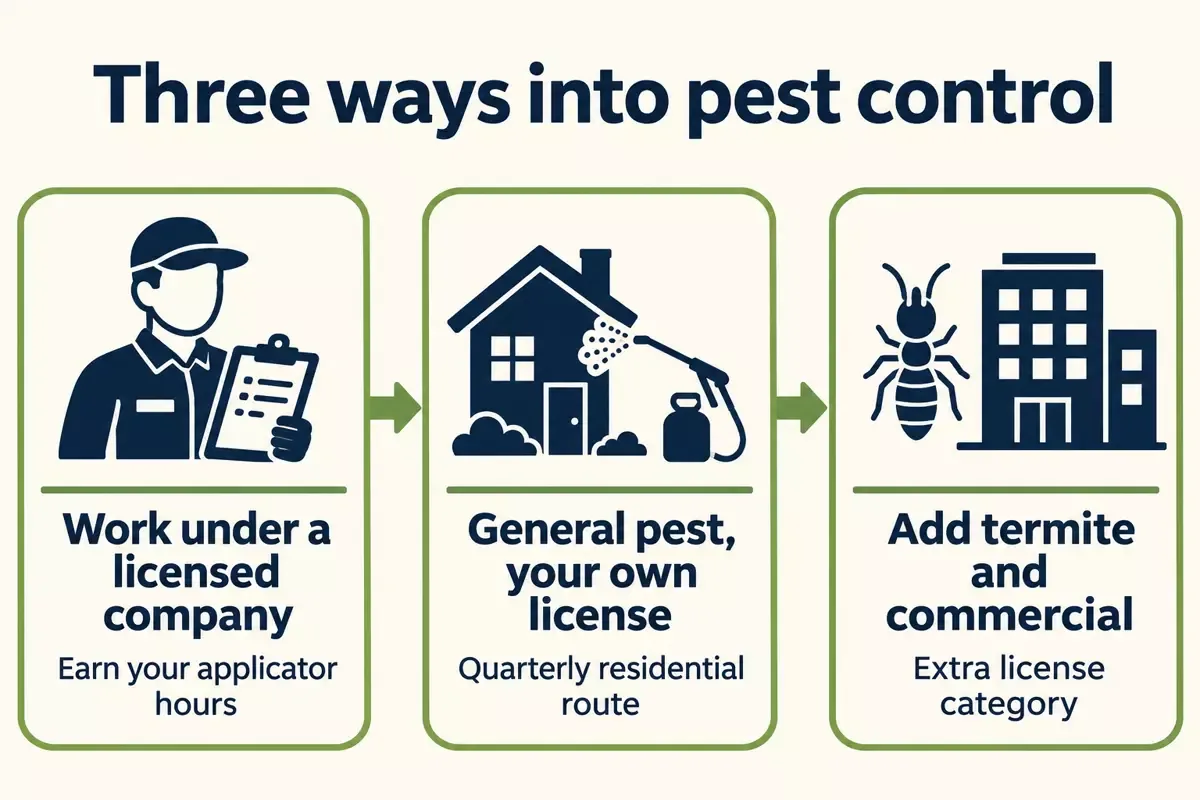
Where you start depends on one thing: whether you already hold an applicator license. There are three ways in, and they stack.
| Your situation | Start as | Why |
|---|---|---|
| No applicator license yet | Technician at a licensed company | You get paid to learn, and some states want documented experience before you can license your own business |
| Licensed, working solo, small budget | General household pest, residential, quarterly | Low kit cost, and every customer comes back four times a year |
| Licensed with a termite or WDO category, crew of two to five | Add termite work and small commercial accounts | Bigger tickets, but more insurance, more paperwork and longer jobs |
A pest control business is a route, not a string of calls. The one-time treatment is how you meet a customer. The quarterly plan is what pays you. A new owner who sells one-off sprays has to find a new customer every week, while an owner who sells a plan finds a customer once and sees them four times a year. Every choice below, from the kit to the price to the area you serve, should make the quarterly stop quicker and more profitable.
Do you need a license to start a pest control business?
Yes, in practice. Federal law requires anyone who applies or supervises the use of restricted use pesticides to be certified, and the EPA's certification guide notes that many states go further and require every commercial applicator to be certified, whatever product they use. States, not the EPA, do the certifying, and you need it in each state where you work.
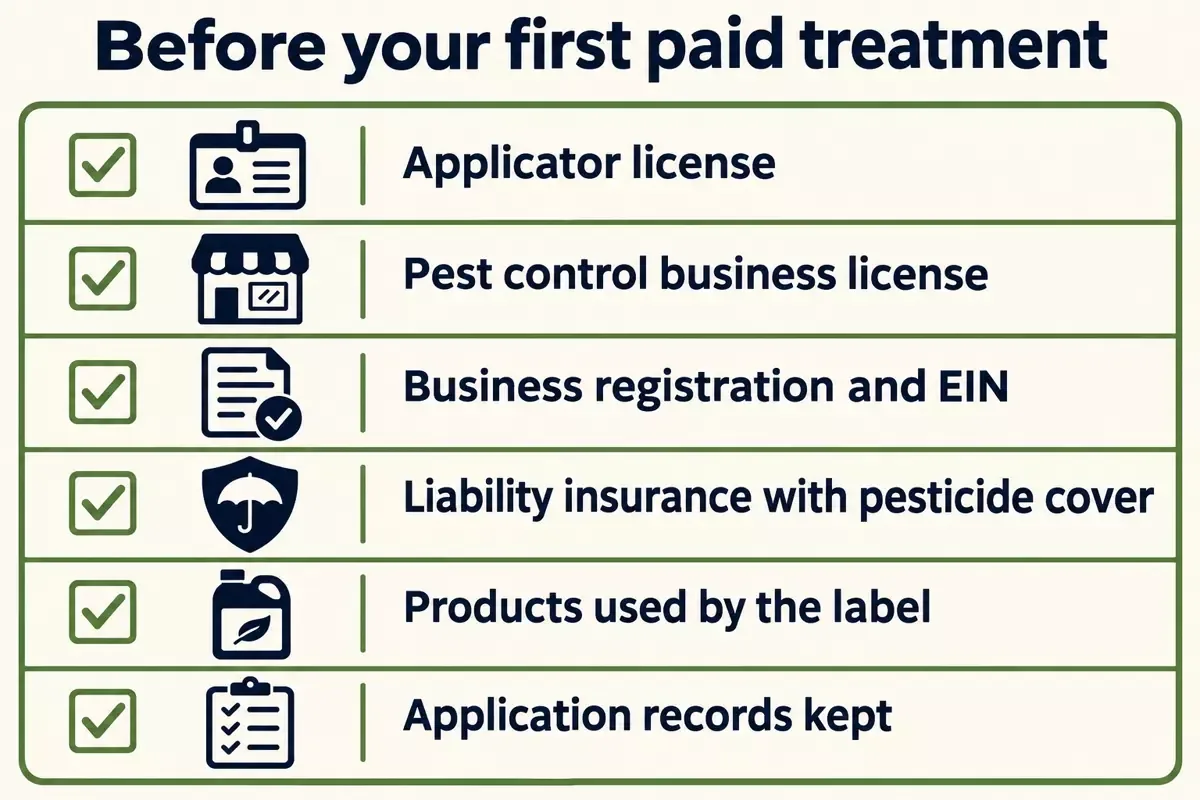
Treat this as a checklist to confirm with your state, not a ruling:
- Your applicator certification. Usually a commercial applicator license in a structural or household pest category, earned by passing your state's exams. Termite and wood-destroying organism work is often a separate category.
- The business license. Many states license the pest control business itself, separately from the person, and some tie it to a certified operator on staff.
- Experience. Some states want proof of time under a licensed company before you can qualify a business. This is why so many owners start as technicians.
- Business registration and EIN. Pick a structure (many owner-operators start as a sole proprietor or single-member LLC), register it, and get an EIN from the IRS before you hire a helper or open a business account.
- Insurance. General liability, and ask the agent whether the policy covers pesticide application, because some policies exclude it. Add commercial auto for the truck and workers' comp when you hire.
- Records. Many states require you to keep a record of every application: date, address, product and amount. Start keeping them on day one.
Your state's pesticide regulatory agency, usually the department of agriculture, sets the exams, categories and fees.
What equipment does a pest control business need?
A one-person general pest business runs out of a pickup or a small van. The starter kit:
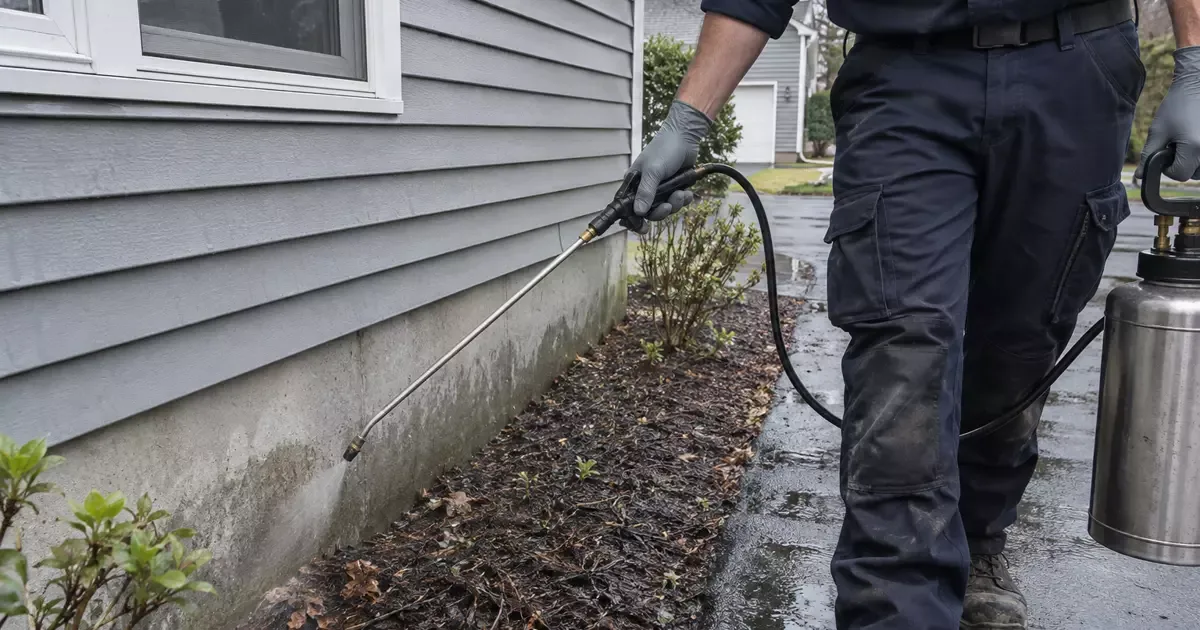
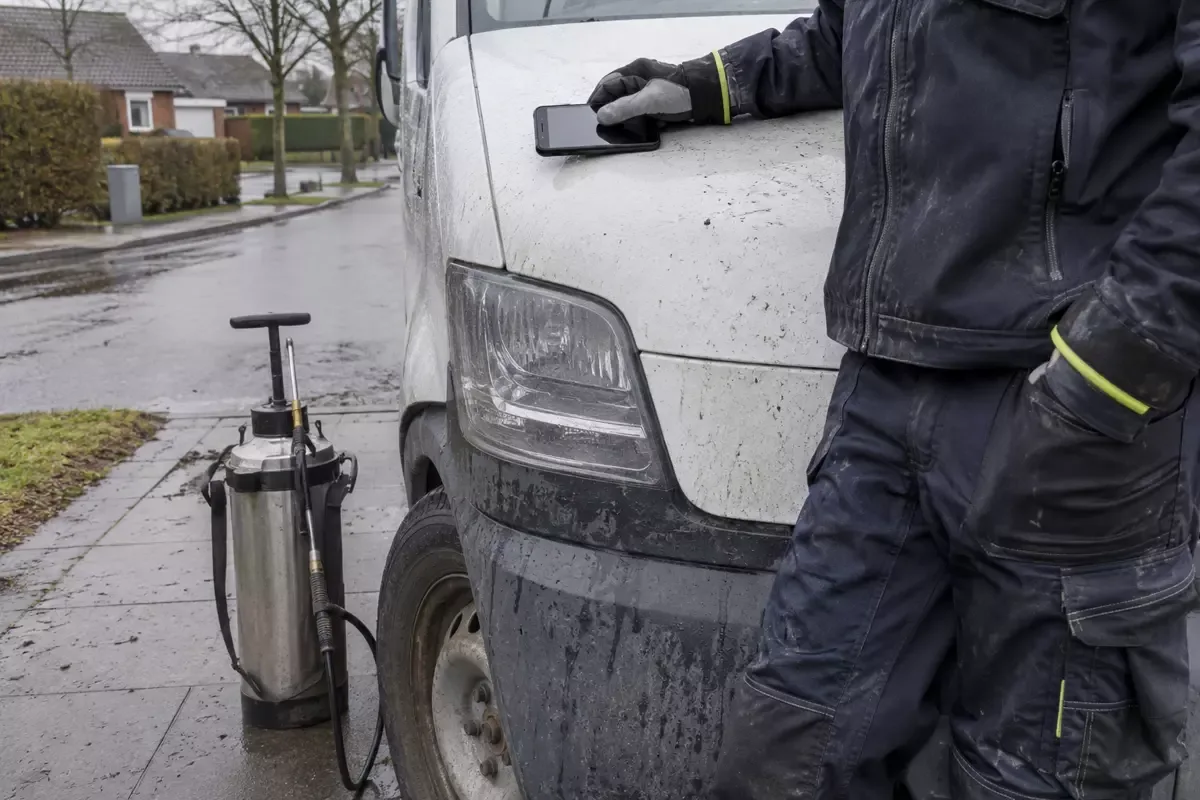
- A stainless or poly hand-pump compressed-air sprayer, and a backpack sprayer for perimeters
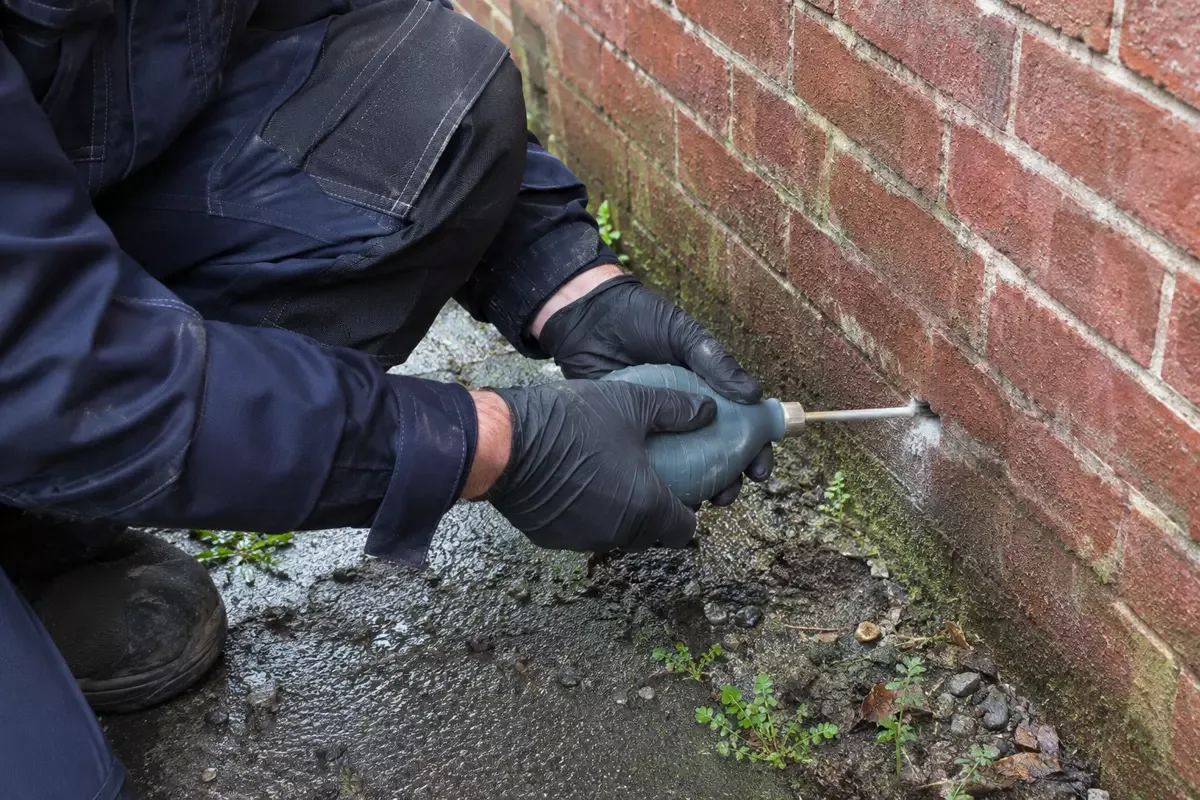
- A bulb or hand duster for cracks, voids and weep holes
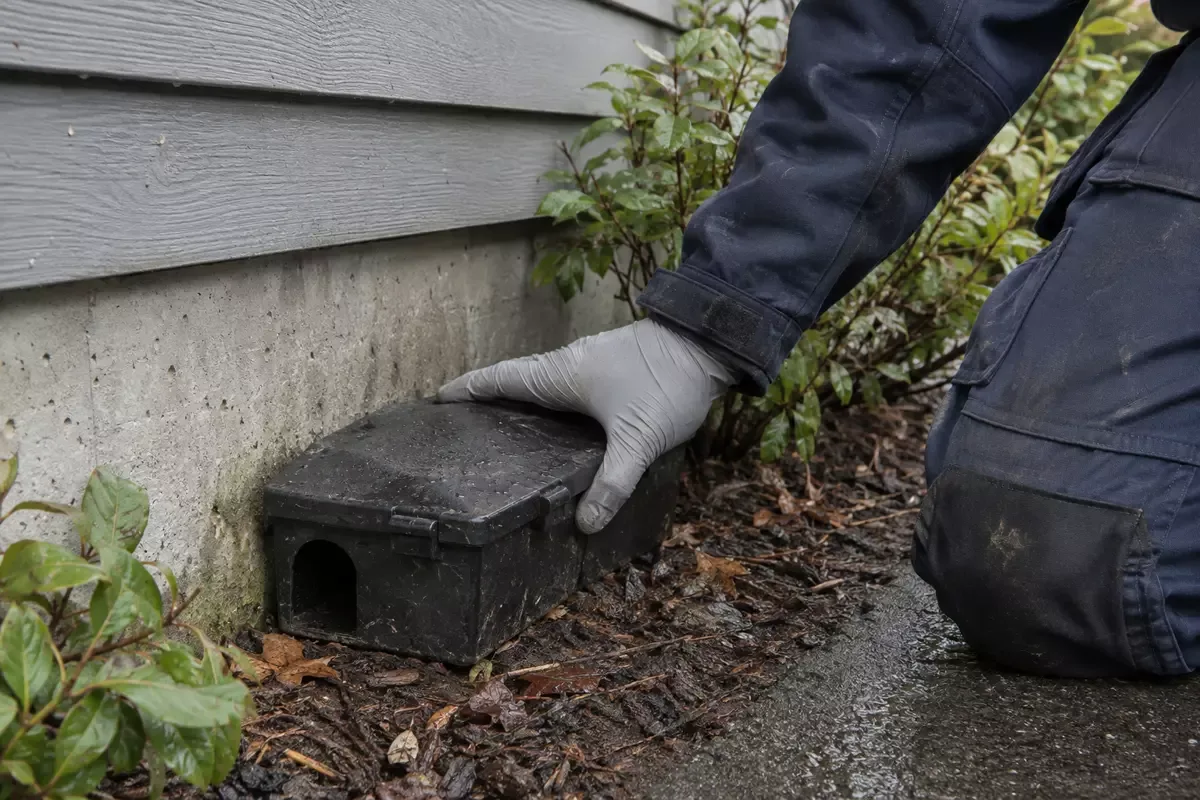
- Rodent bait stations and a bait gun for gel baits
- Glue monitors to see what is living where
- A bright flashlight and an inspection mirror
- The protective gear the product labels require: chemical-resistant gloves, eye protection and, where the label says so, a respirator
- A locked, secured compartment for product in the truck, plus a spill kit
The label is the law. Every product you carry tells you where it can go, how much and what protection you wear, and following it is what keeps the license.
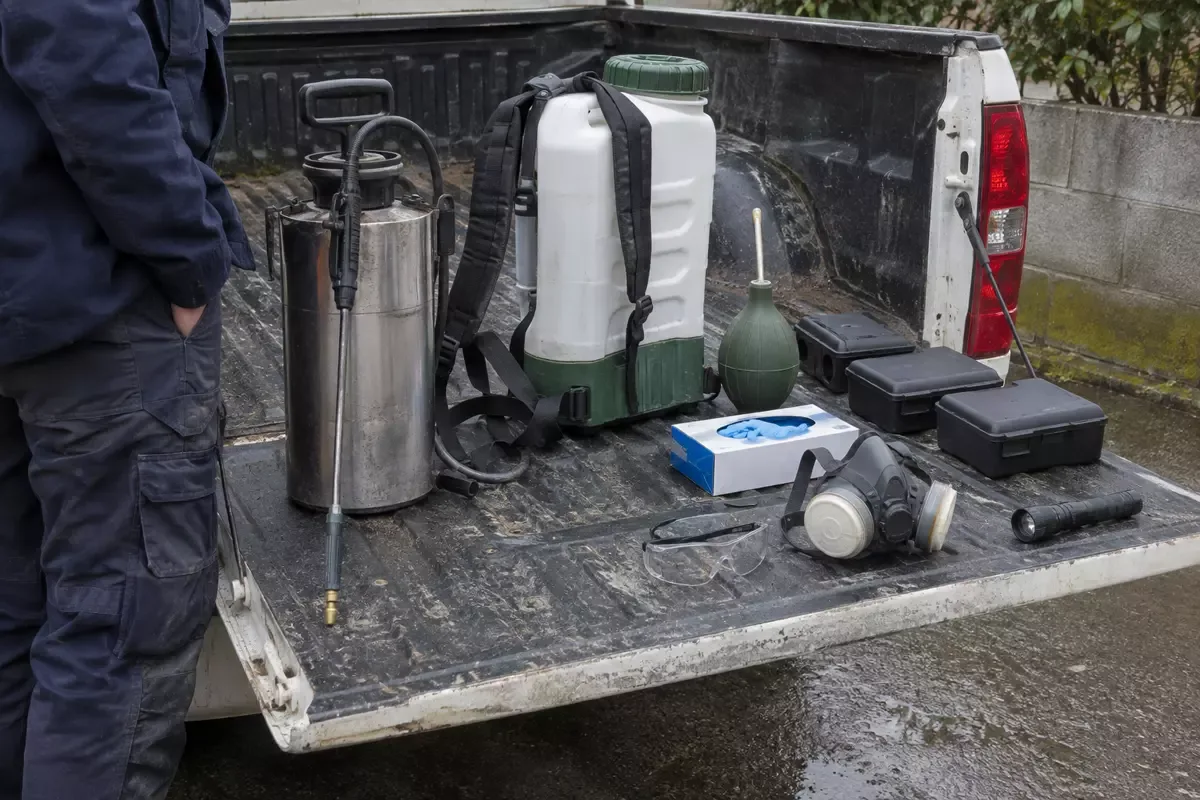
What it costs depends on choices only you can make. Price each line locally before you spend, and that total is your startup budget.
| Startup cost line | What sets the number |
|---|---|
| Exams, applicator license, business license | Your state's fee schedule and how many categories you take |
| Insurance | Your state, your services and whether termite work is included |
| Sprayers, duster, bait stations, PPE | New or used, and how many sprayers you run |
| First product stock | Which pests you treat and how many stops you expect |
| Vehicle | A truck you already own costs far less than a new van |
| Business registration and a phone | Your state and structure |
How to price pest control: the initial service and the quarterly stop
Most residential pest control is sold as an initial service, usually a longer interior and exterior treatment, followed by quarterly visits on a plan. Price the quarterly stop from your own costs, then price the initial higher, because it takes longer and uses more product. These are illustrative inputs, not market prices: swap in your own.
| Cost per quarterly stop | Illustrative input | Amount |
|---|---|---|
| Time on site | 40 minutes at $40/hr | $27 |
| Drive to the stop | 20 minutes at $40/hr | $13 |
| Product and materials | Perimeter spray, bait, granules | $10 |
| Vehicle | Fuel and wear | $8 |
| Insurance and overhead | Policies, license, phone, software, divided by stops | $12 |
| Cost of the stop | $70 | |
| Profit | 30% of the price | $30 |
| Price you quote | One quarterly visit | $100 |
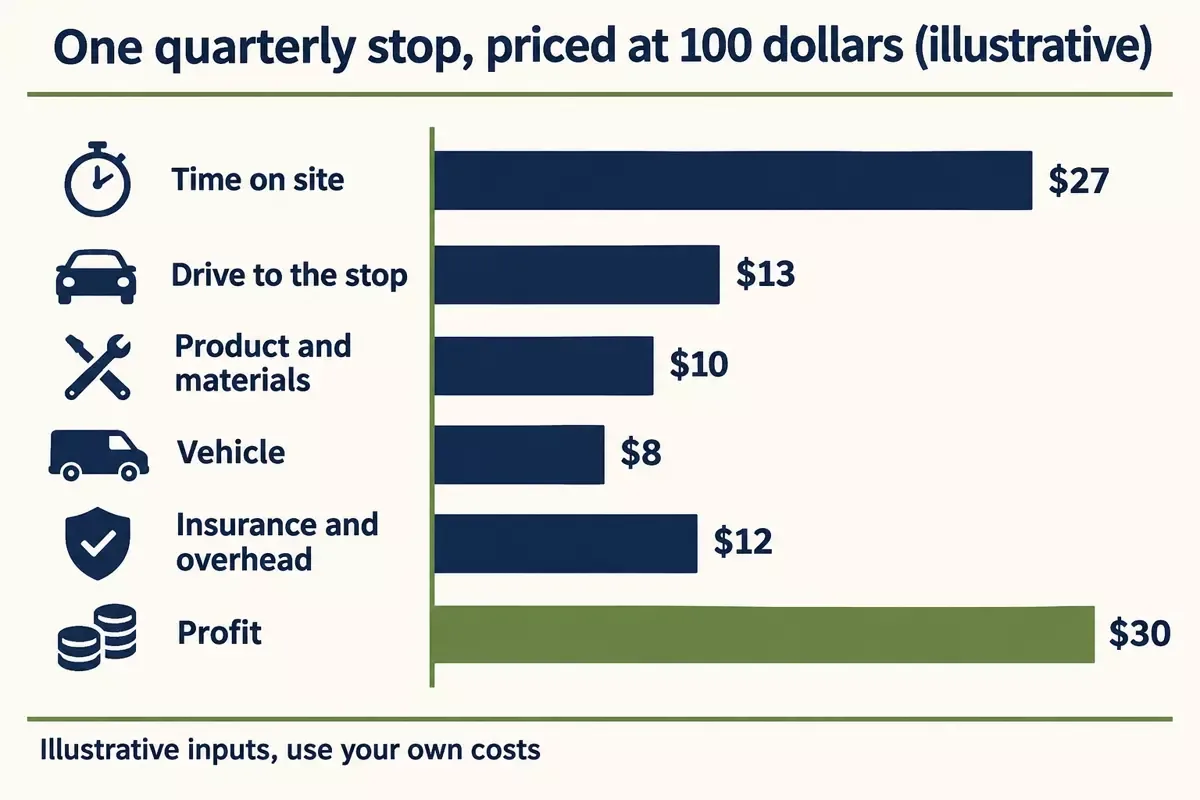
Now look at one customer over a year. With an illustrative $175 initial service and three more quarterly visits at $100, one house pays $475 in year one and $400 in every year it renews. The same house sold as a one-time spray pays $175 once.
The drive line is where a tight route pays. Cut the drive between stops from 20 minutes to 8 and the cost of the stop falls from $70 to $63, so the same $100 visit earns $37 instead of $30.
| Route | Drive per stop | Cost of the stop | Profit on a $100 visit |
|---|---|---|---|
| Customers spread across the county | 20 min | $70 | $30 |
| Customers clustered in a few neighborhoods | 8 min | $63 | $37 |
Check your own hourly number with what an hour of your time really costs, and test the margin on the markup and margin calculator before you print a price.
Price it once, then start your first quote from the driveway next time.
Find your first customers in one tight area
Pick a service area you can cross in 20 minutes and say no to the rest for the first year. Ask each customer for a review the same day, and knock on the neighbors' doors with the offer while you are on the street. Every new house on a street you already serve cuts the drive line in the table above.
Quote it in writing, with a service agreement
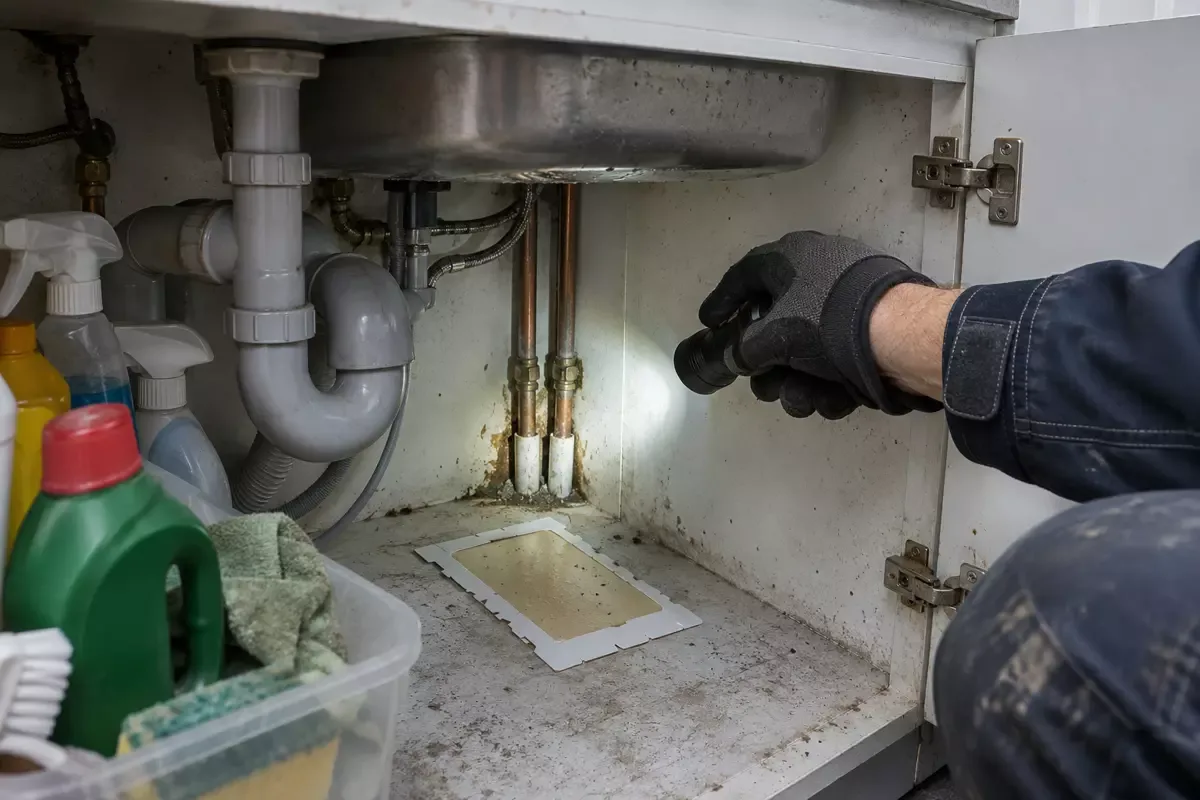
Walk the property before you quote: the foundation, the eaves, the garage, under the sinks and the attic hatch. Note what you find and what you will treat. Then send a written quote, or an estimate when you cannot see the whole problem yet, and put the plan on a short service agreement:
- Which pests the plan covers, and which cost extra (termites, bed bugs, wildlife)
- The initial price, the quarterly price and when each visit happens
- Whether re-services between visits are free, and how many
- How to cancel, and the payment terms
Copy the findings onto a work order so the next visit starts where this one ended.
Start your pest control business in order
How to start a pest control business
- Get certified
Pass your state's commercial applicator exams in the household or structural pest category, or start as a technician at a licensed company to earn the experience your state wants.
- License, register and insure the business
Get the pest control business license if your state has one, register the business, get an EIN and buy liability cover that includes pesticide application.
- Buy the kit
Sprayers, a duster, bait stations, monitors and the PPE your labels require, plus a secured place for product in the truck.
- Pick a tight service area
Choose neighborhoods you can cross in 20 minutes and build the route there first.
- Price the initial and the quarterly plan
Build the quarterly price from time, drive, product, vehicle, overhead and profit, then price the initial higher.
- Quote, treat, invoice and ask for a review
Send a written quote with a service agreement, keep the application record, invoice before you leave and ask for a review that evening.
Run the route from your phone, not the kitchen table
A notebook and a spreadsheet hold up for the first twenty houses. The wall comes when the route starts to work: every customer needs a visit booked each quarter, a reminder before you show up, an invoice after you leave and a note on what you found, and you end up doing it at the kitchen table at night. Driveway Desk keeps your price book, so a quote with the initial and the plan on it takes a few taps in the customer's driveway. It schedules the visits and sends the reminders (with the customer's consent to texts, which TCPA rules require), the invoice goes out when you finish and gets paid into your own Stripe or Square account, and each customer's history sits on their record for the next visit. If you are weighing up the bigger apps, see what to use instead of Jobber as a small crew.
Price it once, then start your first quote from the driveway next time.
Mistakes that cost new pest control businesses money
- Treating before you are licensed. One complaint to the state can end the business before it starts.
- Selling only one-time sprays. You pay to find every customer and see them once.
- A route spread across the county. Twenty minutes of driving per stop is a cost on every visit, forever.
- Unlimited free re-services. Put a number on them in the agreement, or one problem house eats the margin of five.
- No application records. Many states require them, and they are your defense when a customer complains.
- Pricing the initial like a quarterly visit. It takes longer and uses more product; price it that way.
Is pest control a good business to start?
It suits a one-person start better than most trades: the kit is small, the work repeats every quarter, and a customer on a plan is worth several times a one-time job. The catch is the license and the patience to build a route. Owners who already run a lawn crew often add it, and the lawn care startup guide works through the same route logic for mowing. If you are weighing other trades, compare it with starting a cleaning business, where recurring visits pay the same way.
The short version
Get certified in your state, license and insure the business, buy a small kit, and sell a quarterly plan in a tight area. Price the stop from your own costs, keep the drive short and write every agreement down.
Your prices, remembered. Build your first quote on your phone in about two minutes, send it, and get paid into your own account. Start your first quote, or try it free.
Put the method to work
Labor cost calculatorDivide paid-hour costs by the billable-hours ratio, then allow for your target margin to find a selling rate.
Frequently asked questions
It depends on your state's license fees, your insurance quote and whether you already own a truck. A one-person general pest start needs exams and licenses, insurance, two sprayers, a duster, bait stations, PPE and first product stock. Price each line locally, add three months of fuel and product, and that is your number.
A pest control worker inspects homes and buildings, identifies the pest, treats it with the right product or method, and follows the label on every application. They also seal or advise on entry points, keep application records, explain the treatment to the customer and schedule the follow-up visits.
There is no official set of three, but most technicians work by the same idea: identify the pest, prevent it from getting in or finding food and water, and treat only when it is needed. The EPA's integrated pest management principles set it out as four steps: set an action threshold, monitor and identify, prevent, then control.
The US Bureau of Labor Statistics files pest control workers under building and grounds cleaning and maintenance occupations. As a business, pest control is a home service trade, sold like lawn care or cleaning: an initial visit and then a recurring plan.
Put the method to work
Labor cost calculatorDivide paid-hour costs by the billable-hours ratio, then allow for your target margin to find a selling rate.
Your prices, remembered.
Build your first quote on your phone in about two minutes, send it, and get paid into your own account.
Start your first quoteShare article
About the author
Field notes team
We write practical guides for home service crews of one to five. Our editorial standard is to show the calculation, state its assumptions, cite primary sources for factual claims and date competitor comparisons. We distinguish worked examples from market prices and correct errors when they are found. We do not claim trade licenses or credentials on behalf of the team.
More articles

Running a small crew · 11 min
Basic House Cleaning Checklist: 12 Tasks, Every Visit
A basic house cleaning checklist of 12 tasks you finish on every visit: kitchen, bathrooms, dusting, beds and floors, in the right order, with real timings for a 3 bed, 2 bath house and how to price it.

Running a small crew · 13 min
What Do I Need to Start a Mobile Detailing Business? Full Checklist
The mobile detailing startup checklist: paperwork and insurance, the wash and interior kit for the services you sell first, how many towels to stock, and the quote, work order and payment setup.

Running a small crew · 13 min
Roofing Company Business Plan: 7 Parts + Cash Flow Example
A roofing company business plan in seven short sections, with a worked example: one reroof priced line by line, revenue by month, and how much cash a busy June ties up before homeowners pay.

Running a small crew · 11 min
How to Get Clients as a Realtor: 5 Channels That Work
How to get clients as a realtor: start with your sphere and past clients, build referral partners among the trade pros already inside homes, then add open houses and one farm area. Includes a 90-day plan and the commission math.

Running a small crew · 14 min
How to Get Bookkeeping Clients: 6 Ways That Actually Work
How to get bookkeeping clients: start with people you know and local tax preparers, sell a fixed-price cleanup first, then pick one niche, such as trade contractors, and become the bookkeeper its owners refer.

Running a small crew · 13 min
How to Start a Mobile Detailing Business: Water, Kit, Prices
Start a mobile detailing business in order: pick your first customers, sort licenses and insurance, solve water before buying a polisher, price by your real hours plus the drive, and book the maintenance wash.