How to Get a Contractor License in Texas: Who Needs One
Driveway Desk team 14 November 2026 13 min read
Your next job
Less time at the desk.
Build your price book, schedule the next visit and turn completed work into an invoice.
Start your first quoteIn this article
To get a contractor license in Texas, first find out whether your work needs one at all: the state has no license for general contractors, remodelers, roofers or handymen. It does license electrical, air conditioning and refrigeration, and plumbing contractors, so those owners qualify through experience, pass a state exam, carry the required liability insurance and pay the fee. Everyone else registers with the cities they work in and pulls permits there.
Short answer
GC, remodeler, roofer, handyman: no state license, register with each city. Electrical: hire or be a Master Electrician, $110 TDLR contractor license, $300,000 per-occurrence insurance. A/C: 48 months of experience, exam, $115 TDLR license. Plumbing: Master Plumber plus the $225 Responsible Master Plumber designation and $300,000 insurance.
Which Texas contractor license do you need?
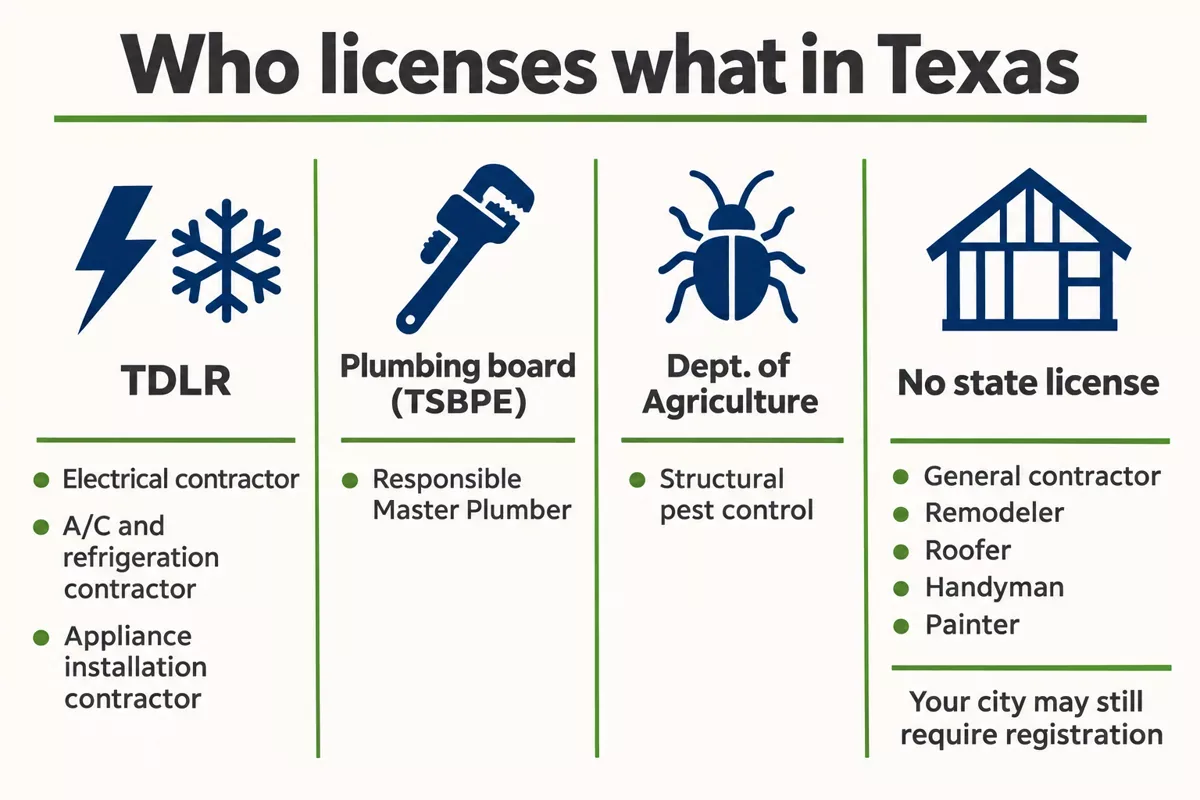
Texas splits licensing by trade, not by job title. The Texas Department of Licensing and Regulation (TDLR) licenses electrical, air conditioning and refrigeration (A/C), and residential appliance installation contractors. The Texas State Board of Plumbing Examiners (TSBPE) licenses plumbers. The Texas Department of Agriculture licenses structural pest control. General building work has no state license at all.
That gives the point most guides bury. In Texas, the title that sounds the most regulated, general contractor, is the one the state does not license. Your trade and your city decide what you need. A GC running whole remodels can start this month. An electrician with ten years in the field still cannot run a company without a Master Electrician on the license.
| Your situation | What to get | Who issues it |
|---|---|---|
| General contractor, remodeler, home builder | No state license. City registration where required | Each city's building department |
| Roofer, painter, flooring, fencing, handyman | No state license. City registration where required | Each city's building department |
| Electrical work for the public | Electrical contractor license with a Master Electrician of record | TDLR |
| Heating, A/C or refrigeration | A/C and refrigeration contractor license, Class A or B | TDLR |
| Residential appliance and pool electrical installs | Residential appliance installation contractor license | TDLR |
| Plumbing and gas lines | Master Plumber plus Responsible Master Plumber designation | TSBPE |
| Pest control for customers | Structural pest control business license | Texas Department of Agriculture |
If you are still deciding whether to run whole builds at all, our guide to becoming a general contractor covers the path in any state. Working across state lines? Compare this with the exam-based system in our California contractor license guide.
Do you need a contractor license in Texas?
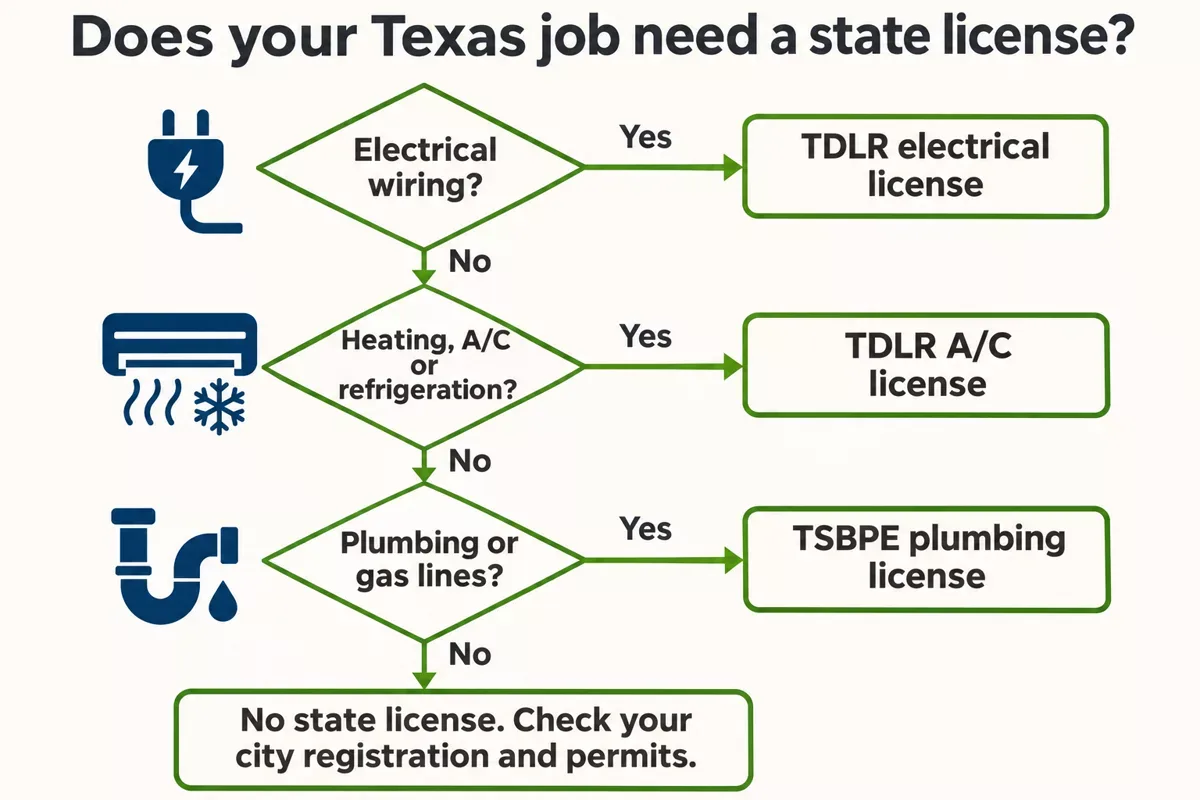
Only if your work falls in a licensed trade. Electrical wiring, heating and A/C, refrigeration, plumbing and gas lines need a state license on the company and a licensed person in charge. General construction, remodeling and roofing do not.
No state license does not mean no rules. Many Texas cities run their own contractor registration and will not issue a permit until you are on their list, and each city sets its own form, fee and insurance proof. Work in three cities and you may register three times. Call the building department of every city you plan to pull permits in before you quote the first job there.
Two exemptions matter for small crews. A homeowner can do electrical work on a home they own and live in, and a maintenance worker who does not work for the public and does not install equipment in new construction is exempt, per TDLR's list of exemptions. Neither covers you once you sell electrical work to customers. Our handyman license guide covers where that line sits for repair work.
How to get a Texas electrical contractor license
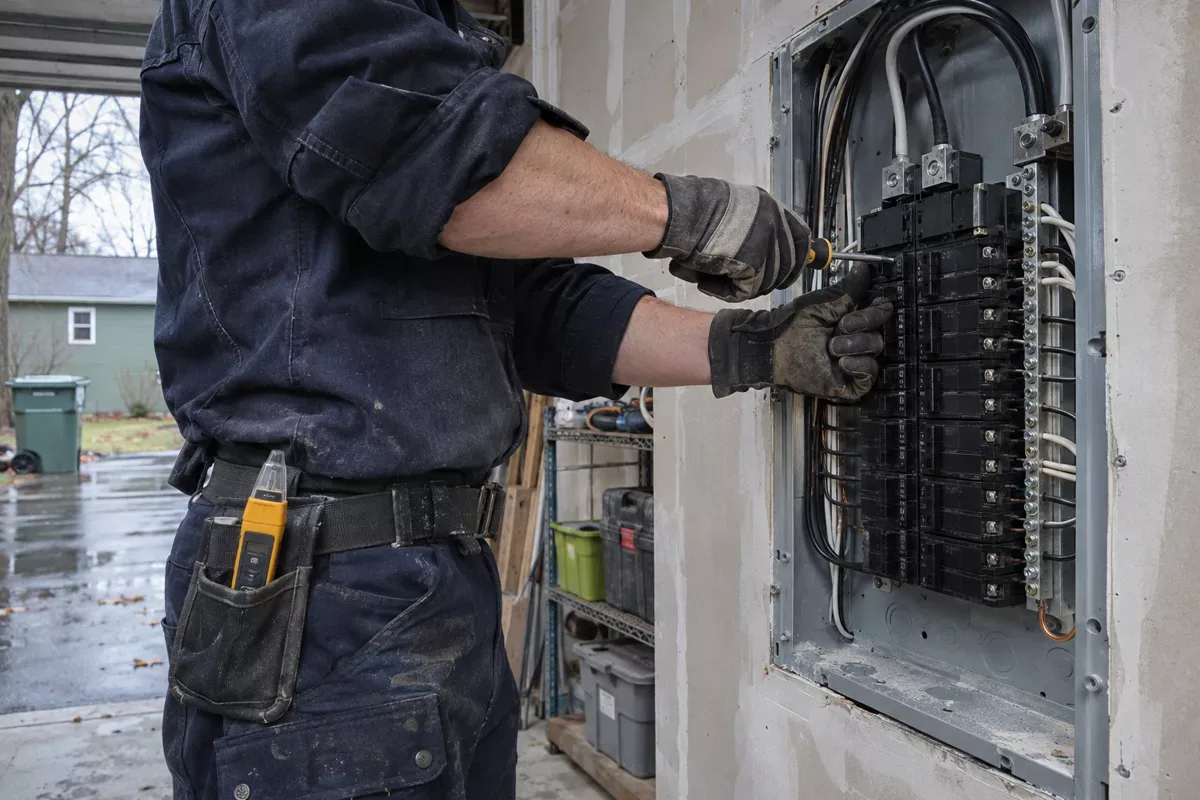
The company holds the contractor license. A licensed Master Electrician has to be the Master Electrician of record, and that can be you. A master can only be the master of record for one contractor, unless they own more than 50% of that business.
To become a Master Electrician, you need a Journeyman Electrician license held for at least two years and 12,000 hours of on-the-job training under a Texas master. The application fee is $45, then you pass the master exam. With the master in place, the electrical contractor license costs $110 and renews every year.
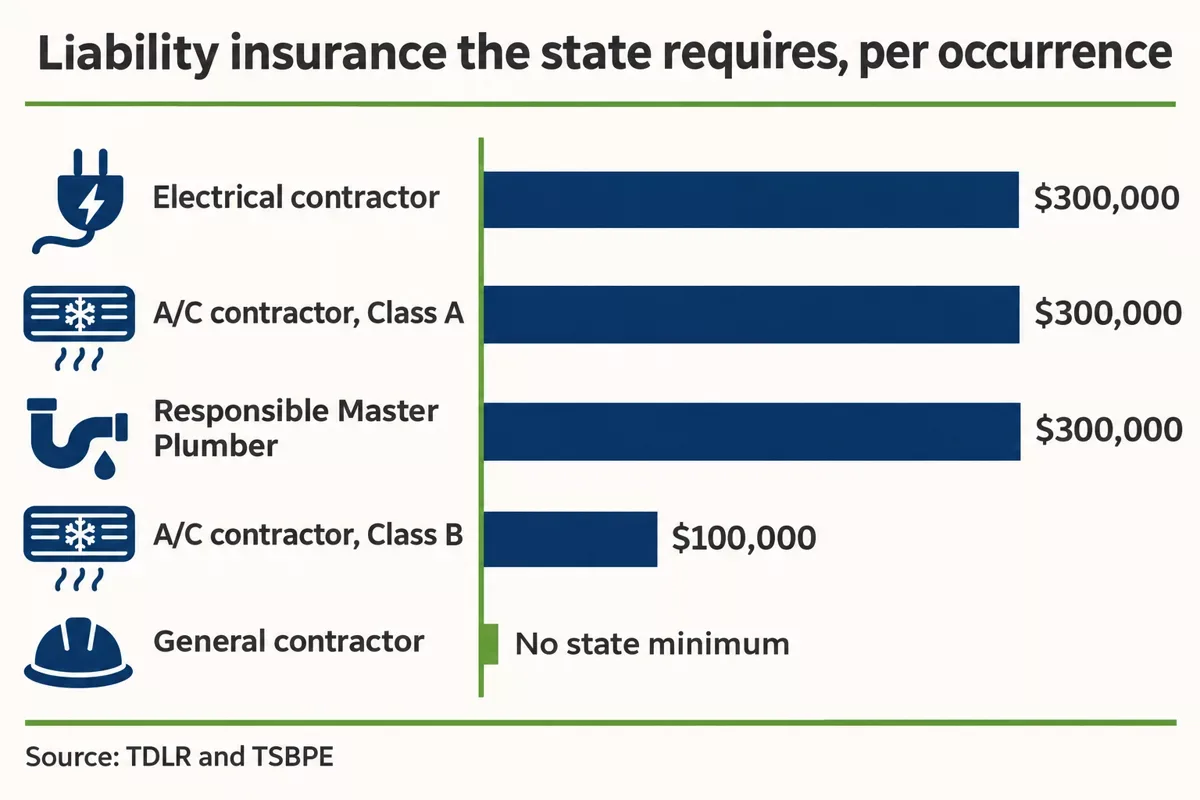
Insurance for an electrical contractor is at least $300,000 per occurrence, $600,000 aggregate and $300,000 aggregate for products and completed operations. If you are coming up through the trade, our guide to how long an electrical license takes lays out the hours.
How to get a Texas A/C and refrigeration contractor license
TDLR wants 48 months of practical experience under a licensed A/C contractor within the past 72 months. If you have held a technician certification for the past 12 months, 36 months within the past 48 is enough. Your supervisors fill in the experience form, not you. A degree in the field, an engineering license or military training can count as an exception.
You pick a class and one endorsement. Class A covers any size unit. Class B covers cooling up to 25 tons and heating up to 1.5 million BTU per hour, which is most residential work. The application fee is $115, then you pass the exam and file insurance. Everything has to be done within one year of filing, and the license renews yearly. Full details are on TDLR's A/C contractor page.
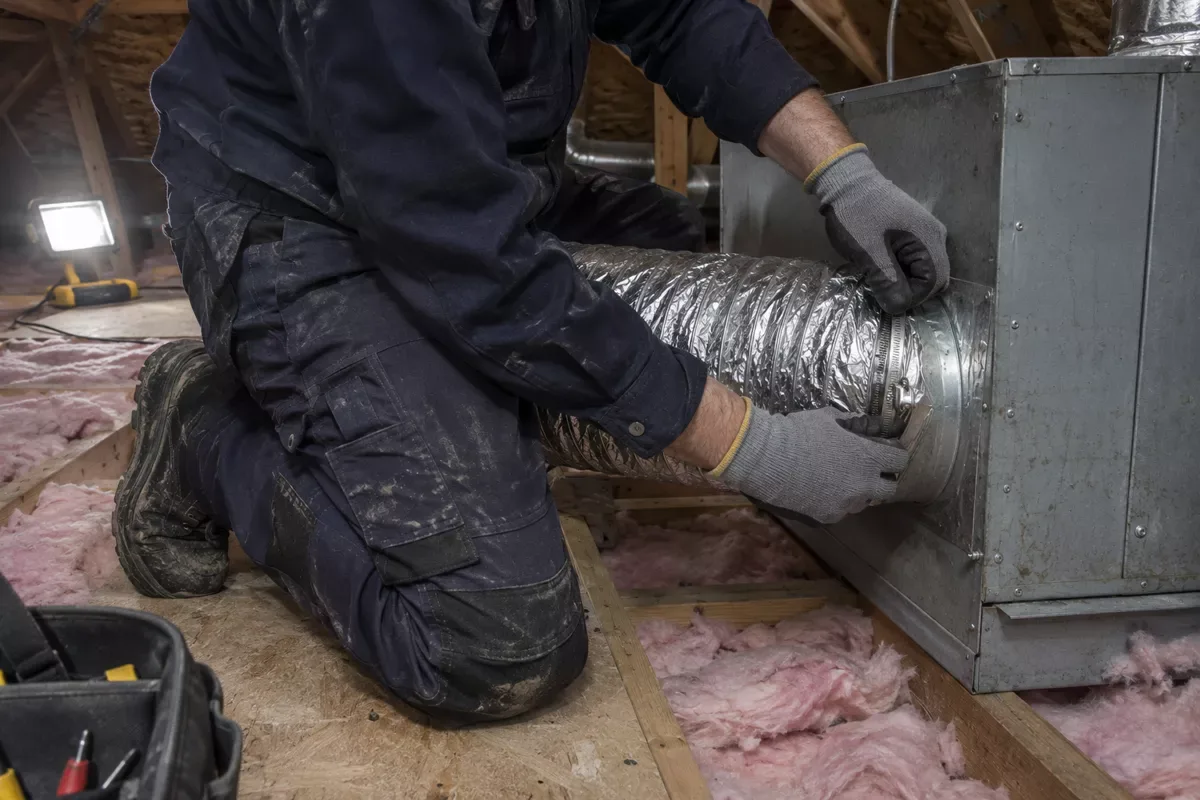
Our guide to getting an HVAC license covers the technician steps that come before this.
How to get a Texas plumbing contractor license
Plumbing runs through a separate board. You become a Master Plumber first: hold a Journeyman Plumber license for two years (or one year plus a Department of Labor approved apprenticeship), pass the master exam, submit fingerprints and pay $75 for the license.
To run jobs under your own company, add the Responsible Master Plumber (RMP) designation: $225 to apply, $300 to renew, and at least $300,000 in commercial general liability insurance. The RMP pulls the permits, requests the inspections, makes sure everyone on the job is licensed or registered, and puts the company name and RMP license number on every service vehicle. An RMP can be the RMP of record for one company at a time.
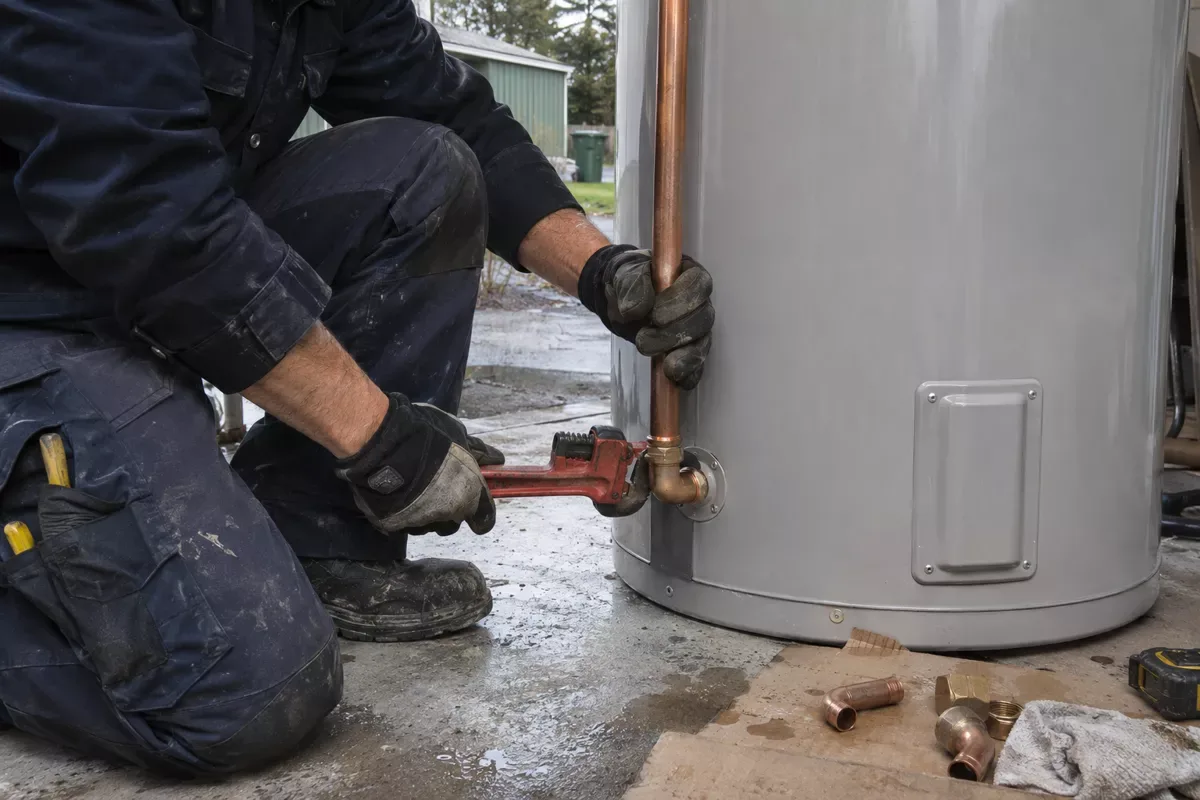
New to the trade? Start with how to become a plumber and work up to the RMP.
How much does a Texas contractor license cost?
The state fees are small. Exam fees and insurance are the real cost. The numbers below are the state application and license fees from TDLR and TSBPE. Exam fees are set by the testing vendor and change, so check them when you schedule.
| License path | State fees | Renewal | Minimum liability insurance |
|---|---|---|---|
| General contractor, remodeler, roofer | $0 state. City registration fees vary | Per city | No state minimum |
| Master Electrician | $45 application, plus exam | Yearly | n/a (sits on the contractor) |
| Electrical contractor | $110 | Yearly | $300,000 per occurrence, $600,000 aggregate |
| A/C contractor, Class A | $115, plus exam | Yearly | $300,000 per occurrence, $600,000 aggregate |
| A/C contractor, Class B | $115, plus exam | Yearly | $100,000 per occurrence, $200,000 aggregate |
| Master Plumber | $75 after passing the exam | Per TSBPE cycle | n/a (sits on the RMP) |
| Responsible Master Plumber | $225 | $300 | $300,000 commercial general liability |
Sources: TDLR electrical and A/C contractor pages, TSBPE Master Plumber and RMP pages, fetched 2026-11-14.
Workers' comp is the odd one out. Texas lets most private employers choose not to carry it. TDLR asks for proof of coverage, a certificate to self-insure, or a statement that you elected not to carry it, and if you opt out you file a notice of no coverage with the Texas Department of Insurance. Opting out saves the premium, but you carry the risk of an injured helper yourself.
How to get a contractor license in Texas, step by step
How to get a contractor license in Texas
- Name your trade
Decide whether your work is general building, which has no state license, or electrical, A/C, plumbing or pest control, which do.
- Check every city you will work in
Call each building department and ask what contractor registration they need before they issue a permit to you.
- Set up the business
Form an LLC with the Texas Secretary of State, or, as a sole owner trading under another name, file an assumed name certificate with your county clerk.
- Qualify the trade license
Document your experience on the agency's form, signed by your supervisors, and pass the exam. Skip this step for general building work.
- Buy the insurance
Get general liability at or above your license's minimum. Many cities and most commercial clients ask for proof even when the state does not.
- Decide on workers' comp
Buy a policy or file the notice of no coverage with the Texas Department of Insurance. Do it before your first helper starts.
- Register and pull permits
Finish the city registration, then pull permits under your license or registration for every job that needs one.
Mistakes that cost Texas contractors jobs
- Assuming "no state license" means no paperwork. Cities still require registration before a permit, and a permit pulled late stops a job.
- Doing light electrical or A/C work on a GC job. Swapping a fixture or a condenser for a customer is licensed work. Sub it to a licensed contractor.
- Writing your own experience form. TDLR wants it filled in by the people who supervised you. A self-signed form gets the application sent back.
- Letting the master or RMP leave without a plan. An electrical contractor has 30 business days to name a new Master Electrician of record after one leaves.
- Missing the one-year window on A/C. Application, exam and insurance all have to be done within a year of filing, or you start over.
- Opting out of workers' comp without telling anyone. A non-subscriber has to file the notice with TDI, and loses the protection a policy gives against an injured worker's claim.
Is a Texas contractor license worth it?
For a licensed trade, it is not optional: you cannot sell electrical, A/C or plumbing work without it. For general contractors, the question is really whether registration and insurance are worth it, and they are the price of getting a permit and a commercial client.
The license also lets customers check you. Homeowners can look up a TDLR license number on the agency's online license search in a minute, and a license number on the quote answers the first question a careful customer asks.
Price your first licensed jobs from real costs
New license holders tend to charge the wage they earned working for someone else. That leaves out the insurance premium, the yearly renewal, the truck, workers' comp or the risk of skipping it, and the hours spent quoting and invoicing. Add those up, divide by the hours you will really bill, and use that as your floor. What an hour of your time really costs does that math for you, and the markup and margin calculator shows what to add on materials.
Then put every job in writing. A written quote with the scope, price, payment terms and your license number keeps you out of disputes.
Price it once, then start your first quote from the driveway next time.
Run the paperwork from the driveway
A notebook and a spreadsheet hold up for the first few customers. The wall comes once you are licensed and the calls start: every job needs a quote typed from prices in your head, a slot on the calendar, a reminder, an invoice and a record of what you did, and it all lands on the kitchen table at night. Driveway Desk keeps your price book, so a quote is drafted from your own prices while you are still in the driveway. You review it, tap send, and the invoice goes out in one tap when the job is done, paid into your own Stripe or Square account. One flat price covers the whole crew, with no contract. If you are weighing the bigger tools, see our Jobber alternative breakdown.
Price it once, then start your first quote from the driveway next time.
The short version
Texas licenses the trade, not the title. General contractors, remodelers, roofers and handymen need no state license, but they register with each city before pulling permits. Electrical, A/C and plumbing contractors qualify through years of supervised work, pass an exam, carry $100,000 to $300,000 per occurrence in liability insurance and pay $110 to $225 in state fees. Rules and fees change, so confirm each step with TDLR, TSBPE or your city before you file.
Your prices, remembered. Build your first quote on your phone in about two minutes, send it, and get paid into your own account. Start your first quote, or try it free.
Put the method to work
Labor cost calculatorDivide paid-hour costs by the billable-hours ratio, then allow for your target margin to find a selling rate.
Frequently asked questions
No. Texas has no state license for general contractors, remodelers or home builders. Many cities require contractor registration before they issue a permit, and any electrical, A/C or plumbing work on the job has to be done by a contractor licensed in that trade.
Form your business, buy general liability insurance, register with each city where you will pull permits, and line up licensed electrical, A/C and plumbing subs. There is no state exam. Experience matters for winning work, not for getting permission.
At the state level, general construction, remodeling, roofing, painting, flooring, fencing and handyman repairs need no license. Electrical, heating and A/C, refrigeration, plumbing, gas lines and pest control do. Cities can still require registration and permits for unlicensed trades.
For state licensing, very little: neither a general contractor nor a handyman needs a state license. The difference is the trade work. A handyman cannot do electrical, A/C or plumbing work for customers without the matching license, and city registration rules apply to both.
A general contractor can register with a city in days. An A/C contractor needs 48 months of supervised experience. A Master Electrician needs a journeyman license held for two years plus 12,000 hours of supervised training, and a Master Plumber needs a journeyman license held for two years.
It depends on the trade and the work you want, not on the license. Licensed trades cannot sell work without the license, so it is required. For general contractors, the low barrier to entry means more competition, so clear quotes and fast invoicing do more to win jobs than the paperwork does.
Put the method to work
Labor cost calculatorDivide paid-hour costs by the billable-hours ratio, then allow for your target margin to find a selling rate.
Your prices, remembered.
Build your first quote on your phone in about two minutes, send it, and get paid into your own account.
Start your first quoteShare article
About the author
Field notes team
We write practical guides for home service crews of one to five. Our editorial standard is to show the calculation, state its assumptions, cite primary sources for factual claims and date competitor comparisons. We distinguish worked examples from market prices and correct errors when they are found. We do not claim trade licenses or credentials on behalf of the team.
More articles

Running a small crew · 13 min
What Do I Need to Start a Mobile Detailing Business? Full Checklist
The mobile detailing startup checklist: paperwork and insurance, the wash and interior kit for the services you sell first, how many towels to stock, and the quote, work order and payment setup.

Running a small crew · 13 min
Roofing Company Business Plan: 7 Parts + Cash Flow Example
A roofing company business plan in seven short sections, with a worked example: one reroof priced line by line, revenue by month, and how much cash a busy June ties up before homeowners pay.

Running a small crew · 11 min
How to Get Clients as a Realtor: 5 Channels That Work
How to get clients as a realtor: start with your sphere and past clients, build referral partners among the trade pros already inside homes, then add open houses and one farm area. Includes a 90-day plan and the commission math.

Running a small crew · 14 min
How to Get Bookkeeping Clients: 6 Ways That Actually Work
How to get bookkeeping clients: start with people you know and local tax preparers, sell a fixed-price cleanup first, then pick one niche, such as trade contractors, and become the bookkeeper its owners refer.

Running a small crew · 13 min
How to Start a Mobile Detailing Business: Water, Kit, Prices
Start a mobile detailing business in order: pick your first customers, sort licenses and insurance, solve water before buying a polisher, price by your real hours plus the drive, and book the maintenance wash.

Running a small crew · 13 min
How to Get Clients for Your Home Service Business: 7 Ways
How to get clients for a home service business: tell everyone you know, verify a free Google Business Profile, ask for reviews, work the street around every job, and follow up every quote you already sent before you buy a single lead.