How to Get a Contractor License in FL: 7 Steps, Fees and Exams
Driveway Desk team Updated 21 November 2026 14 min read
Your next job
Less time at the desk.
Build your price book, schedule the next visit and turn completed work into an invoice.
Start your first quoteIn this article
To get a contractor license in FL, pick the Construction Industry Licensing Board (CILB) category that matches your work, prove four years of experience with at least one year as a foreman, show a FICO score of 660 or finish a 14-hour financial course, get fingerprinted, and pass the state exams with 70% on each test. Then file proof of liability insurance and workers' comp (or an exemption) and pay the initial license fee. You need the license for most jobs of $2,500 or more in labor and materials, and for any job at all once you advertise yourself as a contractor.
Short answer
Pick your CILB category, document 4 years (1 as foreman), apply, get fingerprinted, show a 660 FICO or take the 14-hour course, pass every test at 70%, file $300,000/$50,000 insurance (Division I commercial) or $100,000/$25,000 (residential and specialty), add workers' comp or the exemption, pay the $200 license fee.
Which Florida contractor license do you need?
Florida has no single "contractor license". The CILB at the Department of Business and Professional Regulation (DBPR) issues one license per category, and your experience has to match the category you apply for. Division I covers the three building licenses. Division II covers the trades. Electrical sits on its own board.
Then there is the second choice: certified or registered. A certified license comes from passing the state exam and lets you work anywhere in Florida. A registered license rides on a local competency card from your county or city, and you can only work where you hold that local license.
| Your situation | License to get | Why |
|---|---|---|
| Small repairs under $2,500, no advertising as a contractor | None yet | That is the minor work exemption, with limits below |
| One trade: roofing, plumbing, AC, pool, solar | Division II certified license for that trade | Two exams: Business and Finance plus the trade test |
| Homes up to two stories, remodels, additions | Certified residential contractor | One to three family homes, two habitable stories max |
| Commercial buildings up to three stories | Certified building contractor | Needs commercial experience in four of six areas |
| High-rise and anything unlimited | Certified general contractor | Needs a year on buildings of four stories or more |
| Electrical work | Electrical contractor license (separate board) | Not issued by the CILB |
| Work in one county only, local card already held | Registered license | Cheaper to start, but you cannot cross county lines |
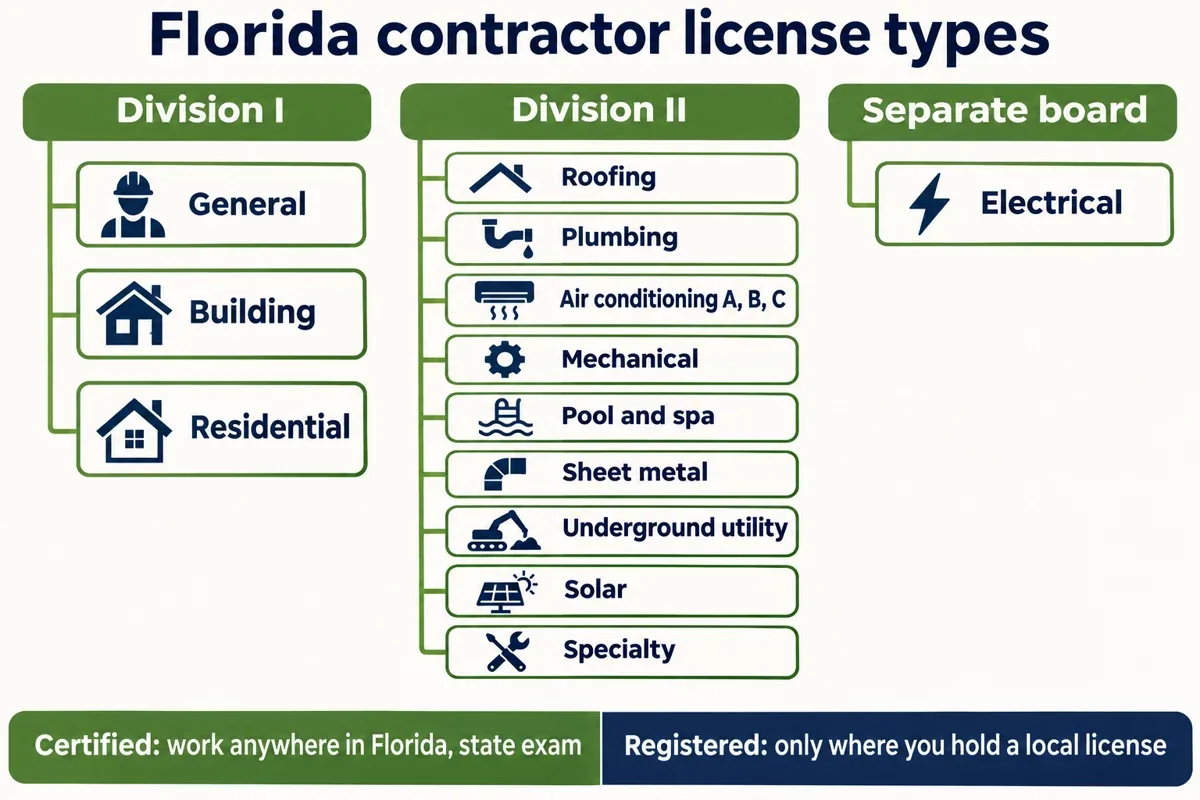
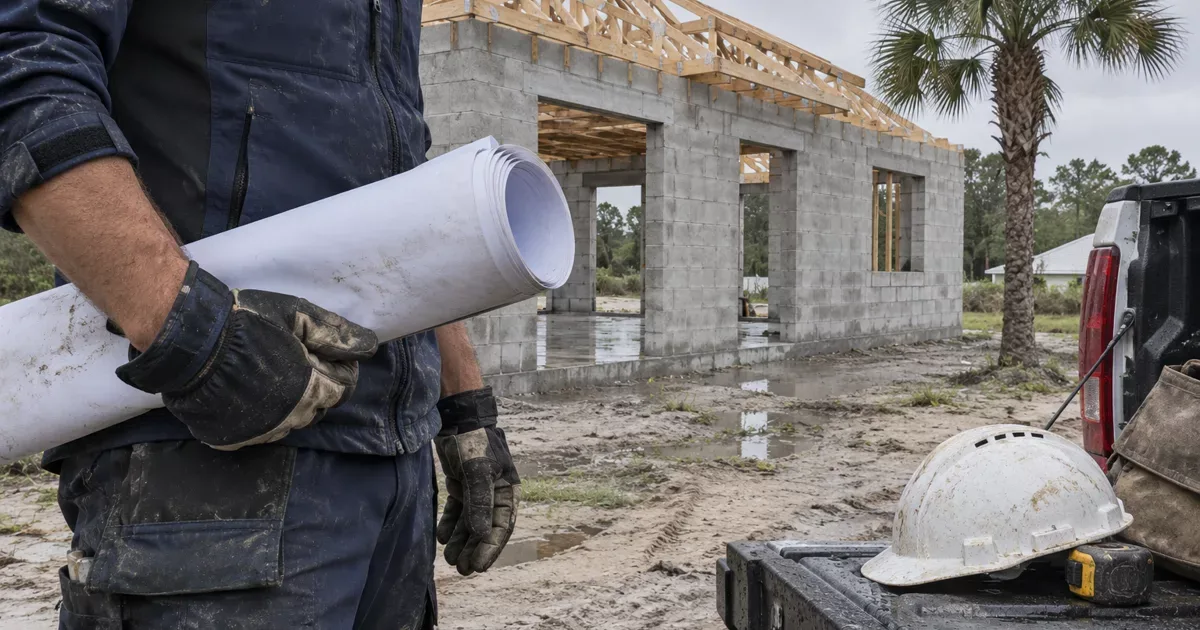
Here is the point most applicants miss. Apply for the license your last four years already prove, not the biggest one on the list. The general contractor license sounds like the goal, but the board's rule (61G4-15.001) wants commercial experience in at least four of six areas (big slabs over 20,000 sq ft, masonry walls, steel erection, elevated slabs, column erection, structural concrete formwork) plus a full year on buildings of four stories or more. A crew that frames houses and lays block for homes will not have that. The residential license asks for three of five areas: foundations and slabs, masonry walls, structural demolition, structural wood framing (trusses count), and column erection. Most small builders already qualify for residential today, and you can step up later. Florida law lets an active residential contractor move to building after three years of proven experience and to general after four.
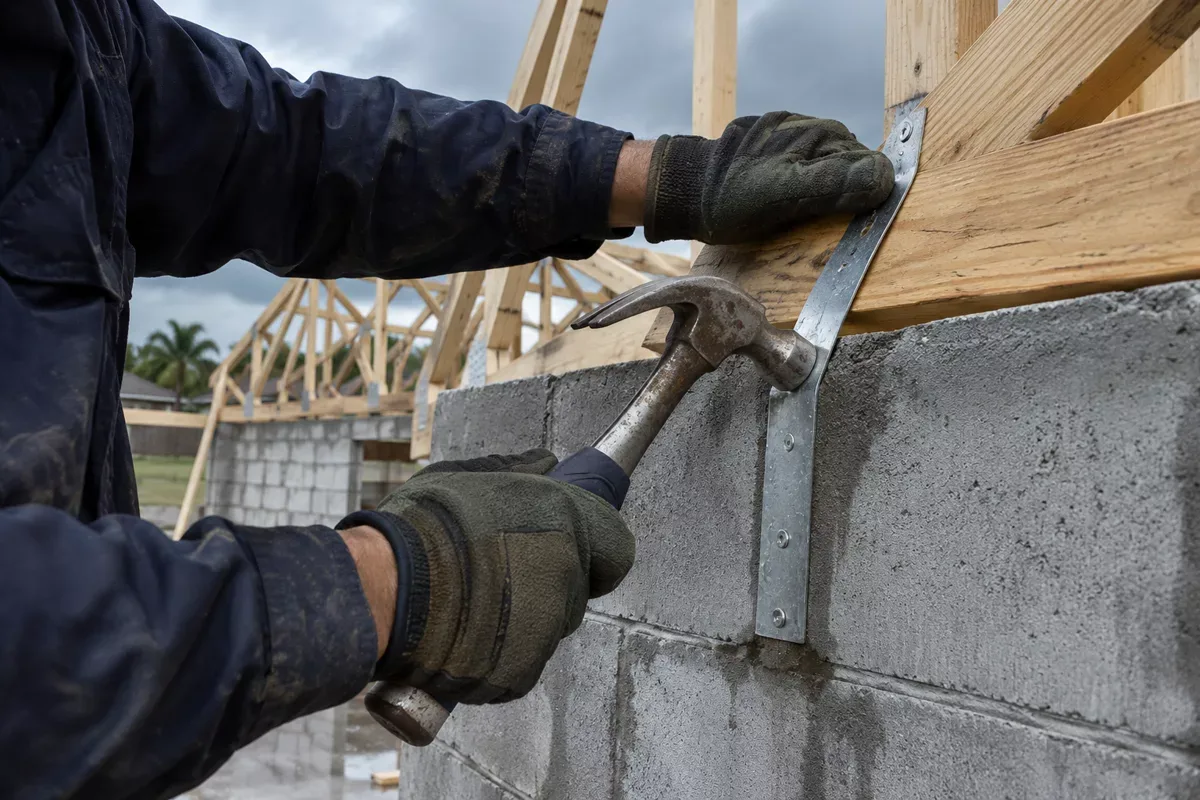
If you are still deciding whether to run whole builds at all, our guide to becoming a general contractor covers the path in any state. Building in the West too? The rules are very different, as our California contractor license guide shows. Texas goes the other way, with no state license for general contractors at all.
Do you need a contractor license in Florida?
Yes, for nearly any paid construction work. Florida Statutes section 489.103(9) exempts only "casual, minor, or inconsequential" work where labor, materials and everything else add up to less than $2,500.
The exemption has two traps. It does not apply when the job is part of a bigger project split into smaller contracts to stay under the line. It also does not apply to anyone who advertises as a contractor or says they are qualified to do contracting. A truck lettered "General Contractor" ends the exemption on day one, whatever the job size.
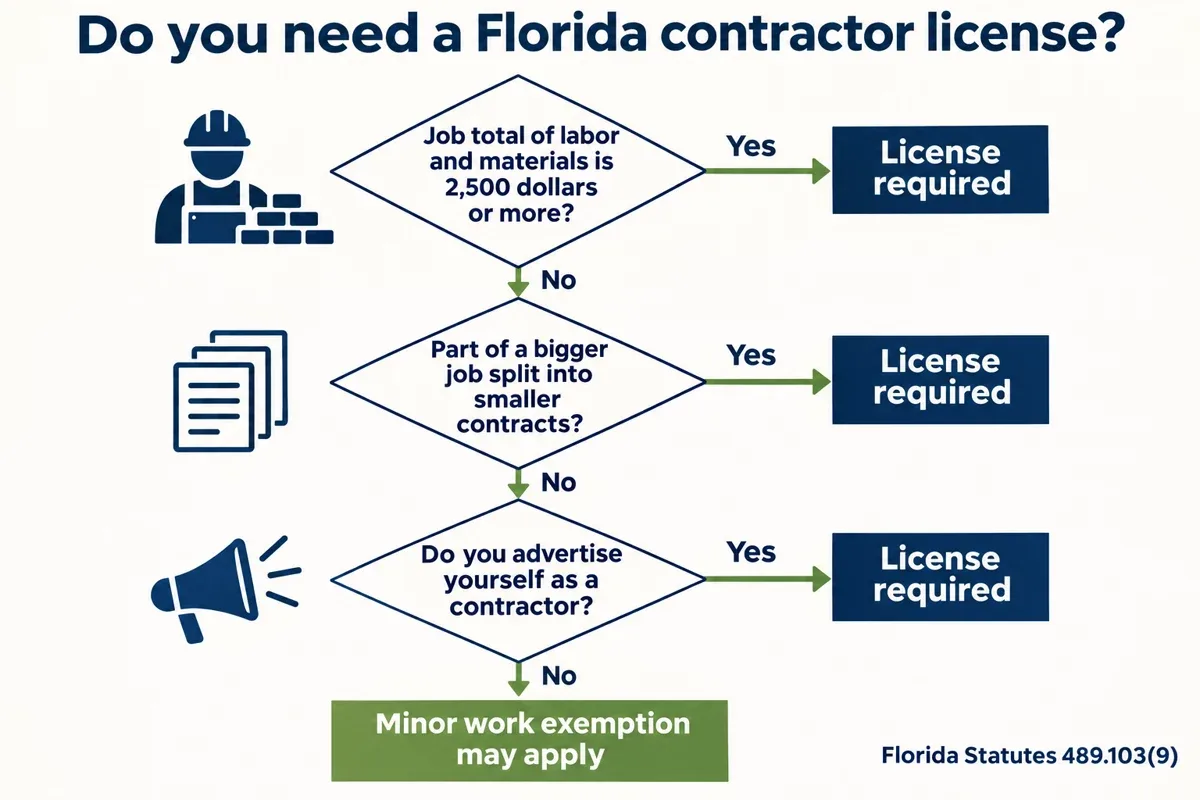
That is why handymen in Florida stay on small, one-off repairs. Our handyman license guide covers what that work can and cannot include. Counties and cities can also require their own local license or registration for trades the state does not license, so check with your building department.
What are the requirements to get a contractor license in Florida?
You need to be 18, of good moral character, and able to prove experience. Under section 489.111, that experience can come one of three ways:
- Four years of active experience as a skilled worker or foreman, with at least one year as a foreman.
- College plus experience: up to three years of college credit (community college counts) can replace field years, but you still need at least one year as a foreman.
- A four-year degree in building construction, architecture or a matching engineering field, plus one year of experience in the category.
On top of that:
- Credit: a consumer credit report with no unsatisfied judgments or liens, and a FICO score of 660 or higher. Below 660, you finish a board-approved 14-hour financial responsibility course instead (Rule 61G4-15.006).
- Fingerprints: every first-time applicant submits a full set for a state and FBI background check, at your cost.
- Insurance: proof of liability and property damage cover at the minimums below.
- Workers' comp: coverage, or an approved exemption through the state's Division of Workers' Compensation if you qualify.
| License | Public liability | Property damage |
|---|---|---|
| General contractor | $300,000 | $50,000 |
| Building contractor | $300,000 | $50,000 |
| Residential contractor | $100,000 | $25,000 |
| Roofing, plumbing, AC, mechanical, pool, solar, other specialty | $100,000 | $25,000 |
Source: Rule 61G4-15.003, F.A.C. Insurance must stay active for the life of the license, and the board audits by zip code.
How much does a Florida contractor license cost?
The state fees for a certified license come to about $535 before anything else, per the board's fee rule (61G4-12.009). The exam itself is $135 plus $80 for each test you sit. The contract administration and project management tests count as one test for fees, so Division I applicants pay for two sittings, the same as Division II.
| Fee | Amount | When you pay |
|---|---|---|
| Exam development fee | $135 | When you schedule the exam |
| Test administration, 2 tests x $80 | $160 | When you schedule each test |
| Application processing | $40 | After you pass |
| Initial license (certified) | $200, or $100 in the second year of the two-year cycle | At licensing |
| State fees total | $535 | |
| Retake | $135 plus $80 per test | Each failed test |
| Renewal every two years | $200 | Each cycle |
| Fingerprints, credit report, reference books, insurance, workers' comp | Varies by vendor and policy | Before you file |
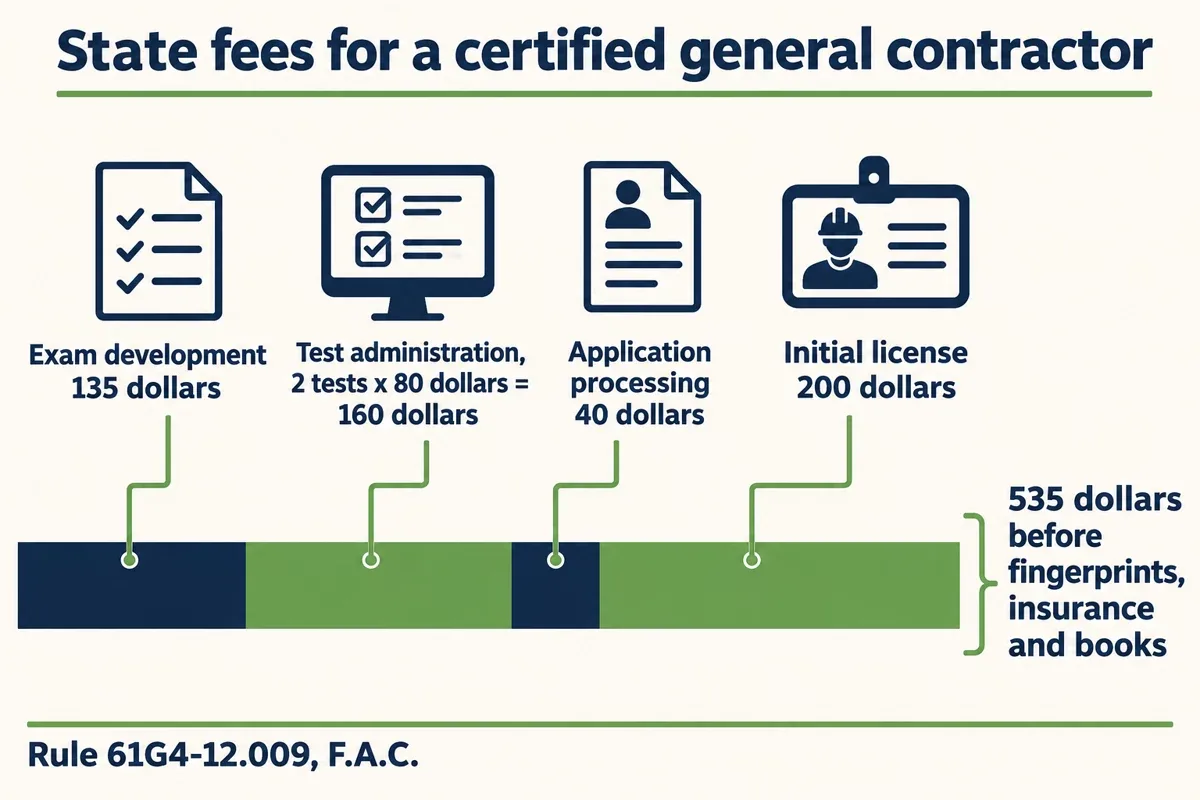
The state fees are the small part. Your real first-year cost is the insurance premium, the reference books for the open-book exam and the time off work to study. Check the current fee on the DBPR application before you pay, because the board can update its rule.
How to get a contractor license in FL, step by step
How to get a contractor license in Florida
- Pick one category
Match the license to the work you have actually done for four years: residential, building, general, or one Division II trade. Decide certified (statewide) or registered (local only).
- Document your experience
Collect proof of four years in that category, one as a foreman, from licensed contractors you worked under. Work done under an exemption does not count.
- Check your credit
Pull a consumer credit report. If your FICO score is under 660 or you have open judgments or liens, sign up for the 14-hour financial responsibility course now.
- Apply and get fingerprinted
File the application with the Construction Industry Licensing Board at DBPR and submit fingerprints through an approved vendor.
- Pass the exams
Division I takes three tests: Business and Finance, contract administration and project management. Division II takes Business and Finance plus the trade test. You need 70% on each.
- File insurance and workers' comp
Send proof of liability and property damage cover at your category's minimum, plus workers' comp or your exemption.
- Pay the license fee
Pay the initial license fee and you are licensed for the rest of the two-year cycle.
How hard is the Florida contractor exam?
It is hard because of the clock, not the content. The tests are open book with an approved reference list, and you need 70% on every test separately. A good score on project management does not save a weak Business and Finance score.
The questions follow set weights. For the general contractor contract administration test, 40% is project contracts and 27% is preconstruction. Project management is 63% construction methods, materials, tools and equipment. Business and Finance covers running the company: setting it up, administration, payroll, taxes, liens and accounting.
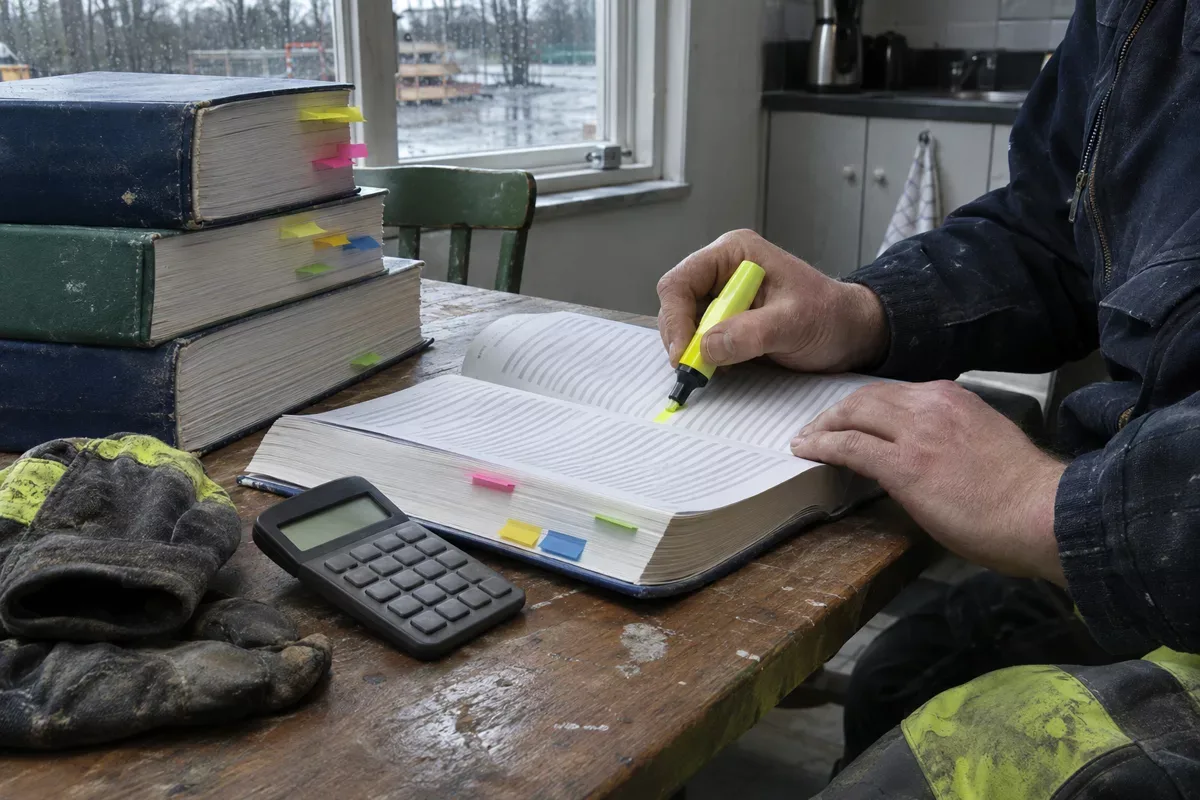
Tab and highlight the reference books before exam day so you can find a lien deadline or a payroll rule in seconds. Field people tend to skip Business and Finance because it feels like office work. It is the test that catches them.
Mistakes that cost Florida applicants months
- Applying for general when you qualify for residential. Without a year on four-story buildings, the board turns the application down. Start residential and step up.
- Counting exempt work as experience. Jobs you did under the $2,500 exemption, or without the right license above you, do not count.
- Letting a lien sit on your credit report. An unsatisfied judgment blocks you even with a high score. Clear it before you apply.
- Thinking a county card works statewide. A registered license only covers the jurisdictions where you hold the local license.
- Treating Business and Finance as the easy test. It has its own 70% bar and its own retake fee.
- Letting insurance lapse after you are licensed. The board audits by zip code, and a lapse is a violation.

A general contractor also cannot do every trade in-house. Roofing, plumbing, AC and electrical go to subs who hold their own license, which is one reason trade owners get licensed early. Our guide to getting an HVAC license covers the AC side, and how long an electrical license takes covers electrical. If roofing is your trade, this business plan for a roofing company shows how to price a roof and how much cash to hold once you are licensed.
Is a Florida contractor license worth it?
Yes, if you want jobs over $2,500 or want to advertise at all. Without a license, you are limited to small, one-off repairs and you cannot put "contractor" on the truck, the website or the quote. A single roof, a bathroom remodel or a pool resurface is already past the line.
The license also changes who hires you. Homeowners and property managers can look up your license on DBPR, and the building permit for contracted work goes out under a licensed contractor's name. The costs are real (insurance, renewals, the study hours), so price them into your work from the first job.
Price your first licensed jobs from real costs
New license holders tend to charge the wage they earned working for someone else. That leaves out the insurance premium, the $200 renewal, workers' comp, the truck and the hours spent quoting and invoicing. Add those up, divide by the hours you will really bill, and use that as your floor. What an hour of your time really costs does that math for you, and the markup and margin calculator shows what to add on materials.
Then put every job in writing. A clear written quote with the scope, price, payment terms and your license number keeps you out of disputes.
Price it once, then start your first quote from the driveway next time.
Run the paperwork from the driveway
A notebook and a spreadsheet hold up for the first few customers. The wall comes once you are licensed and the calls start: every job needs a quote typed from prices in your head, a slot on the calendar, a reminder, an invoice and a record of what you did, and it all lands on the kitchen table at night. Driveway Desk keeps your price book, so a quote is drafted from your own prices while you are still in the driveway. You review it, tap send, and the invoice goes out in one tap when the job is done, paid into your own Stripe or Square account. One flat price covers the whole crew, with no contract. If you are comparing tools, see how the big names stack up in Jobber vs Housecall Pro.
Price it once, then start your first quote from the driveway next time.
The short version
Pick the CILB category your last four years already prove, document one year as a foreman, show a 660 FICO or take the 14-hour course, get fingerprinted, pass every test at 70%, file your insurance and workers' comp, and pay the $200 license fee. Start with residential or your trade license if general is out of reach, and step up later. Rules and fees change, so confirm each step with DBPR before you file.
Your prices, remembered. Build your first quote on your phone in about two minutes, send it, and get paid into your own account. Start your first quote, or try it free.
Put the method to work
Labor cost calculatorDivide paid-hour costs by the billable-hours ratio, then allow for your target margin to find a selling rate.
Frequently asked questions
You must be 18, prove four years of experience in your category (at least one as a foreman, with college credit able to replace up to three years), pass the state exams with 70% on each test, and show a FICO score of 660 or complete a 14-hour financial course. You also need fingerprints, liability insurance at your category's minimum and workers' comp or an exemption.
Yes, if their work falls in a licensed category such as roofing, plumbing, AC, pool or electrical. A general contractor has to sub those trades to someone holding the matching license. Trades the state does not license may still need a local license from the county or city.
It is open book, but timed, and you need 70% on each test separately. Division I licenses take three tests and Division II trades take two. Most people who struggle know the field work but run out of time finding answers in the references, especially on Business and Finance.
A general or building contractor needs at least $300,000 in public liability and $50,000 in property damage coverage. Residential and specialty contractors need $100,000 and $25,000. You also need workers' comp coverage or an approved exemption, and the coverage has to stay active as long as the license is active.
Florida has no state handyman license. A handyman can take casual, minor jobs under $2,500 total, as long as the job is not part of a bigger project and they do not advertise as a contractor. Anything past that line, or any work in a licensed trade, needs a licensed contractor.
For anyone who wants jobs over $2,500 or wants to advertise, yes. Without it you are capped at small repairs and cannot call yourself a contractor. The state fees are about $535, so the bigger costs to plan for are insurance and study time.
Put the method to work
Labor cost calculatorDivide paid-hour costs by the billable-hours ratio, then allow for your target margin to find a selling rate.
Your prices, remembered.
Build your first quote on your phone in about two minutes, send it, and get paid into your own account.
Start your first quoteShare article
About the author
Field notes team
We write practical guides for home service crews of one to five. Our editorial standard is to show the calculation, state its assumptions, cite primary sources for factual claims and date competitor comparisons. We distinguish worked examples from market prices and correct errors when they are found. We do not claim trade licenses or credentials on behalf of the team.
More articles

Running a small crew · 13 min
What Do I Need to Start a Mobile Detailing Business? Full Checklist
The mobile detailing startup checklist: paperwork and insurance, the wash and interior kit for the services you sell first, how many towels to stock, and the quote, work order and payment setup.

Running a small crew · 13 min
Roofing Company Business Plan: 7 Parts + Cash Flow Example
A roofing company business plan in seven short sections, with a worked example: one reroof priced line by line, revenue by month, and how much cash a busy June ties up before homeowners pay.

Running a small crew · 11 min
How to Get Clients as a Realtor: 5 Channels That Work
How to get clients as a realtor: start with your sphere and past clients, build referral partners among the trade pros already inside homes, then add open houses and one farm area. Includes a 90-day plan and the commission math.

Running a small crew · 14 min
How to Get Bookkeeping Clients: 6 Ways That Actually Work
How to get bookkeeping clients: start with people you know and local tax preparers, sell a fixed-price cleanup first, then pick one niche, such as trade contractors, and become the bookkeeper its owners refer.

Running a small crew · 13 min
How to Start a Mobile Detailing Business: Water, Kit, Prices
Start a mobile detailing business in order: pick your first customers, sort licenses and insurance, solve water before buying a polisher, price by your real hours plus the drive, and book the maintenance wash.

Running a small crew · 13 min
How to Get Clients for Your Home Service Business: 7 Ways
How to get clients for a home service business: tell everyone you know, verify a free Google Business Profile, ask for reviews, work the street around every job, and follow up every quote you already sent before you buy a single lead.